



The best questionnaire samples for students cover five areas: academic experience and workload, teaching quality and instructor clarity, learning environment and resources, social support and sense of belonging, and overall course or program satisfaction. Academic experience questions work best for identifying where students struggle or disengage before grades make it obvious; teaching quality questions for evaluating instructor effectiveness from the student perspective; learning environment questions for surfacing resource gaps; social support questions for early identification of at-risk students; and program satisfaction questions for accreditation reporting and curriculum review. The most reliable student questionnaires use anonymous responses, keep length under 10 questions, and are distributed at the end of a course or module while the experience is still fresh — not during exam periods when response quality drops sharply.
Student questionnaires are essential tools for educators, administrators, and researchers seeking to understand student experiences, gather feedback, and drive evidence-based improvements in educational settings. When designed effectively, questionnaires provide valuable insights into academic performance, teaching effectiveness, school climate, student wellbeing, and career development.
However, coming up with the right questions can be a challenge. That's why in today's post, we provide a questionnaire sample for students that you can use as a starting point for your own surveys.
Whether you are searching for output on a specific topic or a general overview of how students are feeling, our sample questionnaire with 50 questions can help.
What is a student questionnaire?
A student questionnaire is a structured set of questions designed to collect insights, feedback, and data from students about various aspects of their educational experience. These questionnaires can be administered in paper form or through digital platforms, making them accessible and convenient for both administrators and students.
Well-designed student questionnaires serve multiple purposes:
- Gather feedback – Collect student perspectives on teaching, curriculum, and school environment
- Inform decision-making – Provide data-driven insights for educational improvements
- Assess effectiveness – Evaluate programmes, policies, and teaching methods
- Identify needs – Discover areas requiring additional support or resources
- Support research – Generate data for academic research and programme evaluation
For educators and administrators, student questionnaires offer a systematic approach to understanding student experiences at scale, enabling data-driven improvements that enhance learning outcomes and school climate.
Types of questionnaire samples for students
Depending on the purpose of the survey, there are several types of questionnaire samples for students. Here are the most common types:
- Academic Performance Questionnaire: A questionnaire sample aims to collect data on students' academic performance, including grades, study habits, and learning preferences, or it could be a research questionnaire sample.
- Teacher Evaluation Questionnaire: It aims to gather students' feedback about their teachers' performance, teaching styles, and effectiveness.
- School Environment Questionnaire: This includes questions to gather feedback about the school's culture, student-teacher relationships, communication, and engagement.
- Mental Health and Bullying Questionnaire:This aims to gather information about students' mental health and emotional well-being, including topics such as depression and anxiety, stress, suicide risk, bullying behaviours,help-seeking behaviours, etc.
- Career Aspirations Questionnaire: It aims to gather information about students' career goals and aspirations, including their interests, skills, and plans.
How AhaSlides works for classroom surveys
Teacher setup:
- Create questionnaire in minutes using templates or custom questions
- Display survey on classroom screen
- Students join via QR code, no logins required
.png)
Student experience:
- Scan QR code on any device
- Submit anonymous responses
- Besides Surveys, they can participate in poll, word cloud and quiz activities
Key difference: Google Forms shows you a spreadsheet later. AhaSlides creates a shared visual experience that makes students feel heard immediately.
Examples of a questionnaire sample for students
Academic oerformance - A questionnaire sample for students
Here are some examples in an academic performance questionnaire sample:
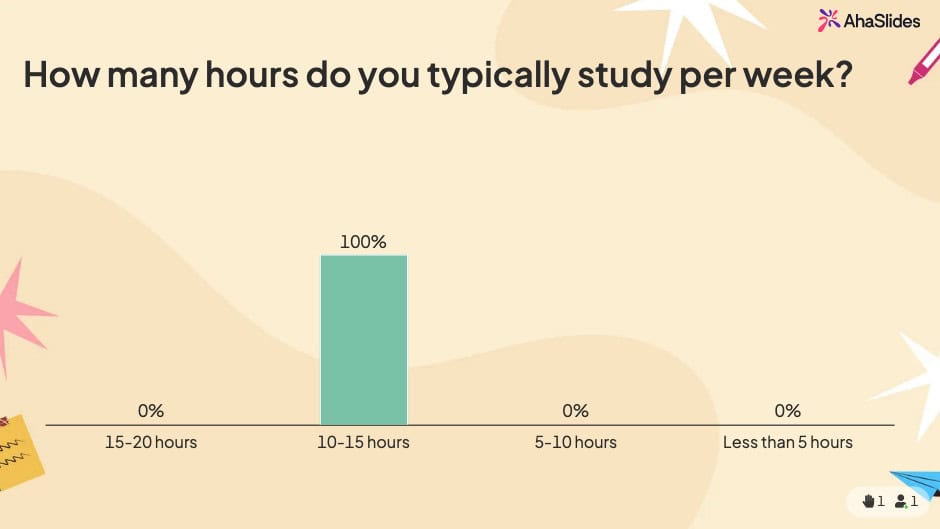
1/ How many hours do you typically study per week?
- Less than 5 hours
- 5-10 hours
- 10-15 hours
- 15-20 hours
2/ How often do you complete your homework on time?
- Always
- Sometimes
- Rarely
2/ How do you rate your study habits and time management skills?
- Excellent
- Good
- Fair
- Poor
3/ Can you focus in your class?
- Yes
- No
4/ What motivates you to learn more?
- Curiosity - I simply love to learn new things.
- Love of learning - I enjoy the process of learning and find it rewarding in and of itself.
- Love of a subject - I am passionate about a particular subject and want to learn more about it.
- Personal growth - I believe learning is essential for personal growth and development.
5/ How often do you seek help from your teacher when you are struggling with a subject?
- Almost always
- Sometimes
- Rarely
- Never
6/ What resources do you use to support your learning, such as textbooks, online resources, or study groups?
7/ What aspects of the class do you like the most?
8/ What aspects of the class do you dislike the most?
9/ Do you have supportive classmates?
- Yes
- No
10/ What learning tips would you give to students in next year's class?
Frequently asked questions
What are the best questionnaire questions for students?
The best student questionnaire questions are: "The workload in this course was appropriate for the credit hours" (5-point Likert), "The instructor explained concepts clearly" (5-point Likert), "I have access to the resources I need to succeed" (5-point Likert), "I feel a sense of belonging in this program" (5-point Likert), and "I would recommend this course to another student" (Yes/No or NPS). Include 1–2 open-ended questions at the end: "What was the most valuable part of this course?" and "What would you improve?"
How long should a student questionnaire be?
Student questionnaires should be 5–12 questions and take no more than 5 minutes to complete. Response rates drop sharply past 10 minutes for student populations. For end-of-course evaluations, 7–10 questions is the standard. For broader program assessments, 10–15 questions with a visible progress bar. Avoid distributing questionnaires during exam periods — both response rates and data quality decline significantly.
When should you distribute a student questionnaire?
Distribute course evaluation questionnaires in the final week of the course — before final grades are released. Response rates peak at 60–80% when collected before grades because students feel their feedback has more influence. For broader program surveys, mid-semester distribution captures the experience while students are still engaged. Never wait until after grades are posted — response rates drop 30–40% and negative experiences are overrepresented.
What is the difference between a questionnaire and a survey?
A questionnaire is the instrument — the set of questions. A survey is the broader process of collecting data using a questionnaire, including distribution, data collection, and analysis. In practice the terms are used interchangeably. Technically: you design a questionnaire, then conduct a survey using it. The distinction matters in academic research but is irrelevant in most professional or educational contexts.
Teacher Evaluation - A Questionnaire Sample for Students
Here are some potential questions you could use in a Teacher Evaluation Questionnaire:
1/ How well did the teacher communicate with students?
- Excellent
- Good
- Fair
- Poor
2/ How knowledgeable was the teacher in the subject matter?
- Very knowledgeable
- Moderately knowledgeable
- Somewhat knowledgeable
- Not knowledgeable
3/ How well did the teacher engage students in the learning process?
- Very engaging
- Moderately engaging
- Somewhat engaging
- Not engaging
4/ How easy is it to contact the teacher when they are outside of class?
- Very approachable
- Moderately approachable
- Somewhat approachable
- Not approachable
5/ How effectively did the teacher use classroom technology (e.g. smartboard, online resources)?
6/ Does your teacher find you struggling with their subject?
7/ How well does your teacher respond to questions from students?
8/ What are the areas in which your teacher excelled?
9/ Are there any areas the teacher should improve?
10/ Overall, how would you rate the teacher?
- Excellent
- Good
- Fair
- Poor
School Environment - A Questionnaire Sample for Students
Here are some examples of questions in a School Environment Questionnaire:
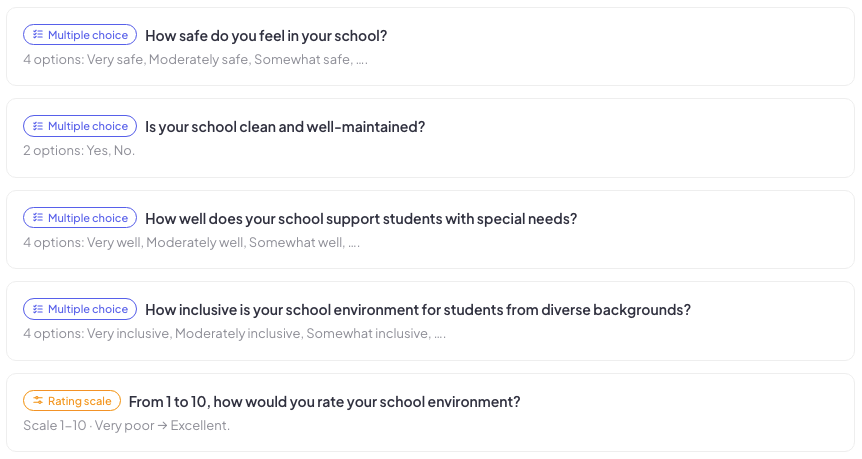
1/ How safe do you feel in your school?
- Very safe
- Moderately safe
- Somewhat safe
- Not safe
2/ Is your school clean and well-maintained?
- Yes
- No
3/ How clean and well-maintained is your school?
- Very clean and well-maintained
- Moderately clean and well-maintained
- Somewhat clean and well-maintained
- Not clean and well-maintained
4/ Does your school prepare you for college or a career?
- Yes
- No
5/ Do school personnel have the necessary training and resources to keep students safe? What additional training or resources could be effective?
6/ How well does your school support students with special needs?
- Very well
- Moderately well
- Somewhat well
- Poor
7/ How inclusive is your school environment for students from diverse backgrounds?
8/ From 1 - 10, how would you rate your school environment?
Mental Health and Bullying - A Questionnaire Sample for Students
The questions below can help teachers and school administrators understand how common mental illnesses and bullying are among students, as well as what types of support are required to tackle these issues.
1/ How frequently do you feel depressed or hopeless?
- Never
- Rarely
- Sometimes
- Often
- Always
2/ How often do you feel anxious or stressed?
- Never
- Rarely
- Sometimes
- Often
- Always
3/ Have you ever been subjected to school bullying?
- Yes
- No
4/ How frequently have you been the victim of bullying?
- Once
- A few times
- Several times
- Many times
5/ Can you tell us about your bullying experience?
6/ What type(s) of bullying have you experienced?
- Verbal bullying (e.g. name-calling, teasing)
- Social bullying (e.g. exclusion, spreading rumours)
- Physical bullying (e.g. hitting, pushing)
- Cyberbullying (e.g. online harassment)
- All behaviours above
7/ If you have talked to someone, who did you talk to?
- Teacher
- Counselor
- Parent/Guardian
- Friend
- Other
- Nobody
8/ How effectively do you think your school handles bullying?
9/ Have you ever tried to seek help for your mental health?
- Yes
- No
10/ Where did you go for help if you needed it?
- School counselor
- Outside therapist/counsellour
- Doctor/Healthcare provider
- Parent/Guardian
- Other
11/ How well does your school, in your opinion, manage mental health issues?
12/ Is there anything else you would like to share about mental health or bullying in your school?
Career Aspirations Questionnaire - A Questionnaire Sample for Students
By gathering information about career aspirations, educators and counsellors can provide tailored guidance and resources to help students navigate their desired careers.
1/ What are your career aspirations?
2/ How confident do you feel about achieving your career goals?
- Very confident
- Quite confident
- Somewhat confident
- Not confident at all
3/ Have you talked to anyone about your career aspirations?
- Yes
- No
4/ Have you participated in any career-related activities at school? What were they?
5/ How helpful have these activities been in shaping your career aspirations?
- Quite helpful
- Somewhat helpful
- Not helpful
6/ What obstacles do you think may stand in the way of achieving your career aspirations?
- Lack of finance
- Lack of access to educational resources
- Discrimination or bias
- Family responsibilities
- Other (please specify)
7/ What resources or support do you think would help pursue your career aspirations?
Learning Preferences & Future Planning Questionnaire
When to use: Year beginning, course selection, career planning
1/ What are your favourite subjects?
2/ What subjects are least interesting?
3/ Independent or group work preference?
- Strongly prefer independent
- Prefer independent
- No preference
- Prefer group
- Strongly prefer group
4/ What are your career aspirations?
5/ How confident are you about your career path?
- Very confident
- Somewhat confident
- Uncertain
- No idea
6/ What skills do you want to develop?
7/ Have you discussed future plans with anyone?
- Family
- Teachers/counsellors
- Friends
- Not yet
8/ What obstacles might prevent achieving goals?
- Financial
- Academic challenges
- Lack of info
- Family expectations
9/ When do you learn best?
- Morning
- Evening
- Doesn't matter
10/ What motivates you most?
- Learning
- Grades
- Family pride
- Future
- Friends
- Recognition
Tips For Conducting a Questionnaire Sample
Effective questionnaire administration requires careful planning and attention to methodology. These best practices help ensure your questionnaires yield valuable, actionable insights:
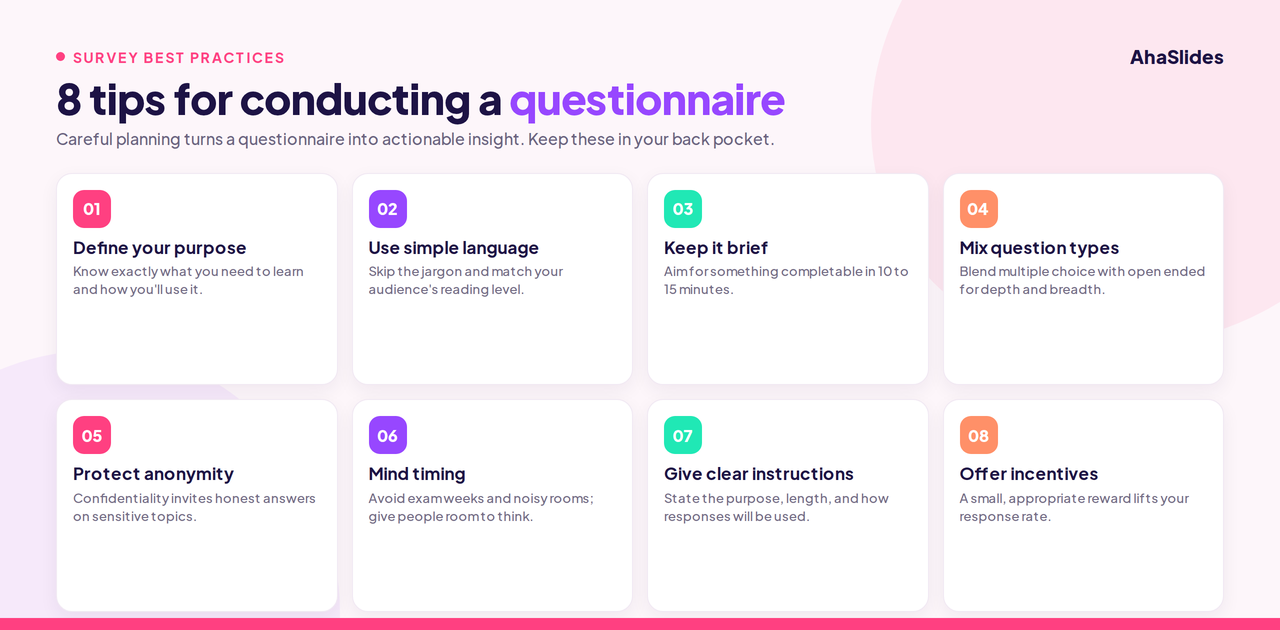
Clearly define your purpose and objectives
Before creating your questionnaire, clearly define what information you need to collect and how you plan to use it. Specific objectives help you design focused questions that generate actionable data. Consider what decisions or improvements will be informed by the results, and ensure your questions align with these goals.
Use simple and clear language
Write questions using language that is appropriate for your students' age and reading level. Avoid technical jargon, complex sentence structures, and ambiguous terms. Clear, straightforward questions reduce confusion and increase response accuracy. Test your questions with a small group of students before full administration to identify any unclear wording.
Keep questionnaires brief and focused
Long questionnaires lead to survey fatigue, reduced response rates, and lower-quality answers. Focus on the most important questions that directly address your objectives. Aim for questionnaires that can be completed in 10-15 minutes. If you need to gather extensive information, consider administering multiple shorter questionnaires over time rather than one lengthy survey.
Use a mix of question types
Combine multiple-choice questions with open-ended questions to gather both quantitative data and qualitative insights. Multiple-choice questions provide structured, easily analyse data, whilst open-ended questions reveal unexpected perspectives and detailed feedback. This mixed approach provides both breadth and depth of understanding.
Ensure anonymity and confidentiality
For sensitive topics like mental health, bullying, or teacher evaluation, ensure students understand that their responses are anonymous and confidential. This encourages honest feedback and increases participation rates. Clearly communicate how data will be used and who will have access to it.
Consider timing and context
Administer questionnaires at appropriate times when students can focus and provide thoughtful responses. Avoid periods of high stress, such as exam weeks, and ensure students have adequate time to complete the survey. Consider the context in which students will complete the questionnaire—quiet, private settings often yield more honest responses than crowded, public spaces.
Provide clear instructions
Begin your questionnaire with clear instructions explaining the purpose, how long it will take, and how responses will be used. Explain any technical requirements if using digital platforms, and provide guidance on how to answer different question types. Clear instructions reduce confusion and improve response quality.
Offer appropriate incentives
Consider offering small incentives to encourage participation, particularly for longer questionnaires or when response rates are important. Incentives can include small rewards, recognition, or the opportunity to contribute to school improvements. Ensure incentives are appropriate and don't compromise the integrity of responses.
Using digital tools for student questionnaires
Digital questionnaire platforms offer several advantages over paper-based surveys, including easier distribution, automatic data collection, and real-time analysis capabilities. For educators and administrators, these tools streamline the questionnaire process and make it easier to gather and act on student feedback.
To put these into practice, the AhaSlides free survey creator lets you build, share, and analyze surveys in minutes — live in a session or sent as a standalone link. For the full survey creation process from objective-setting to analysis, see: How to create an online survey: the complete guide.