



There's no debate here: student debates are one of the best ways to build critical thinking, engage students, and put learning in the hands of the learners.
They're not just for argumentative types, and they work for nearly any age group, subject, or class size, which is why they're becoming a mainstay of school curricula.
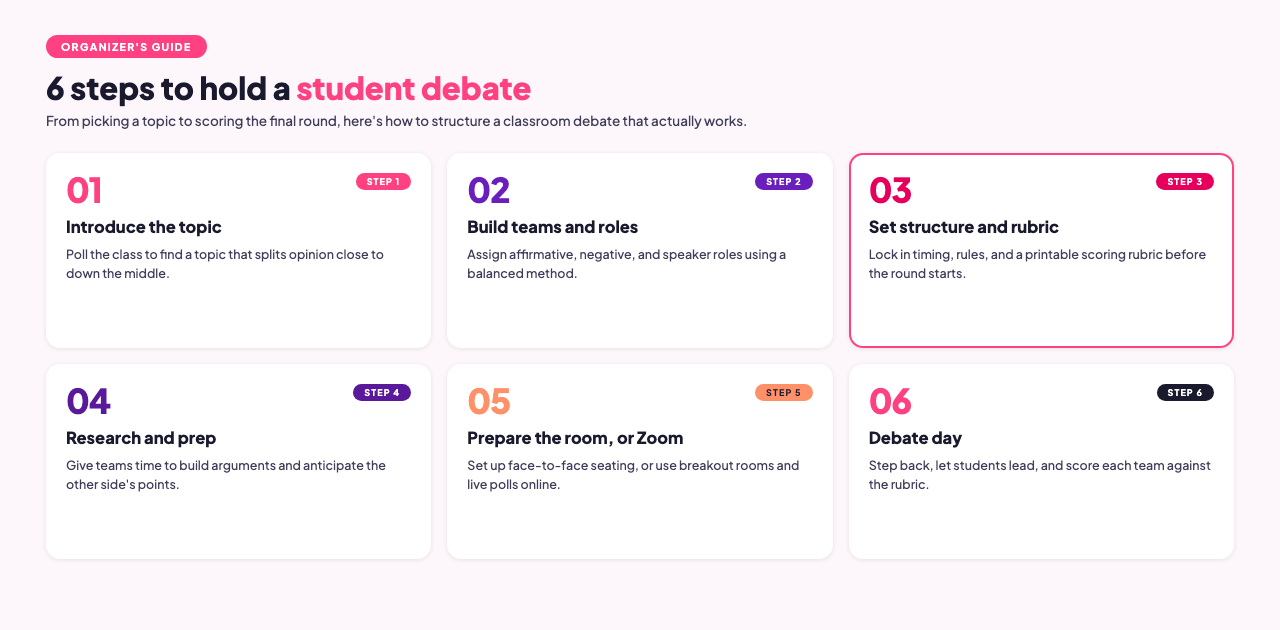
This guide covers what an organizer needs: the benefits, the main formats, the 6 steps to run one, a printable scoring rubric, ESL adaptations, Zoom guidance, and 30 ready-to-use topics.
Why student debates deserve more classroom time
A well-run debate does more than fill a class period. It can shape both the personal and professional parts of a student's life:
The power of persuasion. Students learn to build a convincing, measured argument from evidence rather than volume, a skill that carries well beyond the classroom.
The virtue of tolerance. Debating builds listening skills and teaches students to hear opinions that differ from their own. Even losing teaches them it's fine to change their mind.
It works online. Debates need no special equipment, so they translate to remote and hybrid classrooms with minor adjustments.
It's student-centered. A debate hands students control over what they say and how they respond, rather than positioning the teacher as the only source of information.
The research backs this up. A study of Boston Public Schools students found that participating in interscholastic policy debate raised English Language Arts test scores by 0.13 standard deviations, roughly 68% of a typical year's academic growth for a ninth grader, and increased college enrollment [1]. A meaningful return for an activity that costs nothing but classroom time.
Choose a debate format your class can handle
Before you assign a single team, pick a format. It determines team size, prep time, and how orderly the room will feel. Here's how the four most common classroom-friendly formats compare:
| Format | Team size | Best for | How it works |
|---|---|---|---|
| Oxford-style | 2 teams (2-3 per side) | Whole-class discussion, first-time debaters | Two sides argue a motion. The audience votes before and after to decide who changed the most minds. |
| Lincoln-Douglas | 1 vs. 1 | Advanced students, values-based topics | One speaker per side, focused on ethics and philosophy, with a short cross-examination period. |
| British Parliamentary | 4 teams of 2 | Larger classes, competitive debate clubs | Four teams, two proposing and two opposing, give short speeches that build on or rebut the team before them. |
| Public forum | 2 vs. 2 | Mixed-ability classes | Two-person teams alternate constructive speeches and a "crossfire" question period, built for a general audience. |
For a first classroom debate, Oxford-style is the easiest: it needs the least explanation and keeps the whole class voting rather than sitting out. Once students are comfortable, British Parliamentary and public forum give more of them a speaking role.
6 steps for holding a student debate
Step 1: introduce the topic
The first step is giving students something to argue about. The pool of possible topics is virtually unlimited, and you'll find 30 ready-made ones later in this guide.
The best topic splits the class as close to down the middle as possible. Gather preliminary opinions before assigning sides with an image poll, a word cloud of how students describe their view, a rating scale from 1 to 5, or open-ended questions. A simple yes/no poll works too, and gives an instant read on how evenly the class is split.
Step 2: build balanced teams and assign roles
With a topic chosen, form the two sides: the affirmative (agrees with the statement, or argues for changing the status quo) and the negative (disagrees, or argues for keeping things as they are). If your class is large or many students land in the middle, add a middle ground team that borrows points from either side and argues for a compromise. Don't punish fence-sitters: being genuinely undecided is a legitimate starting point, though it's not a pass on participating.
How you assign students to a side matters as much as the topic. Three methods work well:
Random draw. Pull names from a hat or use a random team generator. Fast and fair, though it can occasionally land your strongest speakers on the same team.
Skill-balanced. Distribute stronger and quieter speakers evenly across both sides based on what you already know about the class. Produces closer rounds but takes more setup time.
Topic-choice. Let students pick the side matching their real opinion. Highest buy-in, but can produce lopsided teams, so cap team size and use a coin flip for overflow.
For speaker roles, a structure borrowed from British Parliamentary debate assigns 4 speakers per team, each with a specific job (opening, rebuttal, second rebuttal, closing). For larger classes, pair two students per role. The rest of the class serves as judges, scoring each team against the rubric from step 3.
Step 3: set the structure, rules, and a scoring rubric
Three things need to be crystal clear before the debate starts: the structure, the rules, and how it will be scored.
Structure. A debate needs to be linear, so nobody talks over anyone else, with enough time for students to actually make their points. A typical structure, starting with the affirmative team:
| Segment | Speaker | Time |
|---|---|---|
| Opening statement | 1st speaker, each team | 5 minutes |
| Prepare rebuttals | Both teams | 3 minutes |
| Rebuttal | 2nd speaker, each team | 3 minutes |
| Second rebuttal | 3rd speaker, each team | 3 minutes |
| Prepare closing | Both teams | 5 minutes |
| Final rebuttal and closing statement | 4th speaker, each team | 5 minutes |
Test the structure, then lock it in once it works, and keep an eye on the clock so no one runs over.
Rules. Clear rules level the playing field between vocal and quiet students: stick to the structure, stay on topic, no swearing, no personal attacks.
Scoring rubric. The point of a classroom debate isn't to "win," but students' natural competitiveness usually benefits from a points system. Judges can use a simple 5-point scale per criterion, then total the scores for each team:
| Criteria | 1 (needs work) | 3 (solid) | 5 (excellent) |
|---|---|---|---|
| Argument clarity | Vague or hard to follow | Clear but not always organized | Clear, logically ordered, easy to follow |
| Evidence use | Little or no support | Some claims backed by facts | Consistently backed by credible, specific evidence |
| Rebuttal quality | Ignores the other side's points | Responds to some opposing points | Directly addresses the strongest opposing points |
| Delivery and presentation | Reads flatly, hard to hear | Mostly confident, some hesitation | Confident tone, good pacing, strong eye contact |
| Teamwork and time management | Team contradicts itself or runs over time | Mostly coordinated and on time | Builds on each other's points, uses time well |
That's 25 points per team. Print the table, hand a copy to each judge, and have them total the score sheet at the end. Judging is never purely a numbers game, so ask judges to jot a one-line justification next to each score.
For an ESL classroom, adjust the rubric to reward growing vocabulary and sentence structure alongside content, rather than penalizing accent or hesitation. More on this below.
Step 4: give students time to research
Once everyone understands the topic and rules, it's time to prepare. Set a research time limit, point students toward a few reliable sources, and check in to keep them on topic. They should research their own points and anticipate the other side's, so they have rebuttals ready rather than freezing when challenged.
Step 5: prepare the room, or run it on Zoom
While teams finalize their arguments, set up the space. Arrange tables and chairs to face each other across the room, the way a professional debate is staged, with speakers standing at the front of their team's area.
Running it virtually. A debate translates to Zoom or any video platform with a few adjustments:
Breakout rooms for team prep. Send each team into its own breakout room for research and rebuttals, then bring everyone back for the debate itself.
A shared, visible timer. Share your screen with an on-screen stopwatch so every speaker can see time remaining without you interrupting.
Virtual audience voting. Run a live poll so the class votes on which team argued more convincingly, before and after. It's the online equivalent of an Oxford-style audience vote, and keeps non-speaking students engaged.
Team identity. Have each team pick colors for their Zoom backgrounds, or invent a mascot to display on screen, a small touch that makes remote teams feel like teams.
Step 6: debate day
Let it begin. This is the students' time to shine, so step in as little as possible, only to keep order or remind the class of the structure and scoring. Score each team against the rubric as the debate unfolds, then tally and average the judges' scores for each team's final result. Save the deeper analysis for the next lesson, once students have had time to decompress.
Adapting debates for ESL and multilingual classrooms
Debate is demanding in a second language, so a few adjustments keep it productive:
Extra prep time. Give ESL students, or the whole class if most are multilingual, more research and drafting time than a native-speaking group would need.
Sentence starters. Provide ready-made phrases to lean on under pressure: "I agree because...", "One piece of evidence is...", "I'd like to challenge that point because...". These scaffold the argument even when vocabulary is still developing.
Pre-taught vocabulary. Teach the handful of topic-specific words students will need beforehand, and let them keep a glossary card at their desk.
Adjusted judging criteria. Weight scoring toward content and growing sentence structure rather than accent or fluency. Treat native-language use as a coaching point during research, not a scoring penalty during the debate.
Written backup. Let students bring a short written outline to refer to, easing the load of holding an argument in working memory in a second language.

A few more formats worth trying
Once the basics are down: roleplay debate has students argue as a fictional or historical figure; impromptu debate gives no prep time; town hall debate has students face the class and answer peer questions directly.
More ideas: 13 online debate games, 12 student engagement ideas, and the flipped classroom approach.
30 classroom debate topics
Take a vote with your students on which of these to run with.
School topics
Should we create a hybrid classroom with both remote and in-class learning?
Should we ban uniforms in school?
Should we ban homework?
Should we try the flipped classroom model of learning?
Should we do more learning outside?
Should we abolish exams and tests in favor of coursework?
Should everyone go to university?
Should university fees be lower?
Should schools offer a class on investing?
Should esports be part of gym class?
Environment topics
Should we ban zoos?
Should it be legal to keep exotic cats as pets?
Should we build more nuclear power plants?
Should we try to slow the birth rate worldwide?
Should we ban all single-use plastic?
Should we turn private lawns into allotments and wildlife habitats?
Should we start an international government for the environment?
Should we force people to change their habits to combat climate change?
Should we discourage fast fashion?
Should we ban domestic flights in small countries with good train and bus systems?
Society topics
Should everyone be vegetarian or vegan?
Should we limit video game playing time?
Should we limit time spent on social media?
Should we make all bathrooms gender-neutral?
Should we lengthen the standard period of maternity leave?
Should we keep developing AI that can do all jobs?
Should we have a universal basic income?
Should prisons be for punishment or rehabilitation?
Should we adopt a social credit system?
Should we ban ads that use our personal data?
A real example to learn from
One of the best examples of student debate on video comes from Intelligence: High School Debate, a show on the Korean broadcasting network Arirang. It covers nearly every element of a well-run student debate a teacher could hope to see in their own classroom.
The students on the show are seasoned pros, many debating eloquently in English as a second language, so manage your expectations. Genuine participation from your class is a strong start on its own.
Frequently asked questions
How many types of student debate are there?
Several, including Oxford-style, Lincoln-Douglas, British Parliamentary, public forum, and impromptu debate, each with its own format and rules, as covered above.
Why should students debate?
It pushes them to analyze issues from multiple perspectives, evaluate evidence, and build logical arguments, skills research links to measurable gains in test scores and college enrollment.
How can I help students research their assigned position?
Point them toward reliable sources like established news outlets, academic journals, and government or nonprofit data, and teach basic citation and fact-checking.
Ready to run one of these live? Try AhaSlides for free to poll your class on a topic, run a live vote on the winning team, and put students at the center of the lesson.