



The best leadership survey questions assess four dimensions: communication clarity, decision quality, psychological safety, and team development. Communication questions work best for identifying whether leaders give clear direction and explain the reasoning behind decisions; decision quality questions for surfacing whether leaders gather input before acting and own outcomes afterward; psychological safety questions for measuring whether team members feel safe raising problems without fear of blame; and team development questions for assessing whether leaders actively invest in growing the people who report to them. The questions that produce the most honest responses are behaviorally specific ("My manager explains the reasons behind major decisions" rather than "My manager is a good communicator") and always collected anonymously — non-anonymous leadership surveys consistently produce inflated scores that cannot be acted on.
Most organizations already know they should be measuring leadership quality. Fewer do it well. The questions are often vague, the process feels performative, and results sit in a spreadsheet nobody revisits.
This guide gives HR professionals and L&D trainers a practical set of leadership survey questions organized by category, plus guidance on design and follow-through. Gallup's research found that managers account for at least 70% of the variance in employee engagement scores across business units [1], which makes measuring leadership one of the highest-leverage things you can do with a survey.
What a leadership survey actually measures
A leadership survey collects structured feedback on how effectively someone in a leadership role is performing, from the perspective of the people they manage, peers, or both. It typically covers communication, decision-making, team support, and behavior under pressure.
The most common format is a 360-degree assessment, where a leader receives input from direct reports, peers, and sometimes senior leaders simultaneously. Research from the American Psychological Association found that multisource (360) feedback leads to meaningful improvements in leadership effectiveness, but only when leaders engage in follow-up activities like goal setting and coaching afterward [2]. The survey alone doesn't change behavior. What happens after does.
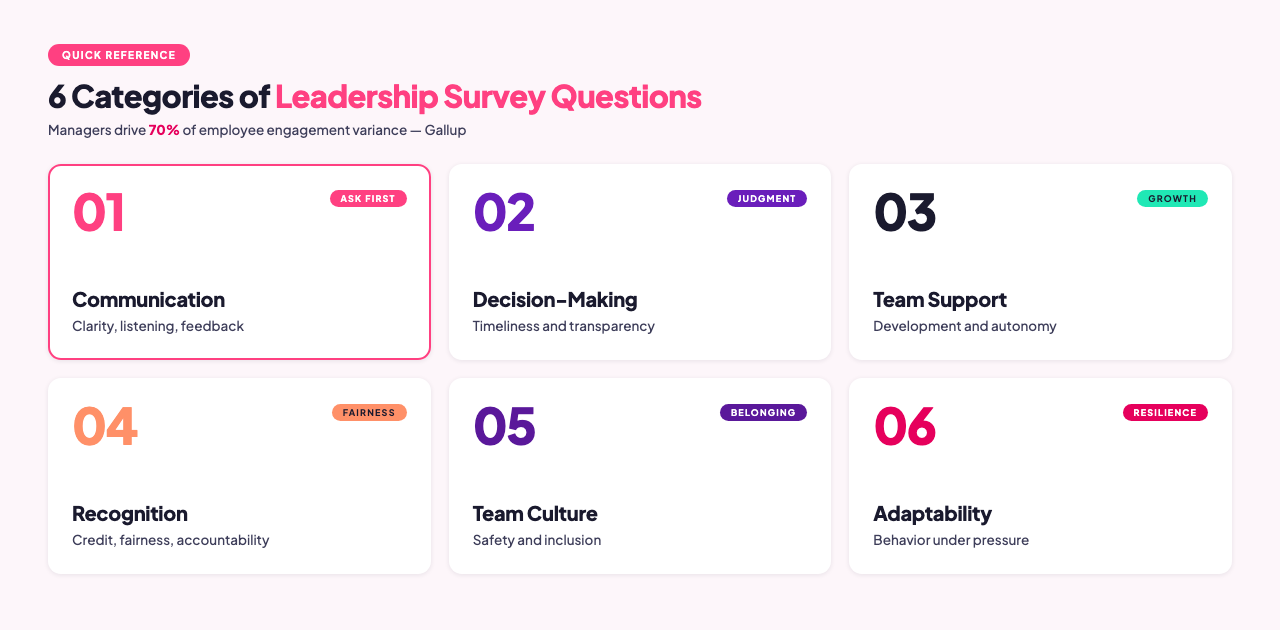
Communication
Communication is where leadership quality is most visible day to day. These questions surface whether leaders are getting information through, creating space for dialogue, and giving people what they need to do their jobs.
- My manager communicates goals and priorities clearly enough for me to act on them.
(1 = Strongly disagree, 5 = Strongly agree) - I receive timely updates when decisions or priorities change.
(1 = Strongly disagree, 5 = Strongly agree) - My manager listens actively and takes my input seriously.
(1 = Strongly disagree, 5 = Strongly agree) - How often does your manager give you useful feedback on your work?
(Never / Rarely / Sometimes / Often / Always) - Is there anything about how your manager communicates that you'd like to see changed?
(Open text)
Decision-making
Leaders make decisions under incomplete information, competing interests, and time pressure. These questions help you assess whether the process is sound, not just whether outcomes turned out right.
- My manager makes decisions in a timely way rather than delaying unnecessarily.
(1 = Strongly disagree, 5 = Strongly agree) - My manager explains the reasoning behind significant decisions.
(1 = Strongly disagree, 5 = Strongly agree) - When my manager makes a decision that affects the team, relevant people are consulted first.
(1 = Strongly disagree, 5 = Strongly agree) - My manager handles uncertainty or ambiguous situations with appropriate confidence.
(1 = Strongly disagree, 5 = Strongly agree)
Team support and development
This is the area where the gap between self-perception and reality tends to be largest. Leaders routinely overestimate how much development support they're providing.
- My manager takes an active interest in my professional growth.
(1 = Strongly disagree, 5 = Strongly agree) - I have access to the resources, tools, or training I need to do my job well.
(1 = Strongly disagree, 5 = Strongly agree) - My manager gives me the right level of autonomy: neither micromanaging nor leaving me unsupported.
(1 = Strongly disagree, 5 = Strongly agree) - My manager advocates for the team's interests when dealing with other departments or senior leadership.
(1 = Strongly disagree, 5 = Strongly agree) - In the past six months, my manager has had a meaningful conversation with me about my career goals.
(Yes / No / Somewhat)
Recognition and accountability
Recognition affects retention and motivation. Accountability affects trust. Both are areas where leaders often have blind spots.
- My manager recognizes contributions and gives credit where it's due.
(1 = Strongly disagree, 5 = Strongly agree) - My manager holds all team members to consistent standards of performance.
(1 = Strongly disagree, 5 = Strongly agree) - When mistakes happen, my manager focuses on learning rather than blame.
(1 = Strongly disagree, 5 = Strongly agree) - My manager follows through on commitments they make to the team.
(1 = Strongly disagree, 5 = Strongly agree)
Team culture and inclusion
Culture is largely a function of what leaders model and tolerate. These questions test whether the values on the wall match the reality in meetings.
- My manager creates an environment where different perspectives are genuinely welcomed.
(1 = Strongly disagree, 5 = Strongly agree) - I feel comfortable raising concerns or disagreeing with my manager without fear of negative consequences.
(1 = Strongly disagree, 5 = Strongly agree) - My manager treats all team members with equal respect regardless of background or role.
(1 = Strongly disagree, 5 = Strongly agree) - Team meetings are productive and a good use of time.
(1 = Strongly disagree, 5 = Strongly agree)
Adaptability and change
How leaders behave during change is often the clearest test of their quality. These questions are especially useful during reorganizations, strategy shifts, or periods of organizational stress.
- My manager handles setbacks and pressure without creating unnecessary anxiety for the team.
(1 = Strongly disagree, 5 = Strongly agree) - My manager adapts their approach when circumstances change rather than sticking rigidly to the original plan.
(1 = Strongly disagree, 5 = Strongly agree) - My manager provides adequate context and support when the team goes through changes.
(1 = Strongly disagree, 5 = Strongly agree)
Overall effectiveness
- Overall, how effective is your manager in their leadership role?
(1 = Very ineffective, 5 = Very effective)
This single-item question is useful as a benchmark for tracking change over time. Pair it with an open-ended follow-up:
"What one thing could your manager do differently to be more effective?"

Survey design: what separates useful from useless
Keep it anonymous, genuinely. Team sizes below eight make anonymity hard to maintain even when results are aggregated. If respondents don't trust the process, you'll get socially safe answers rather than honest ones [2].
Use a consistent scale throughout. Switching between a 5-point Likert scale and a 7-point scale mid-survey confuses respondents and makes cross-question comparisons unreliable. Pick one and stick with it.
Mix rating scales with open text. Quantitative items tell you where problems exist. Open-ended questions tell you why. A short survey with two or three open fields usually yields richer data than a long all-ratings instrument.
Run it on a regular cadence. A one-time survey gives you a snapshot. Quarterly or biannual surveys let you track whether development efforts are moving the needle. Without repeated measurement, you have no way to tell whether a manager's score improved because their behavior changed or because team composition shifted.
Set expectations before you launch. Tell people what will happen with the results. "Your responses will be reviewed by HR and shared in aggregate with each manager" is honest and builds participation. Silence after a survey destroys willingness to complete the next one.
A real-world example
A mid-size technology company running quarterly team health checks found that scores on question 4 ("useful feedback on your work") were consistently the lowest-rated item across most teams. Rather than treating this as a leadership failure, the L&D team used the data to redesign the manager onboarding program, adding a module specifically on giving actionable feedback. Six months later, the same item had moved up by 0.6 points on average across the cohort. The survey gave them the diagnosis; the training gave them the lever.
Common mistakes to avoid
Even well-intentioned leadership surveys fail when the process has design or execution problems. These are the four most common issues HR and L&D teams run into, along with straightforward fixes.
Asking leading questions. A question like "Our managers communicate well with their teams, do you agree?" nudges respondents toward agreement before they've even formed a judgment. Rewrite it as a neutral statement: "My manager communicates goals and priorities clearly enough for me to act on them." The phrasing should not signal what answer the organization is hoping for.
Running the survey without a clear owner. It's common for HR to send out a leadership survey, collect the results, and then wait for someone else to act on them. If no one is named as accountable for the follow-up process (reviewing scores, sharing data with managers, scheduling development conversations), the survey becomes a dead end. Before the survey launches, assign a named owner and a deadline for initial review. Without that, the data rarely moves anywhere useful.
Using too many questions. A 40-item survey sounds thorough, but response quality drops sharply as length increases. Respondents rush, skip open-text fields, or abandon the survey entirely. For most leadership assessments, 15 to 25 items is a workable range. If you need to cover more ground, break it into themed modules run at different points in the year rather than piling everything into one session.
Sharing results without context. Handing a manager a spreadsheet of scores without explaining what the numbers mean or what a reasonable range looks like tends to produce defensiveness rather than action. When sharing results, include a brief guide: what each section measures, how scores compare to a previous cycle or benchmark, and what a realistic improvement target looks like over the next quarter. Managers who understand what they're looking at are far more likely to engage with the feedback productively.
Frequently asked questions
How often should we run a leadership survey?
Most organizations benefit from a biannual cycle: once around the midpoint of the year and once near year-end. This gives managers enough time between surveys to work on development areas before receiving another round of feedback. Quarterly pulse checks work well for specific items (like the overall effectiveness question), but full surveys every three months can lead to survey fatigue and declining response rates.
What's a good response rate to aim for?
For an internal survey where participation is encouraged but not mandatory, a response rate of 70% or higher is generally considered solid. Below 50%, the data becomes hard to interpret reliably, particularly for teams with fewer than ten direct reports, where a few non-responses can shift the aggregate score significantly. If response rates are consistently low, the most common causes are distrust in anonymity, lack of feedback on previous survey results, or surveys that are too long.
Should managers see their individual scores or only team averages?
Standard practice is to share individual scores with managers while aggregating them for senior leadership reviews. The manager needs the item-level data to identify specific development areas; senior leaders need the aggregate to spot systemic trends across departments. One important safeguard: if a team has fewer than five respondents, consider suppressing individual item scores and sharing only the overall rating to protect anonymity. This is especially relevant in small specialist teams where every voice is identifiable.
Running leadership surveys with AhaSlides
AhaSlides Surveys are built for exactly this kind of assessment: a multi-question form your respondents complete on a single page and submit once, with no presenter needed. Mix rating scales for the 1–5 agreement items, matrix blocks, multiple choice, and open-ended boxes in one survey, mark key questions as required, and keep responses anonymous. Share it as a link or QR code for asynchronous feedback, or reveal it as a slide at the end of a workshop while the session is still fresh. For a full walkthrough, see our step-by-step guide to creating a survey online with AhaSlides.
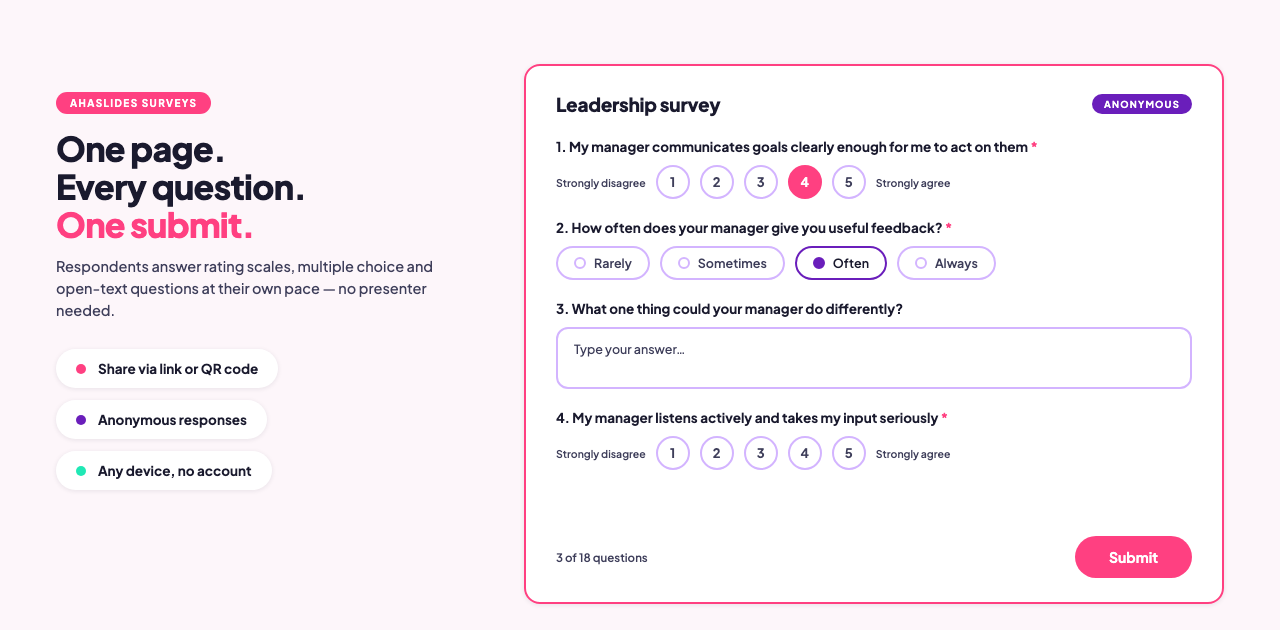
To put these into practice, the AhaSlides free survey creator lets you build, share, and analyze surveys in minutes — live in a session or sent as a standalone link.
Sources
[1] Gallup. "Managers Account for 70% of Variance in Employee Engagement." Gallup Business Journal. https://news.gallup.com/businessjournal/182792/managers-account-variance-employee-engagement.aspx
Frequently asked questions
What are the best leadership survey questions?
The best leadership survey questions are behaviorally specific rather than trait-based. Instead of "Is my manager a good communicator?" ask "My manager explains the reasoning behind major decisions." Instead of "Does my manager support my growth?" ask "My manager has had a meaningful conversation with me about my career development in the past 6 months." Behaviorally specific questions are harder to inflate and produce data that points to concrete changes.
Should leadership surveys be anonymous?
Yes. Leadership surveys should always be anonymous, especially for upward feedback (employees rating managers). Non-anonymous leadership surveys consistently produce inflated scores because employees fear retaliation. True anonymity — where even HR cannot trace individual responses — produces the most honest and actionable data. For small teams under 10 people, consider aggregating results with adjacent teams to prevent identification through unique responses.
How often should you survey employees about leadership?
Annual reviews are the minimum; quarterly pulse surveys of 3–5 leadership questions capture more timely signals. The cadence matters less than what you do with the results — organizations that close the loop (share findings and communicate changes made) see significantly higher participation in subsequent surveys and better improvement scores over time.
What dimensions should a leadership assessment cover?
A well-designed leadership survey covers: communication clarity (does the leader give clear direction?), decision quality (does the leader make decisions with appropriate input and own outcomes?), psychological safety (do team members feel safe raising problems?), team development (does the leader invest in people's growth?), and results orientation (does the leader hold the team accountable fairly and consistently?).
[2] Bracken, D.W., & Rose, D.S. (2011). "When Does 360-Degree Feedback Create Behavior Change? And How Would We Know It When It Does?" Journal of Business and Psychology, 26(2), 183–192. Summarized via APA: https://www.apa.org/pubs/journals/features/cpb-64-3-157.pdf