Looking for cognitive exercise games that are fun to play and give your mind a proper workout? This list has 31 of them: classic puzzles and party games, brain training apps and websites, and table games that suit older adults and groups.
Every game here asks your brain to do something specific, such as hold information in mind, spot a pattern, plan ahead or find the right word. We have also been straight about what the research says, because "brain games" are often sold with bigger promises than the evidence supports.
Quick facts
| Question | Answer |
|---|---|
| How many games are on this list? | 31: 14 classic games, 14 apps and websites, and 3 table games for older adults and groups |
| Do I need to pay? | Not for the classic games. Most apps are free to download or try, with paid plans for full access |
| Do brain games prevent cognitive decline? | The evidence is not strong enough to say so. You improve at what you practise; wider benefits are uncertain |
| What else supports brain health? | Physical activity, staying socially connected and learning new, demanding skills |
What are cognitive exercise games?
Cognitive exercise games are games and puzzles that challenge mental skills such as memory, attention, processing speed, reasoning and language. Some are digital "brain training" exercises built around a particular skill. Others are everyday games, like chess, crosswords or a pub quiz, that happen to make you think hard.
Do brain games work? What the research says
Brain games are a good way to keep your mind busy, but be wary of any product that promises to make you smarter or stop memory loss.
- You get better at what you practise. A 2016 review of the brain-training research, led by psychologist Daniel Simons, found that training improves performance on the trained tasks, with less evidence for closely related tasks and very little for everyday thinking (Association for Psychological Science summary).
- Structured cognitive training shows some promise for older adults. The US National Institute on Aging (NIA) points to the ACTIVE trial, in which older adults trained in reasoning or speed of processing showed less decline over 10 years than those in the memory and control groups. But the NIA also warns that there is "not enough evidence" that commercially available brain-training apps have the same impact.
- App-based training has weak evidence for lasting benefits. A Cochrane review of computerised cognitive training in healthy older adults rated the evidence as low or very low certainty, and found no evidence that effects on overall cognition lasted 12 months.
- The wider picture is "promising but inconclusive". A 2017 National Academies report found encouraging but inconclusive evidence for three approaches: cognitive training, blood pressure control for people with high blood pressure, and increased physical activity (NIA summary of the report).
So choose games you enjoy, play them for the fun and the challenge, and combine them with the habits that support overall brain health: moving more, seeing people and learning new things. The NIA notes, for example, that older adults who learned quilting or digital photography had more memory improvement than those who only socialised or did less demanding activities.
Classic cognitive exercise games
You can play these at home, in a classroom, at a care home or at the office, with little more than a pen, a pack of cards or a board.
1. Memory match
Lay out pairs of picture cards face down. Players flip two cards at a time, trying to find a match, and turn them back over if they don't match. To succeed, you have to remember where every card you have seen was, which makes it a simple test of visual and spatial memory.
2. Trivia quiz
A trivia quiz asks players to pull facts out of long-term memory, often under time pressure. For older adults, questions about music, films and events from their younger years also spark conversation and shared memories. See the section on running a live quiz below for how to set one up.
3. Word association
One player says a word, and the next must say a related word within a few seconds: "beach", "sand", "castle", "king". The game exercises verbal fluency and quick thinking. Add a rule that no word can be repeated to make players keep track of everything that has been said.
4. Sudoku
Fill a 9x9 grid so that every row, column and 3x3 box contains the digits 1 to 9 exactly once. Tracking which numbers are still possible in each square works your logical reasoning and working memory. Puzzles range from gentle to fiendish, so it suits most levels.
5. Quick maths sprint
Set a timer for one minute and solve as many simple sums as you can. Start with addition and subtraction, then move to multiplication and mixed problems. It trains mental arithmetic and processing speed, and it is easy to track your own progress.
6. Chess
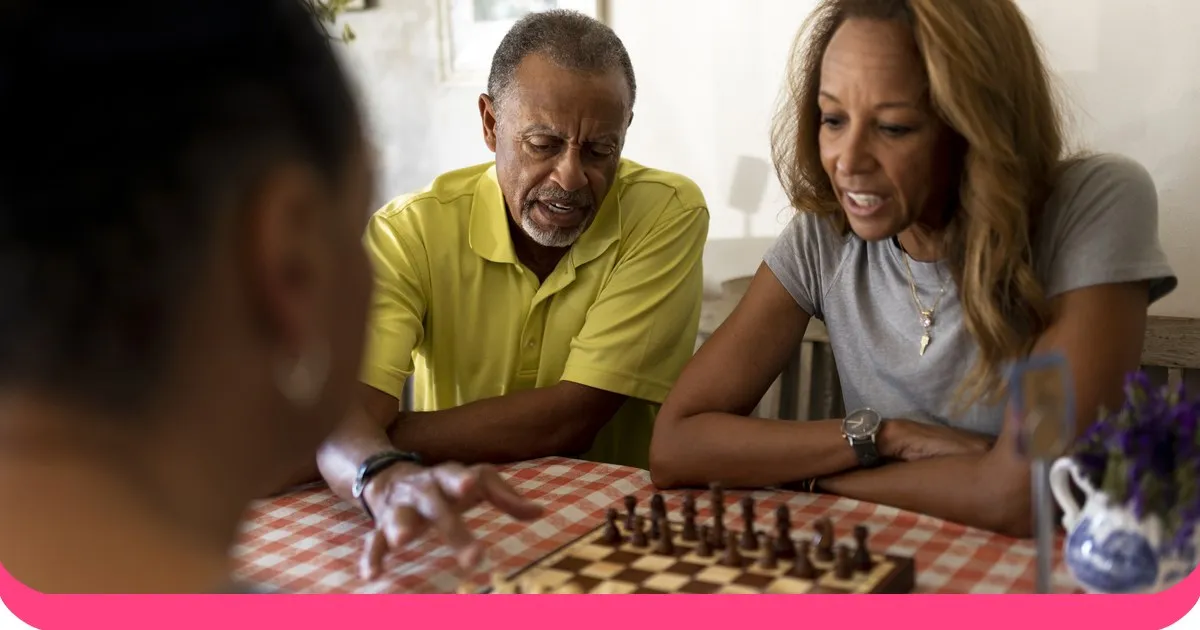
Chess asks you to plan several moves ahead, recognise familiar patterns and anticipate your opponent. If you prefer to play online, Chess.com and Lichess both let you play against people at your level or against a computer, and Lichess is free.
7. Spot the difference
Compare two nearly identical pictures and find the small changes between them. It is a test of visual attention and patience. Printed puzzle books, children's magazines and many free apps have them.
8. Jenga
Players take turns removing a block from a wooden tower and placing it on top without toppling it. Jenga combines fine motor control with planning: you have to judge which block is loose and think about how your move affects the next player.
9. Anagrams
Take a word and rearrange its letters to make new words, for example "listen" into "silent". You can use a letter-tile game or simply write words on cards. Anagrams exercise vocabulary and mental flexibility.
10. Simon says: sequence edition
The leader gives a sequence of actions ("touch your nose, clap twice, then jump") and players must repeat it in order. Add one action each round. It trains working memory for sequences, and the electronic Simon game with coloured lights and tones works the same skill.
11. Mazes
Trace a path from start to finish without hitting a dead end. Mazes train spatial reasoning and planning, especially if you try to solve them with your eyes before using a pen. Printable mazes and maze books come in every difficulty.
12. Jigsaw puzzles
Jigsaws need you to hold shapes and colours in mind while scanning for where each piece fits. They are also relaxing and easy to share, which is why they are a staple in many homes and care settings.
13. Logic puzzles
Grid-based logic puzzles, riddles and brain teasers ask you to reason from clues to a single correct answer. Free sites such as BrainBashers have hundreds of them, and our brain teasers for adults are a good place to start.
14. Crosswords
Each clue sends you searching your memory for a word that fits both the meaning and the letters you already have. Crosswords exercise vocabulary, general knowledge and recall, and many newspapers publish a free daily puzzle.
Brain training apps and websites
Most of these apps are free to download or try, with a paid subscription for the full set of games. Prices and free tiers change, so check the details before you subscribe.
15. Lumosity
Lumosity is one of the best-known brain training apps, with short games for memory, attention, flexibility and problem-solving that adjust to your level.
16. Elevate
Elevate focuses on everyday skills such as reading, writing, speaking and maths, through short daily sessions.
17. Peak
Peak offers games for focus, memory, problem-solving and mental agility, and adapts the difficulty to how well you play.
18. CogniFit
CogniFit starts with an assessment and then builds a personalised programme of cognitive games around your results.
19. BrainHQ
BrainHQ, from Posit Science, has exercises for attention, memory, processing speed and more. The exercises adapt to your performance, and some are free to try.
20. HAPPYneuron
HAPPYneuron offers brain games grouped by the skill they target, such as memory, attention, language and executive functions.
21. NeuroNation
NeuroNation builds a personalised training plan of short exercises for memory, concentration and reasoning.
22. Brainwell
Brainwell starts with a short test to set your level, then tailors a training programme of games covering memory, language and reasoning.
23. Brilliant
Brilliant is less a brain game than an interactive learning app. It teaches maths and coding through hands-on problems, which suits anyone who prefers learning a new skill to replaying the same games.
24. 7 Little Words
In 7 Little Words, you combine groups of letters to solve seven clues per puzzle. It is a good fit for people who enjoy crosswords but want something shorter.
25. Word Crossy
Word Crossy mixes a word search with a crossword: you connect letters to form words that fill a grid. It is free to play, with ads and in-app purchases.
26. Memory Games: Brain Training
Memory Games: Brain Training is an Android app with a set of short memory and logic challenges. It is free to play, with ads and in-app purchases.
27. Dr Kawashima's Brain Training for Nintendo Switch
Dr Kawashima's Brain Training for Nintendo Switch is the latest game in Nintendo's long-running series (known as Brain Age in North America). It is a paid game with quick maths, reading and memory exercises, and a daily check that gives you a playful "brain age" score. It was released in Japan, Europe, Australia and parts of Asia, but not in North America.
28. Wordle
Wordle, from The New York Times, gives you six tries to guess a five-letter word, with colour-coded hints after each guess. There is one free puzzle a day, which makes it an easy five-minute habit that exercises vocabulary and logical elimination.
Games for older adults and groups
These games are social as well as mentally demanding, which matters: the NIA highlights staying connected with others as another way to support cognitive health. They work well at home, in community groups and in care settings.
29. Card games
Classic card games such as bridge, rummy and whist ask players to remember which cards have been played, count points and plan ahead. Solitaire (patience) is a good solo option for the days when no one else is around.
30. Word bingo
Give each player a bingo card filled with common words or phrases instead of numbers. The caller reads out a definition or a clue rather than the word itself, so players have to work out the answer before marking it off.
31. Scrabble and other word-building games
Scrabble, Bananagrams and similar games ask players to build words from a random set of letters, which stretches vocabulary, spelling and strategic thinking. Allow a dictionary for players who want an easier game.
How to run a brain-game session for a group
Whether you are a teacher, an activities coordinator or a team lead, a few simple choices make a group session work better:
- Keep it short. Two or three games in 20 to 30 minutes holds attention better than one long game.
- Mix difficulty and skill. Pair a word game with a number or visual game so that different people get their moment to shine.
- Start easy. Open with a round everyone can win, then raise the difficulty. Early success keeps people playing.
- Make it readable. For older players, use large print, high-contrast cards and clear, spoken instructions.
- Talk afterwards. Ask players which game they found hardest and why. The conversation is part of the value.
Turn it into a live quiz
A live quiz is one of the easiest cognitive exercise games to run for a group, whether it is a classroom, a team meeting or a residents' afternoon. With AhaSlides, you write the questions, everyone joins on their phones, and answers come in live. You can start from one of the ready-made quiz and trivia templates instead of a blank deck.
A picture question adds a visual challenge: show an image and ask about it. To make it a memory test, show the image on one slide and ask about it on the next.

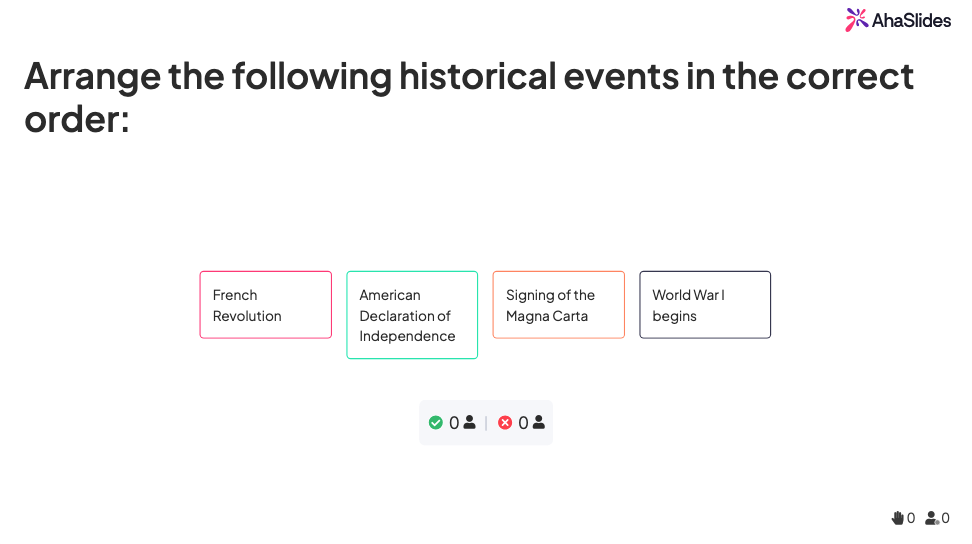
A correct order question asks players to arrange items in sequence, such as historical events or the steps of a process, which works their memory and reasoning together.
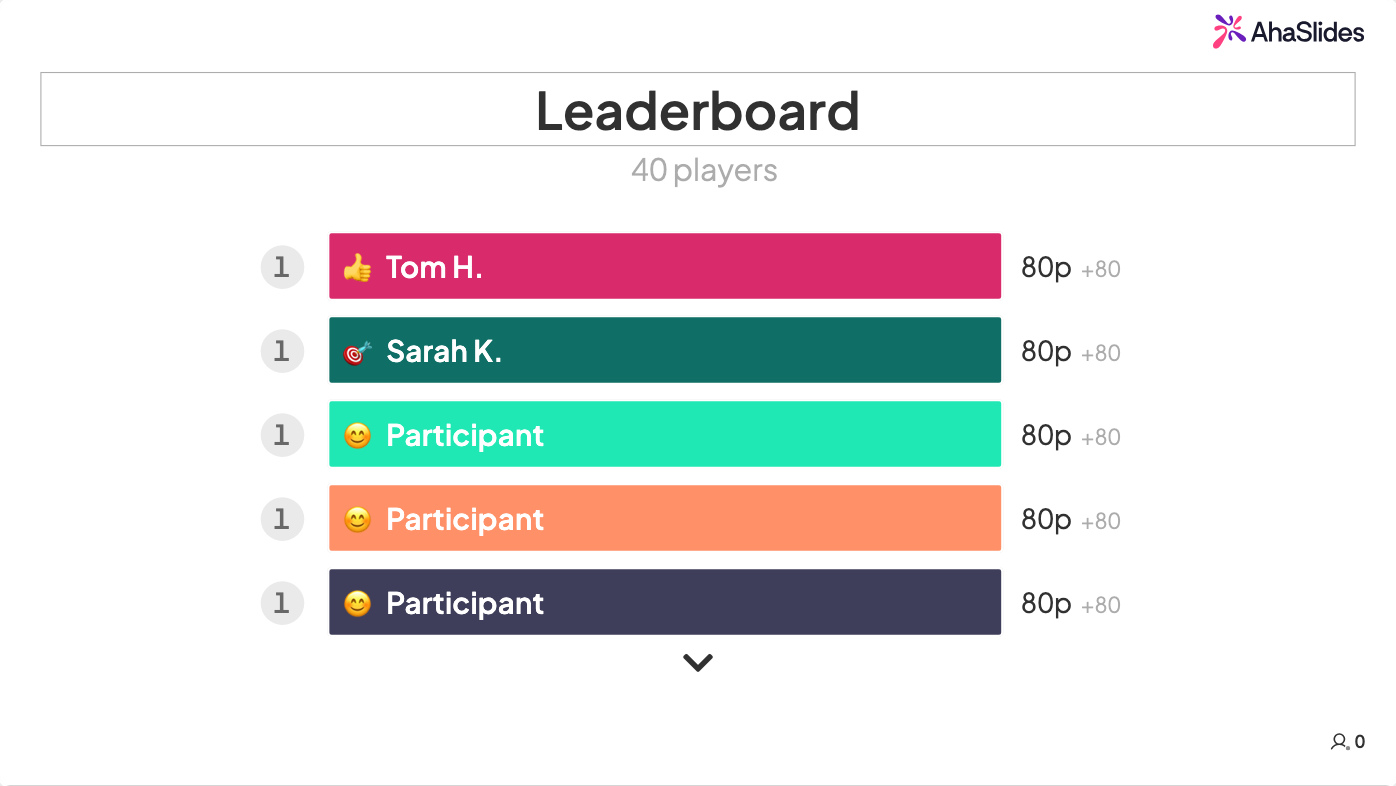
A leaderboard between rounds adds friendly competition and keeps everyone engaged until the end.
For more ideas, see our brain training games for memory, memory games for adults and fun intelligence test games.
Frequently asked questions
What are cognitive training games?
Cognitive training games are activities designed to exercise specific mental skills, such as memory, attention, processing speed and problem-solving. They range from apps like Lumosity and BrainHQ to everyday games such as Sudoku and chess.
Which games are good for brain exercise?
Sudoku, chess, crosswords, trivia quizzes, memory matching and card games such as bridge all challenge different mental skills. The best choice is the one you enjoy enough to keep playing, ideally with other people.
Can brain games prevent dementia?
There is not enough evidence to say so. The NIA notes that some structured cognitive training has shown benefits in research, but that there is not enough evidence that commercial brain-training apps have the same effect. Treat brain games as an enjoyable way to stay mentally active, not as a treatment.
What exercise helps cognitive function?
Several studies link physical activity to better brain health, though the NIA says more research is needed to know what role exercise plays in preventing cognitive decline. US federal guidelines recommend that adults get at least 150 minutes of physical activity a week, and walking is a good start.