

Most town halls fail the same way: a parade of department updates, a short Q&A where three people ask questions, and everyone leaves wondering why that needed to be a company-wide event.
That's a shame, because done right, a town hall is one of the few formats where leadership can speak directly to everyone, hear what people are actually thinking, and leave the whole organization with a clearer picture of where things are headed. Only 31% of U.S. employees were engaged at work in 2024, a decade low [1]. The gap between what leadership knows and what employees understand about company direction is one of the biggest reasons why.
This guide covers what a town hall meeting is, why it's worth doing well, and how to run one that people actually leave feeling was worth their time.
What is a town hall meeting?
A town hall meeting is a planned, company-wide gathering where leadership communicates updates and employees ask questions directly. The Q&A is the core of the format, not an afterthought. That's what separates it from a standard all-hands meeting, which tends to be more broadcast-style and less conversational.
The term comes from the literal town halls of early American governance, where community members met with elected officials to discuss local decisions. The first recorded town hall convened in 1633 in Dorchester, Massachusetts. The format spread into corporate settings because it carries the same implication: leadership is accessible and accountable, not just broadcasting.
Why run town halls at all?
Before getting into the how, it's worth being clear about what town halls are actually for.
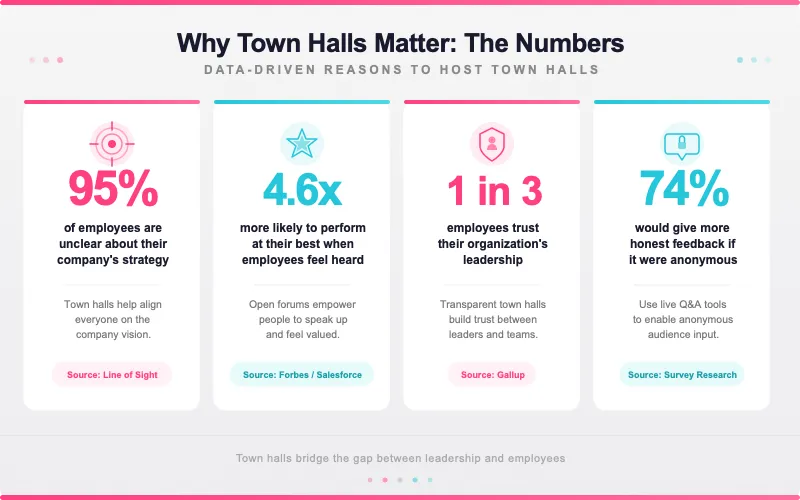
The most direct function is closing the information gap. Research by Line of Sight found that 95% of employees are unclear or unaware of their company's strategy [2]. Information gets filtered at every layer of management, and by the time it reaches frontline employees it's often incomplete or distorted. Town halls give leadership a direct channel to the whole organization, unfiltered.
They also signal that questions are welcome. Employees who feel their voice is heard at work are 4.6 times more likely to perform at their best [3]. Even employees who don't ask questions benefit from hearing others' questions answered honestly. The Q&A format does that in a way a company newsletter never can.
Trust is the longer-term return. Only one in three employees strongly agrees that they trust their organization's leadership [1]. That number moves when leadership shows up regularly, answers hard questions directly, and follows through on what they said they'd do.
Finally, there's alignment. When marketing, engineering, and operations all hear the same message from the same source at the same time, there's less room for the misaligned priorities that slow organizations down.
3 real-world examples
Home Depot. The retailer holds regular store associate town halls where frontline staff can raise concerns directly with senior leaders. These sessions have been credited with surfacing operational problems that managers closer to the data hadn't flagged.
Victor Central School District (New York). The district uses town hall-style sessions for strategic planning, bringing together staff, parents, and administrators to work through priorities together. The format keeps all stakeholders informed and reduces the sense that decisions are made behind closed doors.
Buffer. The fully remote company holds quarterly all-hands town halls with a heavy emphasis on financial transparency. Employees see revenue, costs, and headcount data, and leadership fields questions live. Buffer's reported meeting duration of 60-90 minutes has become a practical benchmark for optimal town hall length [4].
How to structure a town hall agenda
A standard 60-90 minute town hall works well with this structure:

11 tips for a better town hall
Before the meeting
Send a structured agenda in advance. 64% of recurring meetings have no agenda at all [2]. Sending one, even a short one, signals that the meeting has a purpose and lets employees prepare questions.
Collect questions ahead of time. Pre-submitted questions let leadership prepare honest answers rather than improvising around sensitive topics. They also surface what employees actually want to know, which is often different from what leadership assumes they want to know.
Assign a moderator. The person answering questions shouldn't also be managing the queue, watching the clock, and deciding when to move on. A separate moderator keeps the session moving.
During the meeting
Open with something interactive. A live poll asking "What's your biggest question heading into today?" or a word cloud prompt gives people something to do in the first two minutes and shows that the session is participatory.
Break up the content every 10-15 minutes. Audience attention drops significantly after about 10 minutes [2]. A short poll, a quick show of hands, or even a change of speaker resets attention.
Use anonymous Q&A. 74% of employees say they'd be more likely to give honest feedback if the channel were anonymous [3]. Open mic Q&A favors extroverts and senior staff. Anonymous question tools surface what the room is actually thinking.
Address hard questions directly. If a question can't be answered yet, say so and give a timeline for when it can be. Vague answers ("we're working on it") damage credibility faster than a direct "I can't share that yet."
Watch the time ratio. If updates run over and Q&A gets cut to five minutes, employees notice. Protect the Q&A time.
For virtual town halls
Test the technology before the session, not during it. Audio and video problems affect engagement immediately. Nearly three in four digital workers report experiencing technical delays during online meetings [2].
Record the session. Some employees will be in different time zones or unavailable. Recording signals that you want everyone to have access to the information, not just those who can attend live.
Use breakout rooms for larger groups. In town halls with more than 200 attendees, smaller breakout discussions can generate better quality questions than a single large Q&A queue.
After the meeting
Send a written recap within 24 hours. Include a summary of key updates, questions asked and answered, decisions made, and any open items with owners and timelines. This recap is often more useful than the meeting itself for people who need to reference specific decisions later.
Tools for running a town hall
The meeting platform handles the video. What most platforms don't handle well is real-time participation: collecting live questions, running polls mid-session, and giving quiet participants a channel to contribute.
AhaSlides integrates with meetings as an interactive layer. You can run live polls, word clouds, anonymous Q&A, and rating questions without switching tabs or asking employees to download anything. Results appear in real time, so a question like "Which of these topics matters most to you?" can shape the meeting agenda on the spot rather than showing up in a post-event survey nobody acts on.
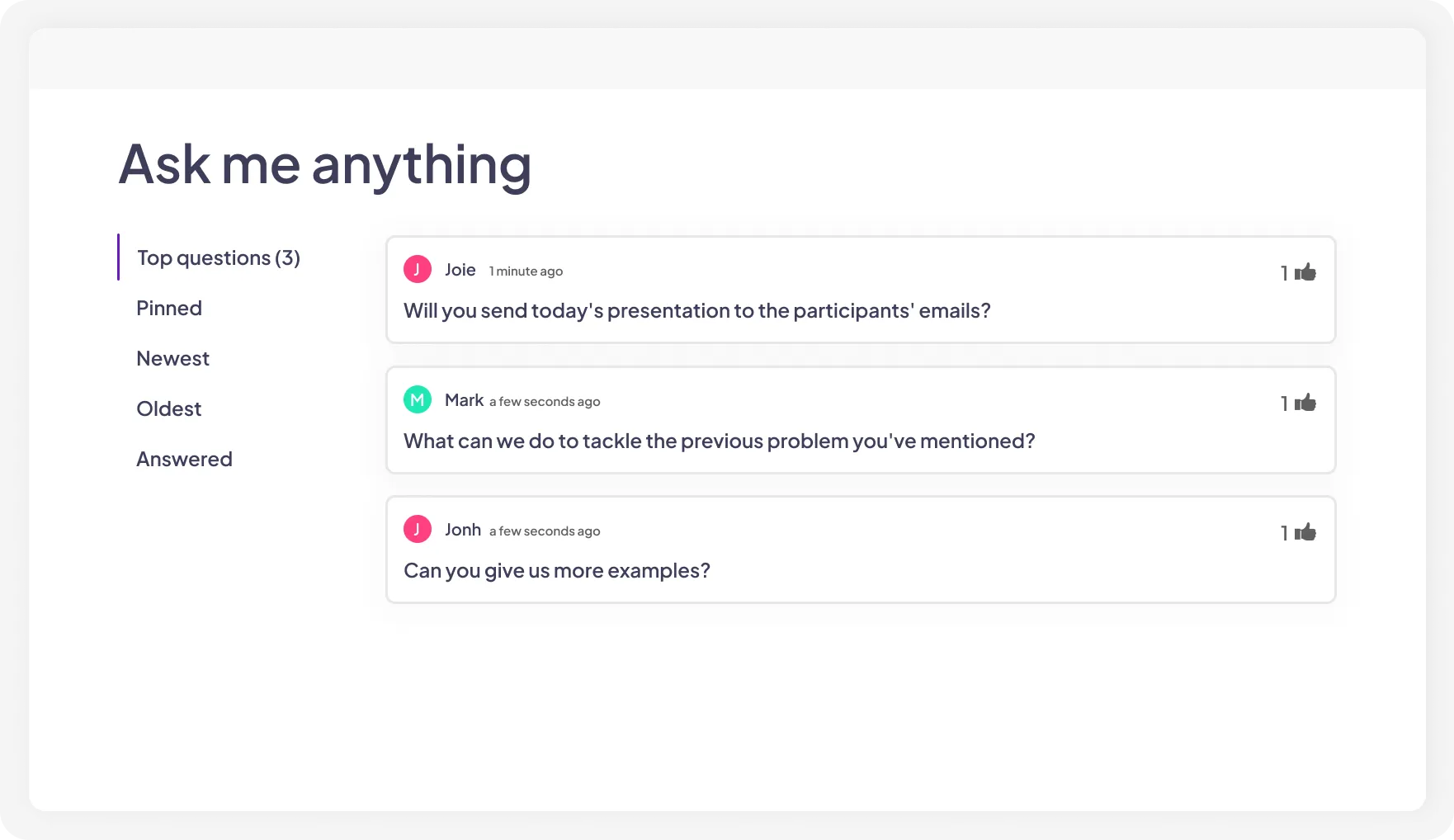
That immediacy matters. When employees see their responses reflected back during the session, the follow-on discussion is usually more candid than a prepared leadership presentation would ever produce.
Virtual vs. in-person: what changes
The format changes more than most people plan for.
In-person has one big advantage: presence. Leadership is physically in the room, which signals commitment in a way a screen can't fully replicate. The risks are mostly logistical. Bad microphone placement means the back row misses half the conversation. Seating arrangements that put leadership at the front of a theatre-style room reinforce hierarchy rather than openness. Small fixes, but worth thinking about.
Virtual removes geography as a barrier, which matters enormously for distributed teams. It also makes anonymous participation easier, since employees are already behind a screen. The main risk is drift. People check email, mute themselves, and disengage in ways that are invisible to the presenter. Structured interaction throughout the session, not just at the end, is the most effective way to keep people present.
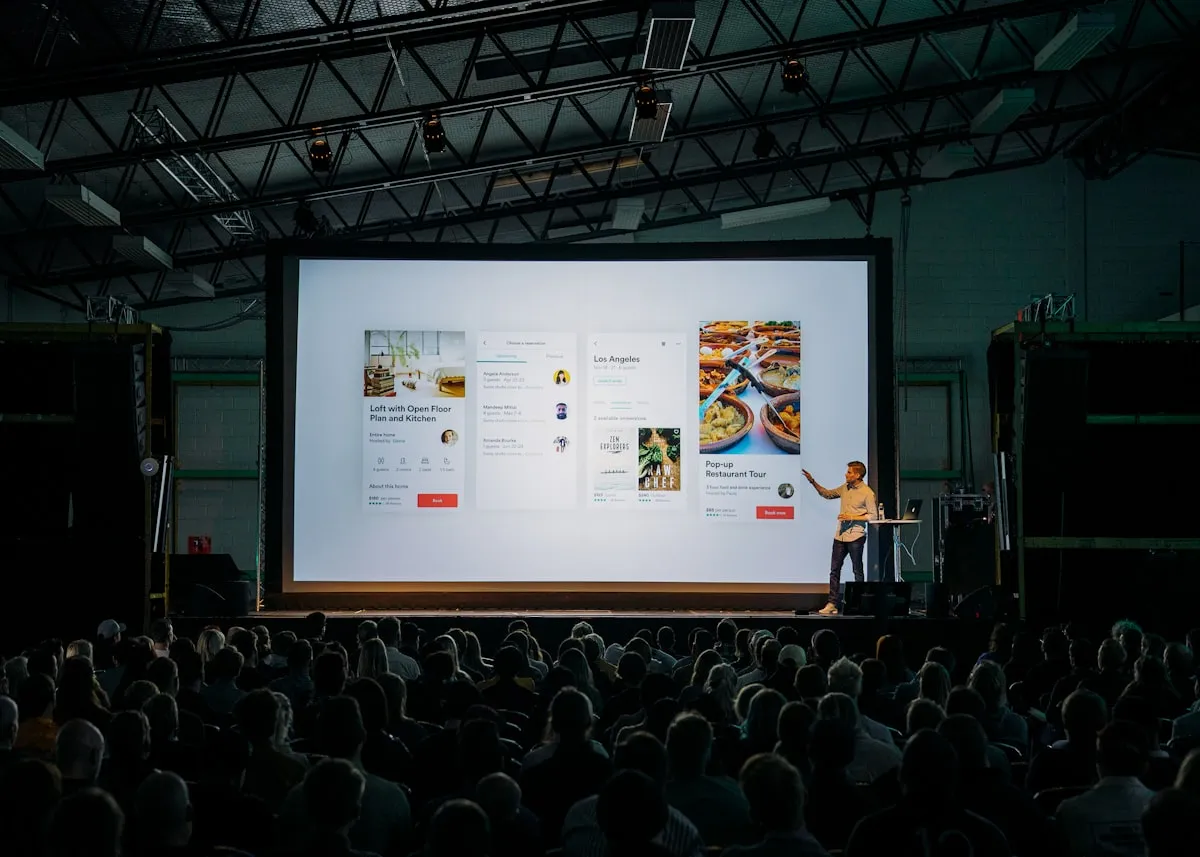
Hybrid is the hardest format to get right. The in-person experience almost always dominates, and remote attendees end up feeling like an audience watching the real meeting happen somewhere else. If you're running hybrid, the fix is deliberate: assign a dedicated moderator for the remote channel, route remote questions into the same Q&A pool as in-person ones, and check in with the remote group explicitly at least twice during the session.
How often should you hold town halls?
There's no universal answer, but research suggests frequency tracks with company growth stage [4]. Fast-growing organizations tend to benefit from monthly town halls, where rapid change means employees need regular updates to stay oriented. Stable organizations often find quarterly is sufficient. Annual company meetings work for compliance and tradition, but they're rarely enough on their own to maintain alignment.
A practical default: quarterly town halls for the full company, with department-level sessions (10-30 people) held monthly. The smaller sessions are where the most useful Q&A actually happens, because employees are more willing to ask specific questions in a smaller group.

Common mistakes to avoid
The most common mistake is turning the town hall into a presentation. If leadership talks for 80% of the time and takes three questions at the end, employees learn quickly that their input isn't really the point. The Q&A should feel like the main event, not the thing that gets cut when updates run long.
Filtering questions is the fastest way to lose credibility. If pre-submitted questions are screened before leadership sees them, or if moderators consistently skip the hard ones, word gets around. Employees stop submitting real questions and start treating the format as theater.
No follow-up is almost as damaging. A town hall where questions get answered but nothing visibly changes is worse than no town hall at all. People remember when commitments don't materialize. A recap email with clear owners and timelines closes that loop.
Finally, inconsistent frequency trains employees to associate town halls with bad news. If the format only appears after layoffs or a difficult quarter, that's the association it builds. Regular cadence is what makes it a communication tool rather than a crisis management one.
Sources
[1] Gallup. State of the Global Workplace 2024 Report. https://www.gallup.com/workplace/349484/state-of-the-global-workplace.aspx
[2] Pigeonhole Live. 25+ Statistics and Trends to Elevate Your Company Town Halls in 2025. https://blog.pigeonholelive.com/company-town-hall-statistics. Aggregates data from Line of Sight, Flowtrace, The Gathering Effect, Owl Labs, and Event Tech Live.
[3] Forbes / Salesforce research, cited in: Pigeonhole Live. 25+ Statistics and Trends to Elevate Your Company Town Halls in 2025. https://blog.pigeonholelive.com/company-town-hall-statistics
[4] Pigeonhole Live. 25+ Statistics and Trends to Elevate Your Company Town Halls in 2025. Cites Buffer, ClickUp, and Hoppier data on duration and frequency benchmarks. https://blog.pigeonholelive.com/company-town-hall-statistics