



Ask most managers what motivates their team and they'll give you a confident answer. Ask the team the same question and you'll often get something different.
That gap between what leadership assumes and what employees actually experience is where disengagement quietly compounds. Gallup puts the productivity cost of disengagement at $8.8 trillion globally, roughly 9% of GDP [1]. But the number isn't the point. The point is that most organizations are working from assumptions instead of data.
A well-structured motivation quiz closes that gap. This guide gives you 35+ ready-to-use questions across six categories, a framework for interpreting what you find, and practical guidance on getting answers people will actually be honest about.
Why motivation quizzes work better than annual engagement surveys
Annual engagement surveys measure sentiment once a year. By the time results are analyzed and shared, the conditions that shaped the responses have often changed. A shorter, more targeted motivation quiz can run quarterly or after key moments such as a reorg, a policy change, a new manager, and give you actionable data while it's still relevant.
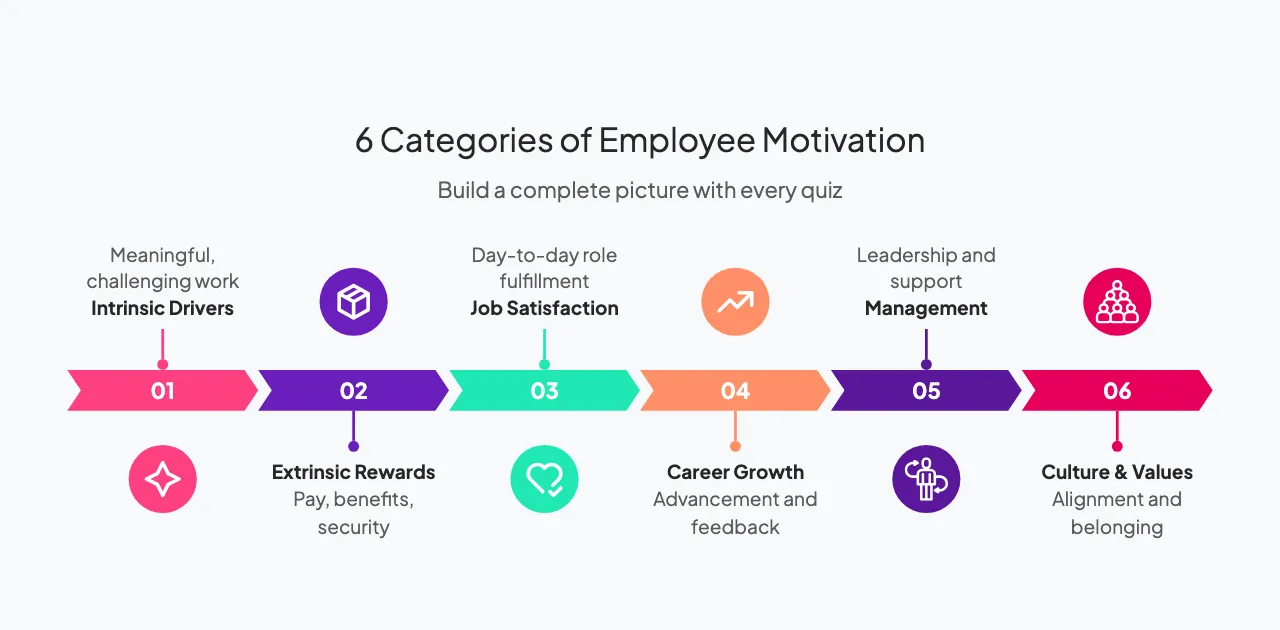
The distinction between intrinsic and extrinsic motivation also matters here. Research consistently shows that intrinsic motivators (meaningful work, autonomy, growth) drive sustained performance, while extrinsic rewards (pay, benefits, status) tend to address immediate dissatisfaction without building long-term engagement [2]. A well-structured quiz covers both, which is why the six categories below are split between internal drivers and external conditions.
Choosing your quiz categories
Three motivation frameworks are worth knowing before you build your quiz:
Maslow's hierarchy of needs arranges human motivators from physiological safety at the base up through belonging, esteem, and self-actualization [3]. In a workplace context, this means employees who feel their job security or basic compensation is at risk won't respond to appeals about purpose or growth. Address lower-order concerns first.
Adams' equity theory (1963) holds that employees compare their inputs and outcomes to those of colleagues, and demotivation sets in when that comparison feels unfair [3]. Questions about compensation fairness and recognition effectiveness tap into this directly.
McClelland's theory of needs groups employees by their dominant drive: achievement, affiliation, or power [3]. Employees who score high on achievement want challenge and progress; those driven by affiliation value relationships and team culture; those motivated by power want influence and responsibility. A quiz that covers all three profiles gives you a richer picture than one that focuses only on pay and benefits.

The six categories and 35+ questions
1. Intrinsic motivators
These questions measure whether employees find the work itself meaningful, challenging, and worth doing.
- The work I do feels meaningful, not just productive.
- I have enough autonomy over how I approach my work to feel genuinely invested in it.
- My role challenges me in ways that help me grow.
- I feel a sense of accomplishment at the end of a typical workday.
- The problems I work on are interesting enough to keep me engaged.
- I feel ownership over the outcomes I'm responsible for.
2. Extrinsic motivators
These questions measure whether the tangible rewards and conditions of employment are meeting expectations.
- I feel I am compensated fairly for the work I do.
- The benefits package this organization offers meets my needs.
- My contributions are recognized in ways that feel genuine, not performative.
- The recognition I receive reflects the impact of my work, not just my visibility.
- I would recommend this organization as a place to work to someone I respect.
3. Job satisfaction
These questions assess how employees feel about the day-to-day reality of their role.
- My workload is manageable without requiring unsustainable hours most weeks.
- I have the tools and resources I need to do my job well.
- My day-to-day tasks make good use of my skills and strengths.
- I feel proud of the work I produce here.
- In one word, describe how motivated you feel at work right now. (word cloud)
4. Career growth
These questions identify whether employees see a viable future at the organization.
- I have clear opportunities to grow within this organization.
- I understand what I need to do to advance my career here.
- Someone at this organization has invested meaningfully in my development in the past six months.
- I can see a realistic career path for myself here.
- What type of development would benefit you most right now? (multiple choice: Leadership training / Technical skills / Certifications / Mentorship / Lateral moves)
5. Management and leadership
Managers account for a large share of the variation in employee engagement. These questions get specific about what's working and what isn't.
- My manager sets clear expectations and follows through on commitments.
- The feedback I receive from my manager is specific and useful, not just evaluative.
- My manager supports my growth, even when that growth might take me elsewhere.
- I feel comfortable raising concerns or disagreements with my manager.
- Senior leaders' actions are consistent with the values they communicate publicly.
- My manager gives me the autonomy I need to do my best work.
- I have confidence in the decisions being made by leadership right now.
6. Culture and values
These questions measure alignment between what the organization says it stands for and what employees actually experience.
- This organization's stated values match how it actually operates day to day.
- I feel psychologically safe enough to raise a concern or a different point of view without career risk.
- Credit for wins is shared fairly among the people who contributed.
- When something goes wrong, this organization focuses on learning rather than blame.
- I feel like I belong here, not just that I work here.
- What is the one thing this organization could change that would most improve your motivation? (open text)
- On a scale of 0-10, how likely are you to still be working here in 12 months? (eNPS-style outcome question)
A real-world example: using results to fix a management gap
A mid-sized tech company in Singapore ran a motivation quiz after noticing a spike in voluntary turnover among junior engineers. Their intrinsic motivation scores were solid. People found the work interesting. However management scores were consistently low on two items: feedback quality and availability.
The L&D team used those results to design a targeted program for team leads focused on one-on-ones and structured feedback delivery. Six months later, the same quiz showed measurable improvement in those two categories, and turnover in the affected team dropped by roughly a third.
The quiz didn't solve the problem on its own. It made the problem specific enough to act on.
How to get honest answers
Anonymous responses are essential for questions about management and compensation. If employees suspect their answers can be traced back to them, they'll answer in ways that feel safe rather than accurate. Make anonymity explicit, not just as a setting in the tool, but as something you say out loud in the communication that goes out with the quiz.
Keep it short. Fifteen to twenty questions is the practical ceiling for a standalone motivation quiz. If you need to cover all six categories, consider rotating them: run intrinsic and extrinsic motivators one quarter, management and culture the next.
Act on what you find, and tell people what you did. The fastest way to kill response rates on the next survey is to run one and never share the results or make any visible changes. Even a brief summary like "You told us feedback quality was a problem; here's what we're changing" builds the credibility that makes future data reliable.
Common mistakes to avoid
The questions are the easy part. These are the process failures that turn good data into a wasted quarter.
No plan for the results. Data without an owner is just a dashboard nobody checks. Before you send the quiz, agree on who reviews the results, what scores will trigger action, and when findings get shared. If you can't answer those three questions before launch, you're not ready to launch.
Double-barreled questions. 'Do you feel management communicates well and listens to your concerns?' is two questions pretending to be one. If someone agrees with the first half but not the second, their answer is unscoreable. One question, one thing. Always.
Reporting only averages. A career growth score of 3.8 looks fine until you break it down by tenure and find that five-year employees score 2.6. Company-wide averages are where problems go to hide. Always segment by department, level, and tenure before you conclude anything.
Running it once and moving on. One quiz tells you where things stand today. It doesn't tell you whether they're getting better or worse. Run the same core questions quarterly and you've got a trend line. Run them once and you've got a snapshot that gets stale before anyone acts on it.
Running the quiz with AhaSlides
There's a version of this where the quiz goes out on a Tuesday, results come back Friday, and someone builds a slide deck that gets presented at the next leadership meeting. That works. But something different happens when you run the culture and values section live during a team session.
A question appears on screen: 'When something goes wrong, this organization focuses on learning rather than blame.' The average score lands at 2.1. Nobody says anything at first. Then someone does. Then three more people do. That conversation that starts because everyone can see the number at the same time is worth more than any follow-up action plan written in private.
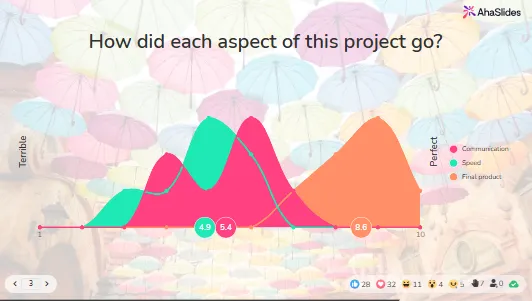
AhaSlides lets you run the full motivation quiz as a live session or send it asynchronously, depending on what the moment calls for. Rating scales, word clouds, multiple-choice polls, and open-text questions all in one place. Employees join by phone with no login and no app download. Results display in aggregate only, so the management section gets honest scores instead of safe ones. And the templates are free to use and fully customizable: adjust the wording, the scale labels, and the categories to match how your organization actually talks about this stuff.
What to do with the results
A motivation quiz produces value only if someone acts on it. A basic analysis framework:
Start with the outcome questions. The eNPS-style retention indicator and the word cloud give you a headline read before you dig into category scores. If retention intent is low and the word cloud is dominated by words like 'stuck' or 'overlooked,' you know the direction before you've run a single cross-tab.
Compare category scores against each other, not just against benchmarks. A team that scores 4.2 on intrinsic motivation and 2.4 on management has a specific, actionable problem. A team that scores 3.1 across the board has a different kind of problem, one that's harder to locate and harder to fix. The gap between your highest and lowest category scores is usually more useful than any individual number.
Segment before you conclude. Company-wide averages mask the problems that matter most. Break results down by team, tenure, and level. A career growth score of 3.7 looks acceptable until you see that employees with more than three years at the company score 2.5. That's a retention risk hiding in plain sight.
Read the open-text responses before you write the summary. Numbers tell you what. Open-text responses tell you why. Question 6 of the culture and values section will surface themes that no rating scale can capture. Look for patterns across responses, not just individual comments.
Pick one or two priority areas and act visibly. Trying to address every low score at once produces no visible change anywhere. Choose the categories with the lowest scores and the clearest connection to outcomes you care about (retention, performance, or team stability) and act on those first. Then tell people what you did and why. That communication is what makes the next quiz worth running.
Frequently asked questions
How long should an employee motivation quiz take to complete?
Most employees will complete a 15-to-20-question quiz in under ten minutes. Beyond that, completion rates tend to drop. If you want to cover all six categories thoroughly, it's better to spread them across two or three shorter quizzes run over separate quarters than to send one long form that people abandon halfway through.
How often should we run a motivation quiz?
Quarterly is the most practical cadence for most organizations. It gives you enough time to act on one round of results before the next one runs, and it builds a data set that shows trends rather than a single point in time. If your organization is going through significant change like a merger, a leadership transition, or a major policy shift, running a shorter pulse check between scheduled cycles makes sense.
What should we do if scores are consistently low in one category?
Low scores in a single category are a signal to investigate before you act. Pull the open-text responses from that section, speak directly with a representative sample of employees, and verify that the quiz results reflect a genuine structural issue rather than a communication problem. Sometimes low scores on "career advancement" reflect a real lack of opportunity; other times they reflect that available pathways exist but aren't visible to employees. The solution looks very different depending on which it is.
Sources
[1] Gallup. State of the Global Workplace: 2023 Report. https://www.gallup.com/workplace/393497/world-trillion-workplace-problem.aspx
[2] Tandfonline. "The impact of extrinsic and intrinsic motivation on job satisfaction." Cogent Business & Management, 2023. https://www.tandfonline.com/doi/full/10.1080/23311975.2023.2270813
[3] MTSU Pressbooks. "Theories of Motivation." Organizational Transformation. https://mtsu.pressbooks.pub/organizationaltransformation/chapter/chapter-7-theories-of-motivation/