


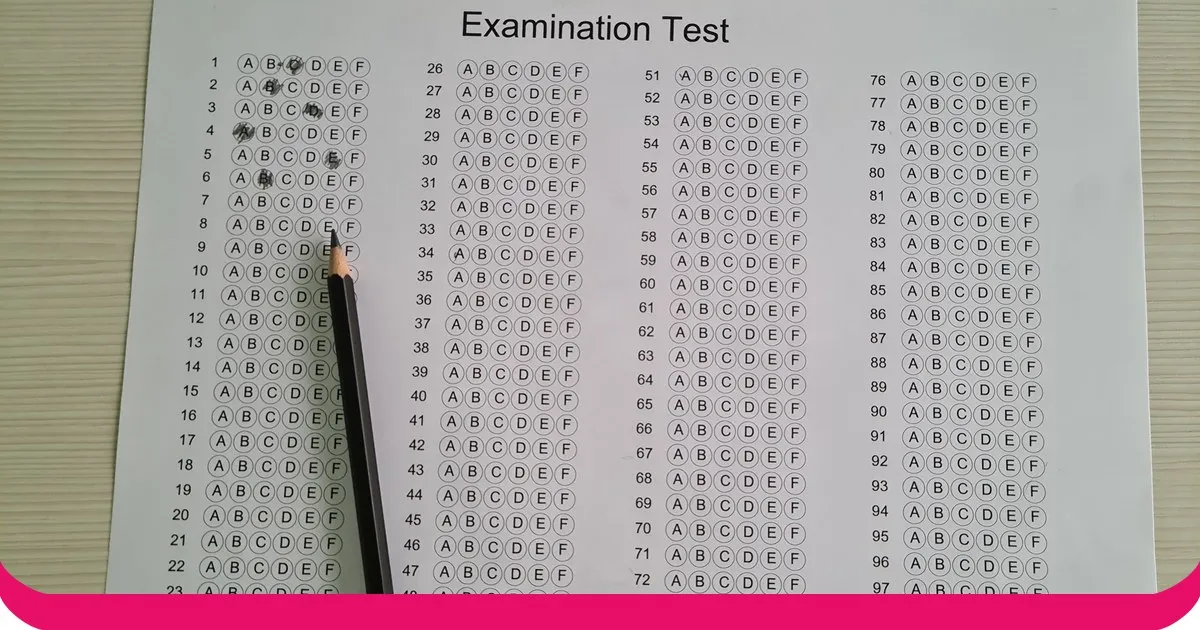
A multiple choice question (MCQ) gives the reader a stem, which is the question, and a set of options that includes the correct answer and several incorrect ones called distractors (Johns Hopkins University). Here are 10 types of multiple choice questions, each with a worked example, when to use it and how to write it well.
They suit quizzes, lessons, training and live polls. Multiple choice questions are good at factual recall and, when well written, can test analysis and evaluation, but they cannot measure how well someone organises and expresses ideas (Johns Hopkins University). So pick the type that fits what you want to learn. The 10 types below move from simple to more demanding, and the last two have no right answer at all.
Multiple choice question types at a glance
At a glance4 quick answers
How many types are there?
Answer10, grouped by how the stem is written, how many answers are right, what skill they test and whether there is a right answer at all.
How many options should each question have?
AnswerThree or four. Research finds three is generally enough; a common university guideline asks for at least four.
Which types suit a quiz?
AnswerDirect question, sentence completion, negative, single best answer, multiple response, true or false, scenario and data questions.
Which types suit a poll or survey?
AnswerThe opinion poll and the rating scale, because neither has a wrong answer.
The 10 types of multiple choice questions, with examples
Types by how the stem is written
These three differ only in how the question is phrased. The answer is one correct option in all of them.
How the stem is written3 types
1Direct question. Which gas do plants take in from the air for photosynthesis?
AnswerCarbon dioxide. Plants take it in through their leaves and use it, with water and light, to make sugars.
Use it whenYou want the clearest, fastest question. University guidance says to write the stem as a complete question rather than an incomplete statement when you can.
2Sentence completion. At sea level, pure water boils at ____ °C.
Answer100. Put the blank at the end so the stem still reads as one clear thought.
Use it whenThe fact reads naturally as a statement, such as a definition or a measurement. If a direct question is just as easy to write, use that.
3Negative stem. Which of these is NOT a primary colour in the RGB model used by screens?
AnswerYellow. Screens mix red, green and blue light; yellow is made by combining red and green.
Use it whenKnowing the exception matters, such as a safety rule. Capitalise and bold the NOT, because readers skim past a small one.
Types by how many answers are right
These change the number of correct options, from one best answer to several, or to just two choices.
How many answers are right3 types
4Single best answer. Which is the best way to check whether learners understood a new topic during a lesson?
AnswerRun a quick three-question quiz. Every learner answers, so you see the whole room instead of the loudest voices. Several options are partly useful, which is why the stem says "best".
Use it whenJudgement matters and more than one option is defensible. Say "best" in the stem so nobody argues for a second correct answer.
5Multiple response. Which of these are prime numbers? Select all that apply.
Answer2 and 11. 9 is 3 × 3 and 15 is 3 × 5, so each has another factor.
Use it whenMore than one answer is right and you want to see whether people can find all of them. Tell players that several answers are correct.
6True or false. The three angles of a triangle on a flat surface add up to 180 degrees.
AnswerTrue. A guesser still has a 50 per cent chance, so this type suits warm-ups better than serious assessment.
Use it whenYou need a fast check of one clear fact. Keep each statement fully true or fully false.
Types that test application
These ask people to use what they know. Well-written multiple choice questions can reach analysis and evaluation, not only recall.
Testing application2 types
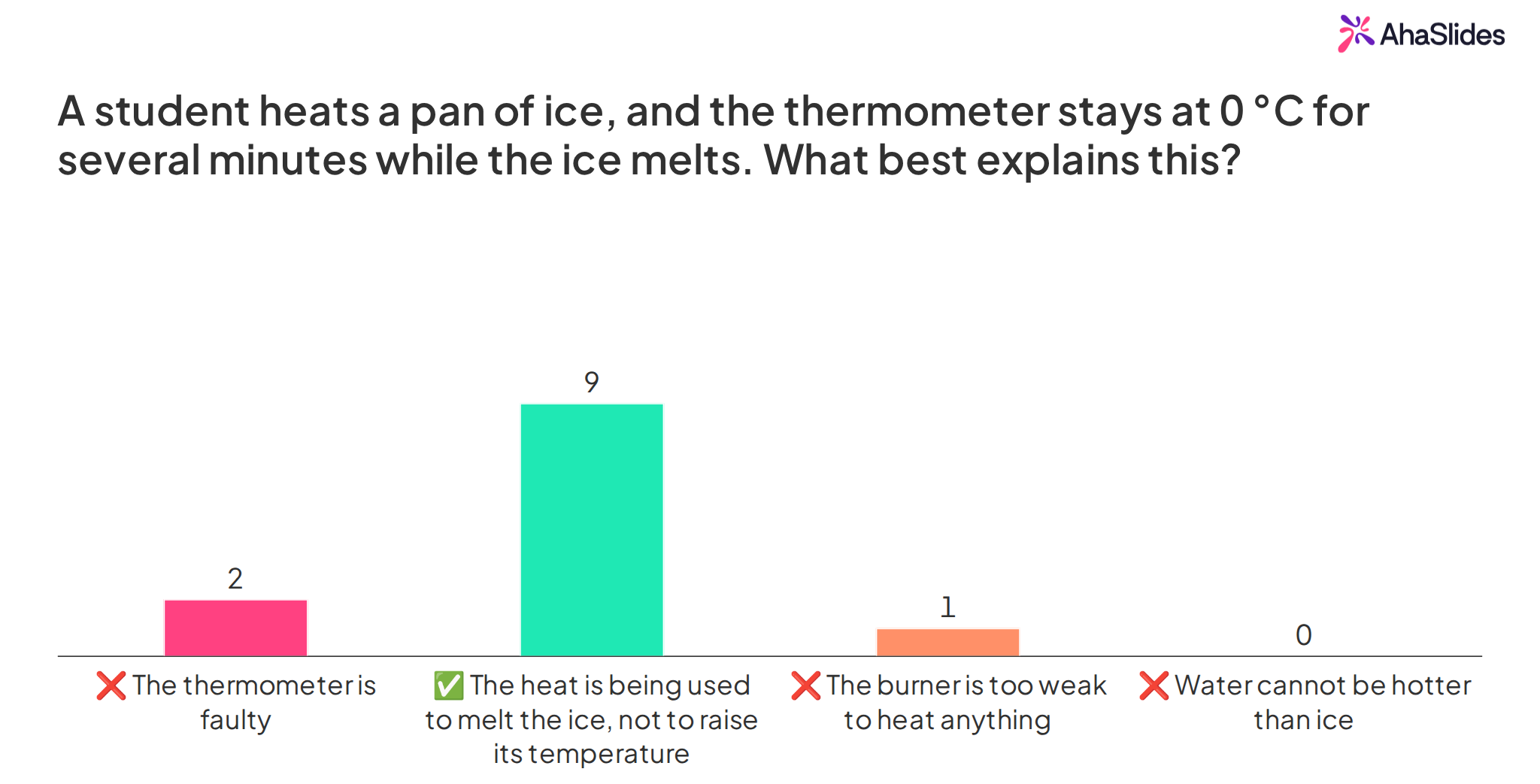
7Scenario question. A student heats a pan of ice, and the thermometer stays at 0 °C for several minutes while the ice melts. What best explains this?
AnswerThe heat is being used to melt the ice. While a substance changes state, the energy goes into the change rather than a rise in temperature.
Use it whenYou want people to apply an idea, not recall it. A short realistic situation moves a question beyond facts.
8Data or image question. Quarterly sales were Q1 £12,000, Q2 £18,000, Q3 £14,000 and Q4 £21,000. Between which two consecutive quarters did sales rise the most?
AnswerQ3 to Q4. The rises were £6,000, a fall of £4,000 and £7,000. On a slide you would show the numbers as a chart or table.
Use it whenYou want people to read information, such as a chart, map, diagram or table, instead of remembering it. It has only three options, which is enough.
Types with no right answer
These gather opinions instead of checking knowledge, so they belong in polls and surveys. They use the same layout, a stem plus options, which is why they count as multiple choice.
Polls and surveys2 types
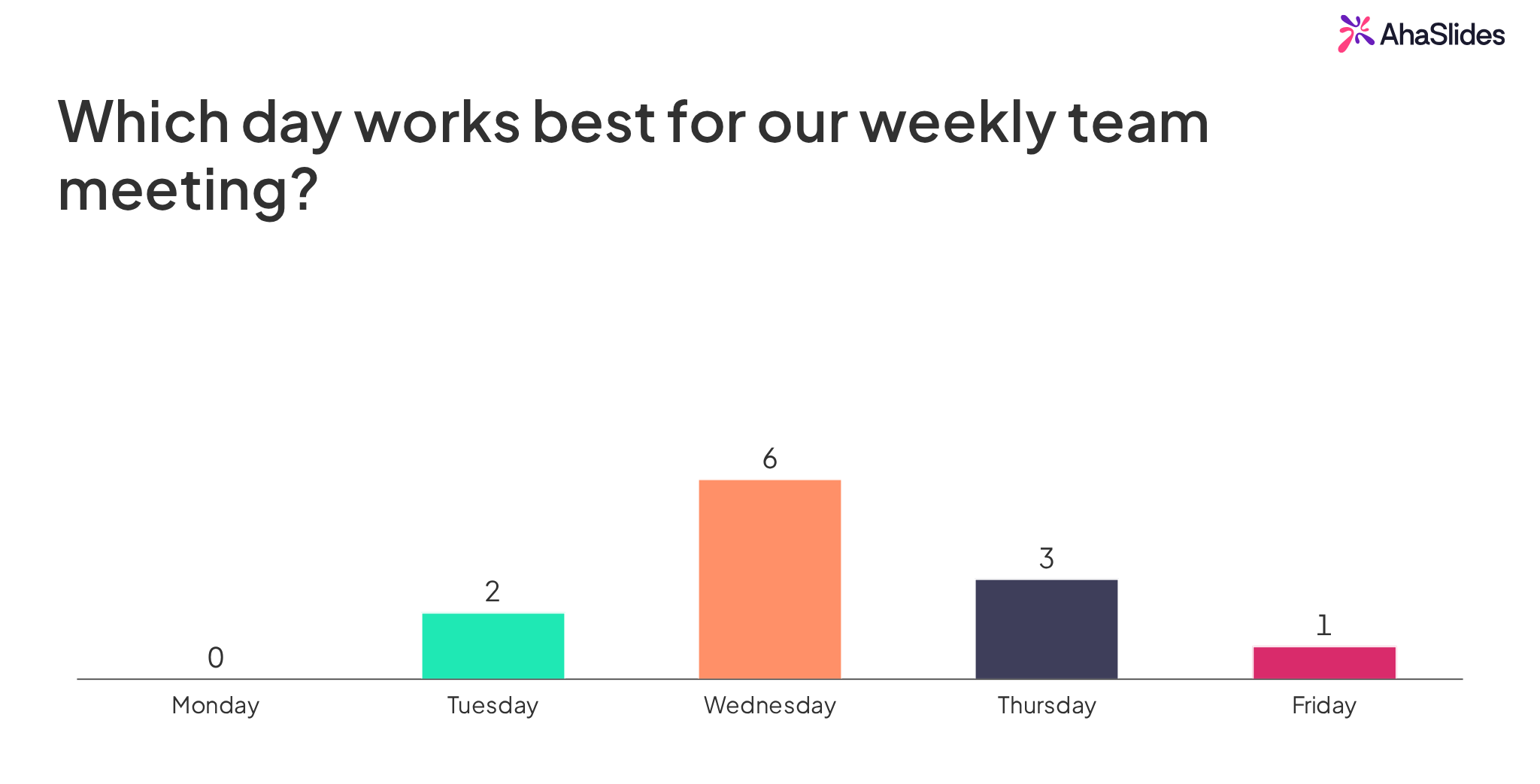
9Opinion poll. Which day works best for our weekly team meeting?
ResultNo wrong answer. The votes are the data. The group sees the split at once and can decide.
Use it whenYou are gathering preferences or making a group decision, in a meeting, a workshop or a class.
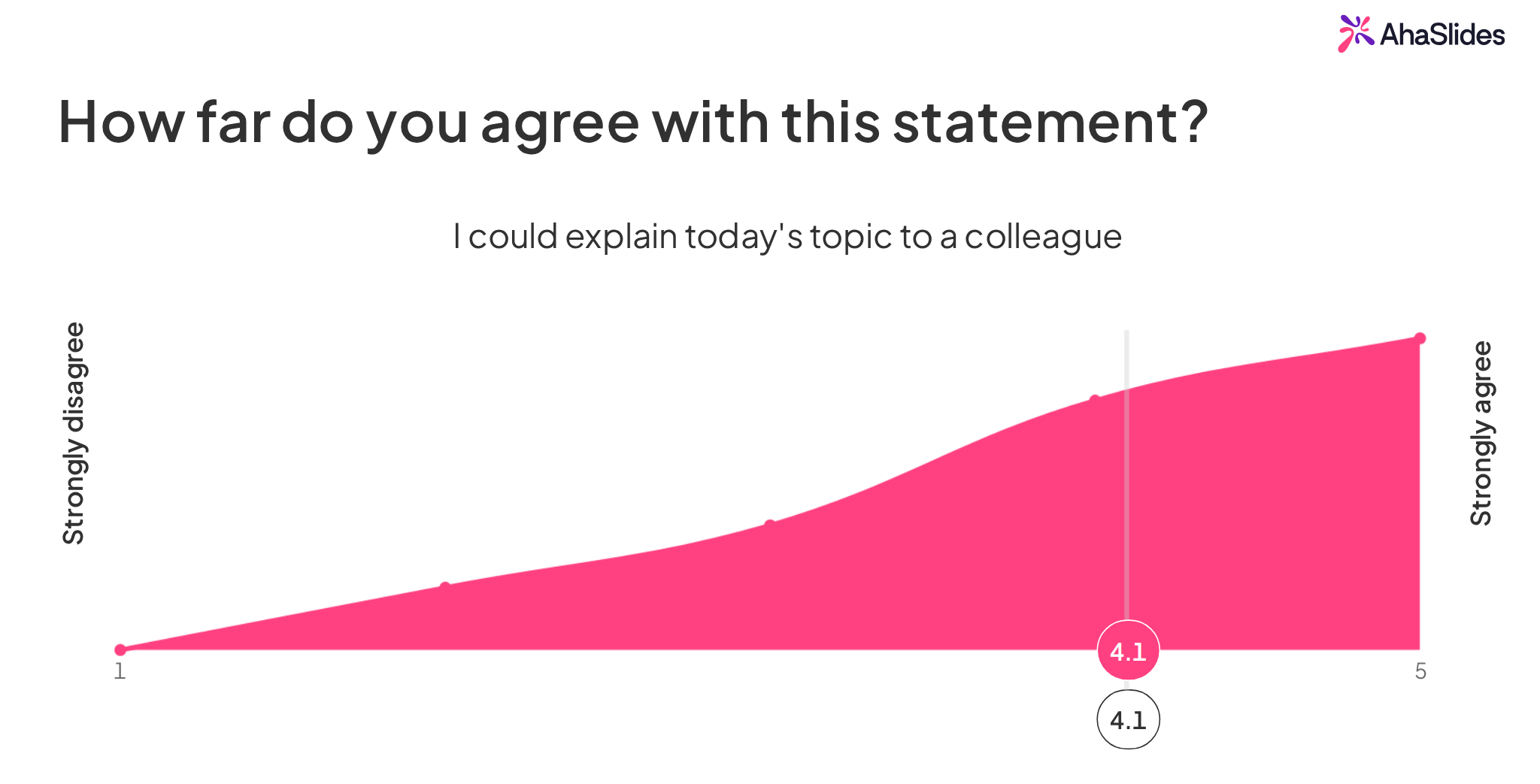
10Rating scale. I could explain today's topic to a colleague.
ResultNo wrong answer. Each option sits at a fixed point on one ordered scale, so you can compare groups and track change over time.
Use it whenYou are measuring attitudes or confidence. Label every point, and keep the direction the same across a whole survey.
Want more on the rating-scale type? See our Likert scale examples, and the Sullivan and Artino article on analysing Likert-type data. For quiz formats beyond multiple choice, see our guide to types of quiz and these true or false questions.
How to write a good multiple choice question
These six rules come from university teaching guidance, and they apply to every type above.
- Write the stem as a complete question, and cut what it does not need. "What is the definition of psychoanalysis?" beats "Psychoanalysis is…". Move any words repeated in every option into the stem (Johns Hopkins University).
- Make one answer correct and the distractors believable. If the wrong options are silly, such as a cartoon character in a history question, people guess without knowing anything (Johns Hopkins University).
- Keep options parallel and in a logical order. Match grammar and length, and sort numbers or dates so the order gives nothing away (Johns Hopkins University).
- Avoid "all of the above" and "none of the above". They let people reach the answer with partial knowledge (Johns Hopkins University).
- Use three or four options. A meta-analysis of 80 years of research found three options generally optimal (Rodriguez, 2005), while the Johns Hopkins guide recommends at least four. Either is fine; padding to five rarely helps.
- Highlight any negative. If you must use NOT or EXCEPT, make it obvious so people do not misread the question (Johns Hopkins University).
One more caution. Results can be affected by things unrelated to the subject, such as reading ability and the use of context clues (Johns Hopkins University), so keep the wording plain and the stems short.
Run multiple choice questions live with AhaSlides
With a free quiz maker, people answer on their phones and the results update on screen. Here are three of the types above, captured from a real session with 12 players.
Scenario and single best answer questions suit a Pick Answer quiz slide. The correct option is marked once the question closes, so you can discuss why the wrong ones were tempting.
Opinion polls use a Poll slide. There is no correct answer, so the chart is the result.
Rating scales use a Scale slide, which shows the average as well as the spread of answers.
Prefer to start from a ready-made set? The template library has quizzes and feedback surveys you can copy and edit.
Frequently asked questions
What are the main types of multiple choice questions?
The 10 types in this guide are direct question, sentence completion, negative stem, single best answer, multiple response, true or false, scenario, data or image, opinion poll and rating scale.
How many options should a multiple choice question have?
Three or four. A meta-analysis of 80 years of research found three options generally optimal (Rodriguez, 2005), and a Johns Hopkins guide recommends at least four (Brusini).
What is a distractor?
A distractor is an incorrect option. Good ones are plausible to someone with partial knowledge, so guessing does not work (Johns Hopkins University).
Can multiple choice questions test more than recall?
Yes. Written well, they can assess analysis, evaluation and critical thinking, but they cannot measure a person's ability to organise and express ideas (Johns Hopkins University). Scenario and data questions are the usual route.
Sources
- Brusini, A. Writing effective multiple choice questions. The Innovative Instructor, Best Practice vol. 17, Johns Hopkins University (2018)
- Rodriguez, M. C. Three options are optimal for multiple-choice items: a meta-analysis of 80 years of research. Educational Measurement: Issues and Practice 24(2), 2005
- Sullivan, G. M. and Artino, A. R. Analyzing and interpreting data from Likert-type scales. Journal of Graduate Medical Education 5(4), 2013