


You finished the lesson with five minutes to spare. The room starts to buzz, and you need something fast. Quick games to play in the classroom are exactly the safety net teachers need: low prep, high engagement, and genuinely useful for reinforcing what students just learned.
Here are four categories of classroom games that work for almost any grade level.
Vocabulary games
Language sticks better when students are competing to use it. These vocabulary games need no materials and take under a minute to explain:
- What am I? Students describe a word or object using only adjectives and verbs. Classmates guess. Great for building descriptive vocabulary.
- Word scramble: Write a scrambled word on the board linked to the lesson topic. Students race to unscramble it. You can also show a picture and ask students to form the word from given letters.
- ABC game: Call out a topic such as animals, food, or countries, and teams must name items for each letter of the alphabet in order. First team to reach Z wins.
- Hangman: A classroom classic. Pick a vocabulary word from the current unit, draw the gallows, and let students guess letters one by one.
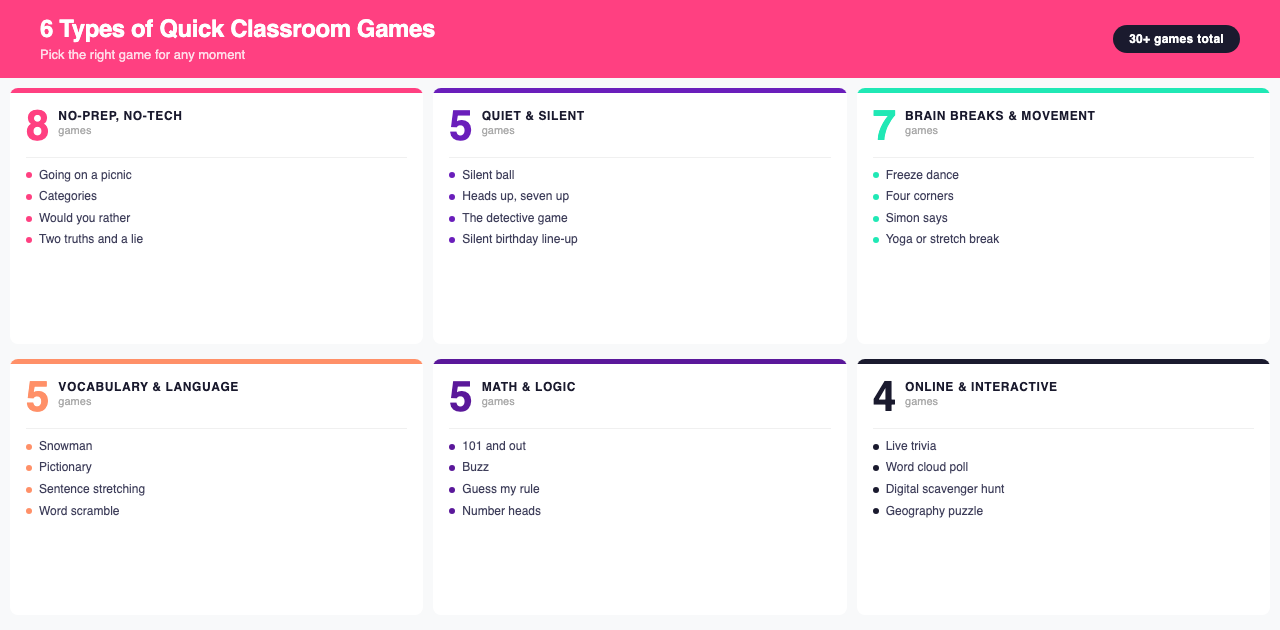
Math games
Math games work especially well as warm-ups or cool-downs. They build number fluency without feeling like extra homework:
- Sorting game: Students pick up classroom objects and sort them by color, size, or shape. First group to correctly sort 20 items wins. Builds number sense and categorization skills.
- Fraction action: Students answer fraction questions correctly to collect cards. The student with the most cards at the end wins. The card-collecting format gives students a concrete goal beyond just getting the right answer.
- Addition and subtraction bingo: Give out bingo cards filled with answers, then call out equations instead of numbers. Students must calculate the result and mark the matching answer.
- 101 and out: Teams take turns rolling a die and adding the number to their running total. The goal is to get as close to 101 as possible without going over. Simple, fast, and surprisingly tense.

Online classroom games
Online platforms have made it easy to run interactive games in minutes. Students join with a code on their phones, no app download needed.
- Digital scavenger hunt: Ask students to find a specific item at home or look up a specific piece of information online. First to find it and share it wins.
- Virtual trivia: Run a quick trivia round tied to the lesson topic. Competitive formats keep students more alert than a passive review session.
- Geography puzzle: Free interactive map sites let students complete labeled world maps as a timed challenge. Works well as a five-minute filler for history or geography classes.
- Pictionary online: Teams take turns drawing a word or phrase while teammates guess. Use the Zoom whiteboard or a free Pictionary generator to run this during virtual lessons.
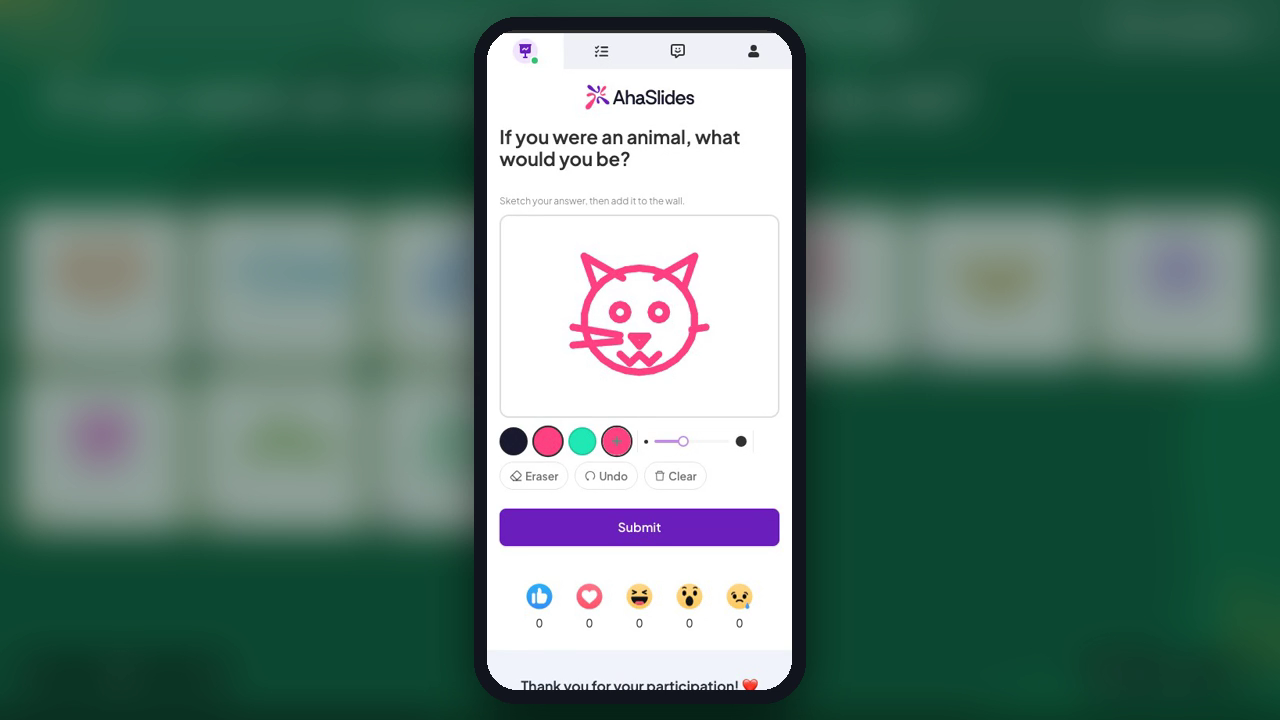
- Draw the answer: Post one prompt and have the whole class sketch a response on their phones at the same time. Every drawing lands together on your screen, so nobody sits and watches. Good for a fast vocabulary check or an end-of-lesson mood read.
Running the sketch round: Add a Draw Answer slide in AhaSlides and type your prompt as the question. Students join with the room code and get a blank canvas with pen colors, a brush-size slider, an eraser, and undo. When they hit Submit, the drawing locks and appears on your screen labeled with their name. There is no scoring and no leaderboard on this slide type, so it stays a warm-up rather than a test. Prompts that work: draw the water cycle, draw the main character's mood at the end of chapter four, draw how you feel about tomorrow's quiz. Give a hard 60-second limit, because rough sketches read better on the board than careful ones.
Physical games
Getting students out of their seats for even three minutes resets their focus. These physical games need zero materials:
- Duck, duck, goose: A student walks around the circle, tapping heads and saying "duck." When they say "goose," the tagged student jumps up and chases them around the circle.
- Musical chairs: Play music while students walk around a ring of chairs. When the music stops, everyone finds a seat. One chair fewer each round.
- Red light, green light: Students move when you say "green light" and freeze on "red light." Anyone who moves after a red light is out.
- Freeze dance: Play a short burst of music and let students dance freely. When the music cuts, they freeze. Great for younger grades to burn off energy between focused tasks.
Run classroom games with AhaSlides
AhaSlides lets you launch a live quiz, word scramble, or trivia round in under a minute. Students join from any device with a room code, results appear in real time, and you can see instantly who understood the lesson and who needs a follow-up. The free plan includes ready-made templates so there is nothing to build from scratch.