
The science of distraction: what 1,048 presenters told us about attention

We asked US presenters how distracted their audiences are, then set their answers against the research on attention. Here is every finding, with its source.

Download the white paper

Free PDF, 38 pages. No form to fill in.
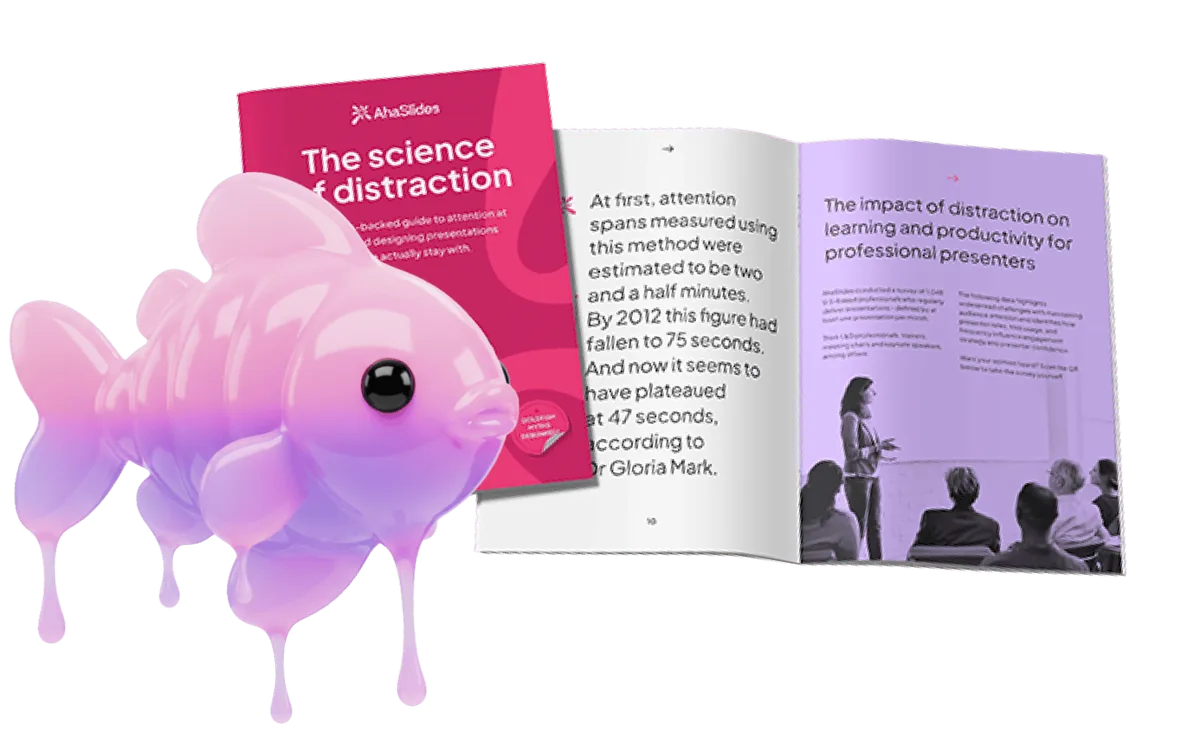
The science of distraction white paper, open at Dr Gloria Mark's 47-second finding, next to a pink goldfish

About this research

AhaSlides commissioned the research firm Centiment to survey 1,048 US-based professionals who present at least once a month in 2025: trainers, L&D professionals, meeting chairs, keynote speakers and others. Every answer is self-reported, so the figures show what presenters notice and believe, not measured attention or learning. It is a survey of presenters, not a learning and development study, and it does not show that interactive tools improve learning.

Download the white paper

What 1,048 presenters told us

  • 82.4%

    of presenters say their audiences are regularly distracted

  • 88%

    believe attention spans are getting shorter

  • 63.3%

    say shorter attention spans hurt learning outcomes

  • 1.7%

    do nothing when attention drops

Download the white paper

The survey findings in full

What the 1,048 US presenters reported in 2025. Each figure is a share of all respondents unless it says otherwise.

  • Most audiences drift

    82.4% of presenters say their audiences are regularly distracted, most often by multitasking (48.3%) or digital devices (43.9%).

  • Tired screens and passive sessions

    Screen fatigue (41.9%) and a lack of interactivity (41.7%) follow close behind as the reasons presenters give.

  • Attention feels shorter than it used to

    88% believe attention spans are getting shorter: 43.2% say significantly and 44.8% slightly. 7.3% see no change and 3.4% see improvement.

  • Notifications get most of the blame

    Presenters blame social media and constant notifications (64%) and information overload (61.5%), then cognitive fatigue or burnout (49.8%).

  • Meetings and design play a part

    Too many meetings or sessions (36.3%), changing work or education settings (25.8%) and poor presentation design (20.1%) are named too.

  • Lost attention has a cost

    69.8% say shorter attention spans hurt productivity, 66.1% say people retain less and 63.3% see weaker learning outcomes.

  • Presenters feel it too

    A third of presenters (33.3%) say shorter attention spans affect how satisfied they feel in their own job.

  • Almost every presenter fights back

    Only 1.7% do nothing when attention drops. 62.3% use humour or storytelling and 58.0% group discussions or breakout sessions.

  • Movement, slides and games

    51.5% add movement, 48.3% use interactive slides, 46% mix content formats and 19.8% use gamification.

Download the white paper

Interactive tools: what the answers show

These are links in the survey answers, not proof that the tools cause anything.

  • Who uses them

    Within each group, 81.4% of higher educators, 70.2% of corporate trainers, 64% of general presenters and 59.6% of middle managers use interactive tools.

  • More distraction, more tools

    Presenters who see more distraction in their audiences are more likely to use interactive tools.

  • Users feel more confident

    Users report more confidence than non-users (45.1% against 33.3%). Non-users are slightly more likely to use no engagement method (3.1% against 0%).

Download the white paper

When presentations invite people to take part, most do

In AhaSlides platform data from September 2025, 80.9% of audience members answered at least one interactive slide on average, and 44.6% answered every interactive slide. This is usage data from presentations run on AhaSlides, not a controlled study: it shows how many people join in when asked, not how much they learn.

Download the white paper

How long can people stay focused?

The published research the white paper draws on, each finding with its source. Numbers in brackets match the references further down this page.

  • The 8-second goldfish is a myth

    The claim that attention fell to 8 seconds, below a goldfish's 9, is credited to a 2015 Microsoft Canada study [4].

  • The BBC could not trace it

    The BBC found it was not from that study. Fish expert Felicity Huntingford said there is no evidence goldfish have short attention spans [5] [6].

  • About 47 seconds on one screen task

    Dr Gloria Mark (UC Irvine) measures time on one screen task: about 2.5 minutes in 2004, 75 seconds by 2012, now about 47 [7].

  • Switching leaves attention behind

    Dr Sophie Leroy calls it attention residue: after a switch, part of your attention stays on the last task [8].

  • Switching costs output

    Psychologist David Meyer found switching between tasks can cut productivity by as much as 40% [9].

  • We check our phones more than we think

    People estimate they check their phones 40 times a day; the real figure is closer to 99, according to Solitaired [10].

  • Dopamine is about wanting

    Kent Berridge and Terry Robinson showed dopamine drives wanting a reward, seeking it and expecting it, more than enjoying it [11].

  • Unpredictable rewards pull hardest

    Nir Eyal argues the pull is strongest when the reward is unpredictable, like the next like or comment, which builds a habit [12].

  • Jumping between screens is normal

    King's College London found 42% of UK people call themselves positive multi-screeners [13], and 62% of 18 to 34-year-olds can't stop checking phones [14].

Download the white paper

What research says helps people stay with you

Most of these studies look at students, memory or the brain in general, not workplace training, so read them as pointers rather than proof.

  • Emotion helps memories stick

    LeDoux and McGaugh found emotional moments drive amygdala activity and release adrenaline and cortisol, which helps people remember them [17].

  • Surprise pulls attention back

    Marsel Mesulam found the brain's parietal cortex is especially sensitive to new or unusual things [18].

  • People remember what they produce

    Slamecka and Graf's 1978 generation effect: people remember information better when they produce it themselves than when they only read it [19].

  • Producing an answer engages the brain

    Some researchers link active generation, producing an answer yourself, to activity in the prefrontal cortex [21].

  • Active learning beat lectures

    Freeman's 2014 review of 225 studies of university STEM courses found students did better with active learning than lectures [20]. Students, not workers.

  • Engaging talks bring listeners into step

    Brain imaging shows more compelling speeches activate shared language and social networks across listeners, supporting shared understanding as well as attention [27].

  • Emotions spread

    Research on mirror neurons suggests emotions are contagious, so a calm, prepared presenter helps settle a room [26].

  • Design for every brain

    In a 2024 YouGov poll, 19% of Americans identify as neurodivergent, which the white paper rounds to one in five [23].

  • Most people struggle in meetings

    Polls by the QEII Centre and Udemy found up to 80% of people struggle with attention and focus in meetings [24] [25].

Download the white paper

References

The 27 sources cited in the white paper, numbered as in the paper. References 15 and 16 are AhaSlides' own data, explained under About this research.

Download the white paper

Questions about attention in training and presentations

There is no single number, because focus depends on the task and the setting. The most quoted figure, an 8-second attention span, is a myth: the BBC could not trace it to the Microsoft study it is credited to. The best measured figure comes from Dr Gloria Mark at UC Irvine, who found people stay on one screen task for about 47 seconds before switching. That measures screen work, not a live session, but it shows how quickly attention moves on when nothing gives it a reason to stay.

In AhaSlides' 2025 survey of 1,048 US presenters, 82.4% said their audiences are regularly distracted, most often by multitasking (48.3%) and digital devices (43.9%). Separate polls by the QEII Centre and Udemy found up to 80% of people struggle with attention and focus in meetings. All of these are self-reported, so they show how common distraction feels rather than measure it.

The white paper's sources point to a few habits. Use emotion and stories, because emotional moments are remembered better. Add surprise, which the brain notices. Keep the message simple. Get people doing, not only listening: people remember what they produce themselves. Education technologist Dr Graeme Salter suggests a change of state, such as a story, a poll or a quiz, about every ten minutes; that interval is his advice from practice, not a tested rule. Most of this evidence comes from students and lab studies, not adult training.

AhaSlides commissioned the research firm Centiment to survey 1,048 US-based professionals who present at least once a month in 2025, including trainers, L&D professionals, meeting chairs and keynote speakers. The answers are self-reported. It is a survey of presenters' views, not a study of learning.

No. The survey records what presenters report, and AhaSlides platform data shows how many people take part when asked; neither measures learning. The strongest outside evidence for active learning, the 2014 review of 225 studies of STEM courses, is about university students, not workplace training.

Download The science of distraction (PDF, 38 pages). AhaSlides published it on 5 February 2026, and it is free with no form to fill in.