Round 1
Easter basics
Three pick-the-answer questions on why Easter moves, where the bunny comes from and what eggs mean.
- Pick answer


Ten questions on Easter traditions, symbols and history in three short rounds: pick the answer, type a short answer, then order items or sort them into groups. Suits all ages, and a spinner wheel closes the deck.
Three pick-the-answer questions on why Easter moves, where the bunny comes from and what eggs mean.
Three short typed answers about the Easter Bunny's first gift, a Good Friday food and a famous island.
Put Easter events and steps in order, sort symbols and foods into groups, then finish with a spinner wheel.
Every question, grouped by round. Answers stay hidden until you tap.
Why does Easter fall on a different date each year?
It's determined by the first full moon after the spring equinox
Fun fact: The church treats the equinox as fixed on 21 March, and the full moon it uses comes from tables rather than observation. In the Western calendar Easter therefore always lands between 22 March and 25 April.
Where did the Easter Bunny tradition originate?
Germany
Fun fact: The German Osterhase (Easter hare) is first attested in a Latin dissertation from the late 1600s. In some regions foxes, cranes or storks were said to bring the eggs instead.
What do Easter eggs symbolise?
The rebirth of nature and life
Fun fact: Decorated eggshells are very old: engraved ostrich eggs found in Africa are about 60,000 years old. For Christians the egg also came to stand for the empty tomb and the resurrection.
What did the Easter Bunny originally bring to children?
Eggs
Also accepted: Egg, Coloured eggs, Colored eggs
Fun fact: In the early German tales the Easter Hare judged whether children had been good or disobedient. Candy and toys joined the coloured eggs later.
What food, marked with a cross, is traditionally eaten on Good Friday?
Hot cross buns
Also accepted: Hot cross bun, Cross buns, Cross bun
Fun fact: The earliest definite record of hot cross buns is a London street cry from 1733. A St Albans story dates them to 1361, but that account is a later report.
Which explorer discovered Easter Island on Easter Sunday?
Jacob Roggeveen
Also accepted: Roggeveen
Fun fact: Roggeveen was the first recorded European visitor, on 5 April 1722, and named the island after the day. Polynesian settlers had lived there since around 1200 CE.
Order the Easter traditions from oldest to newest:
Fun fact: Fry's of Bristol made the first hollow chocolate Easter egg in 1873, and Cadbury followed with its first egg in 1875.
Arrange the process for determining Easter’s date in order:
Fun fact: This is the simplified rule. The church fixes the equinox at 21 March and uses a calculated full moon, so Easter can differ from a purely astronomical reckoning.
Sort the following into "Easter Symbols" and "Not Easter Symbols"
Fun fact: The Easter lily is described as a symbol of the resurrection in Western Christianity, while the jack-o'-lantern belongs to Halloween and the tree to Christmas.
Sort the following into "Traditional Easter Foods" and "Not Associated with Easter":
Fun fact: Lamb is linked to Easter partly because spring lambing roughly coincides with the holiday. Pumpkin pie is usually made for Thanksgiving and Christmas.
Who will share with us...
Press View and claim to open the slides, then make your own copy.
Add team names, a prize and any questions of your own.
Start the quiz on your big screen or share your screen.
Players join on their phones and play live.
About 10 minutes for all 11 questions.
Yes. This quiz is written for all ages.
Yes. Share your screen on Zoom or Teams and put the join code in the chat. Everyone answers on their own device.
Yes. Once you have your own copy, every question is yours to edit.
More for Easter.
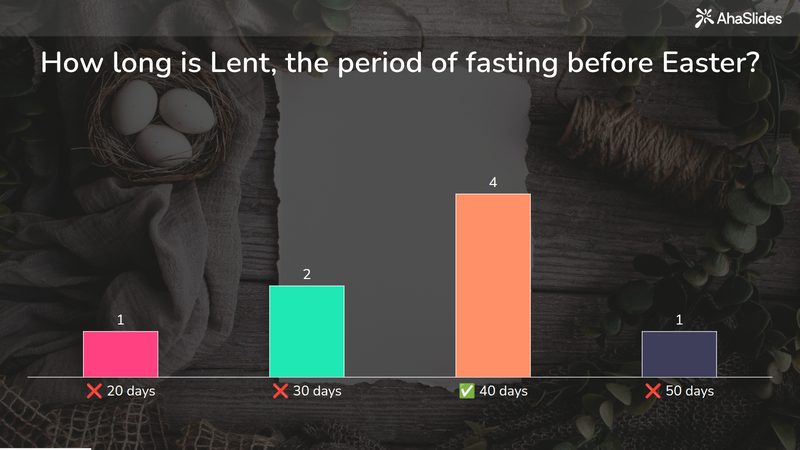
General knowledge, global traditions and fun facts about Easter, with a leaderboard.