Round 1
The zodiac
Five questions on the twelve animals, the elements and the year order.
- Pick answer
- Short answer
- Put in order


Twenty questions across four rounds on the zodiac, new year traditions, food and legends. Mixes pick-answer questions with a match-up and a put-in-order round.
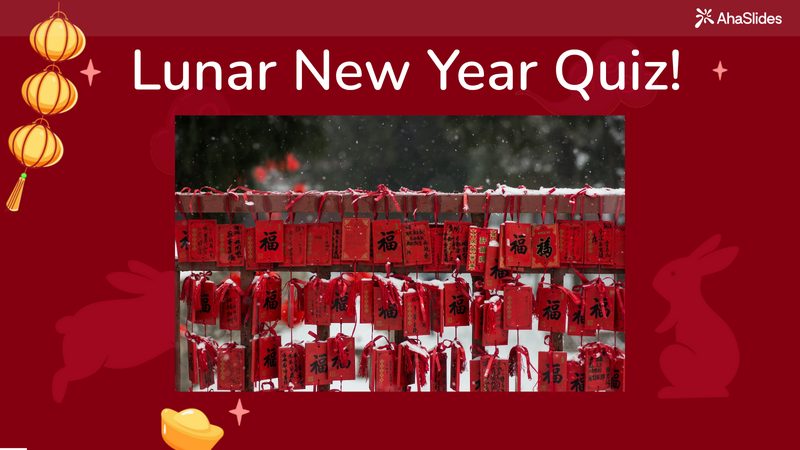
Five questions on the twelve animals, the elements and the year order.
Five questions on cleaning, red envelopes, names and the festival's 15 days.
Five dishes to place on the map.
Five questions on the Jade Emperor, Nian and the Kitchen God.
Every question, grouped by round. Answers stay hidden until you tap.
Which 3 are NOT animals of the Chinese zodiac?
Fun fact: The twelve zodiac animals are the rat, ox, tiger, rabbit, dragon, snake, horse, goat, monkey, rooster, dog and pig.
The lunar year starting January 2025 is the year of the what?
Snake
Fun fact: Lunar New Year fell on 29 January 2025, starting the Year of the Snake. 2026 is the Year of the Horse.
The 5 elements of the Chinese zodiac are water, wood, earth, fire and... what?
Metal
Fun fact: The five elements, or Wu Xing, are wood, fire, earth, metal and water. Each year pairs an animal with an element on a 60-year cycle.
In some cultures, what zodiac animal replaces the goat?
Sheep
Fun fact: The Chinese character for this sign can mean goat, sheep or ram, so some cultures call the year the Year of the Sheep.
If 2025 is the Year of the Snake, what is the order of these 4 years?
Fun fact: After the Snake come the Horse (2026), Goat (2027), Monkey (2028) and Rooster (2029).
In most countries, it is traditional to remove bad luck before Lunar New Year by doing what?
Sweeping the house
Fun fact: Families clean the house before the new year to sweep out bad luck. Sweeping on New Year's Day itself is avoided, so good luck is not swept out.
Which of these coloured envelopes would you expect to see at Lunar New Year?
The red envelope with the gold 福 character
Fun fact: Red envelopes (hongbao) hold gift money and are given to children and unmarried younger relatives. Red stands for good luck.
Match the country to the name of its Lunar New Year.
Fun fact: Tsagaan Sar is Mongolia's White Moon festival, Tết is the Vietnamese new year and Seollal is the Korean one.
Lunar New Year in China typically lasts how many days?
15
Fun fact: Celebrations run for 15 days, from New Year's Day to the Lantern Festival.
The final day of the Lunar New Year in China is known as Shangyuan Festival, which is the festival of what?
Lanterns
Fun fact: Shangyuan is the Lantern Festival, held on the 15th day, when people hang and carry lanterns and eat sweet rice balls.
Which country or territory celebrates Lunar New Year with 'bánh chưng'?
Vietnam
Fun fact: Bánh chưng is a square sticky rice cake filled with pork and mung beans and wrapped in leaves, made for Tết.
Which country or territory celebrates Lunar New Year with 'tteokguk'?
South Korea
Fun fact: Tteokguk is a rice cake soup eaten on Seollal, and eating it is said to add a year to your age.
Which country or territory celebrates Lunar New Year with 'ul boov'?
Mongolia
Fun fact: Ul boov are stacked biscuits displayed on a plate for Tsagaan Sar, with the layers built in an odd number.
Which country or territory celebrates Lunar New Year with 'guthuk'?
Tibet
Fun fact: Guthuk is a noodle and dumpling soup eaten on the eve of Losar, the Tibetan new year, with hidden fillings that are said to tell your fortune.
Which country or territory celebrates Lunar New Year with 'jiǎo zi'?
China
Fun fact: Jiaozi dumplings are eaten at Lunar New Year in northern China. Their shape resembles old gold ingots, so they stand for wealth.
The heavenly emperor who rules over Lunar New Year is named after which gemstone?
Jade
Fun fact: The Jade Emperor is the ruler of heaven in Chinese folk religion and the host of the zodiac race.
According to Chinese legend, how were the 12 zodiac animals first decided?
A race
Fun fact: In the legend the Jade Emperor held a river race and the animals were ranked by finishing order, with the rat first.
In China, which of these is used to scare off the legendary beast 'Nian' on the day of the new year?
Firecrackers
Fun fact: Nian is said to fear loud noise and the colour red, which is why firecrackers, red paper and drums are part of the new year.
It's traditional to leave 'zào táng' out in the house in order to appease which god?
Kitchen God
Fun fact: Sticky 'stove candy' is offered to the Kitchen God, Zao Jun, before he reports on the family to the Jade Emperor, so his words will be sweet.
The 7th day of the Lunar New Year is 'ren ri' (人日). Legend says it's the birthday of which creature?
Humans
Fun fact: Ren ri means 'human day', and legend has the goddess Nüwa creating humans on the seventh day.
Press View and claim to open the slides, then make your own copy.
Add team names, a prize and any questions of your own.
Start the quiz on your big screen or share your screen.
Players join on their phones and play live.
About 20 minutes for all 20 questions.
This quiz is written for adults and teens. For younger players, pick one of the family quizzes for this holiday.
Yes. Share your screen on Zoom or Teams and put the join code in the chat. Everyone answers on their own device.
Yes. Once you have your own copy, every question is yours to edit.
More for Lunar New Year.
A Lunar New Year team session with six open prompts (favourite things, games, food, decorations, challenges) and four quiz questions on the zodiac, Seollal and festive food. Suits a workplace or class; mostly discussion.
A back-to-work discussion template: seven open prompts (wishes, holiday stories, childhood games, favourite foods) plus five short Lunar New Year questions on customs and the zodiac. Mostly conversation, not a scored quiz.
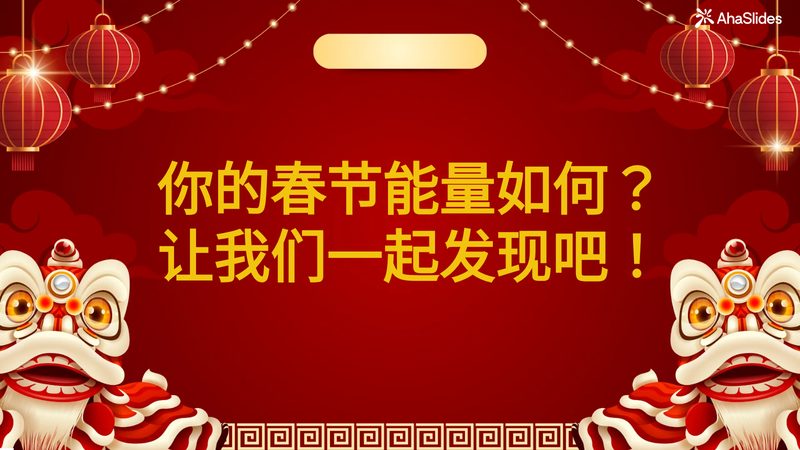
Eight multiple-choice questions on Lunar New Year customs: New Year's Eve, the zodiac, fish, red decorations, firecrackers and the Lantern Festival. The template is in Chinese, mostly in Simplified characters, and suits a Chinese-reading group.