



The first five minutes of a meeting set the tone for everything that follows. Most of the time, that tone is: passive, slightly awkward, and waiting for someone else to go first.
Icebreaker games change that. Not because they're fun, though the good ones are, but because they do something specific: they get people talking before the high-stakes part of the meeting begins. A group that has already contributed once is far more likely to contribute again.
This guide covers 17 activities for in-person, hybrid, and remote teams, from quick 2-minute warm-ups to structured games that run 15-20 minutes. Where research exists on why specific formats work, it's cited.
Top 17 icebreaker games for work
1. Spin the wheel
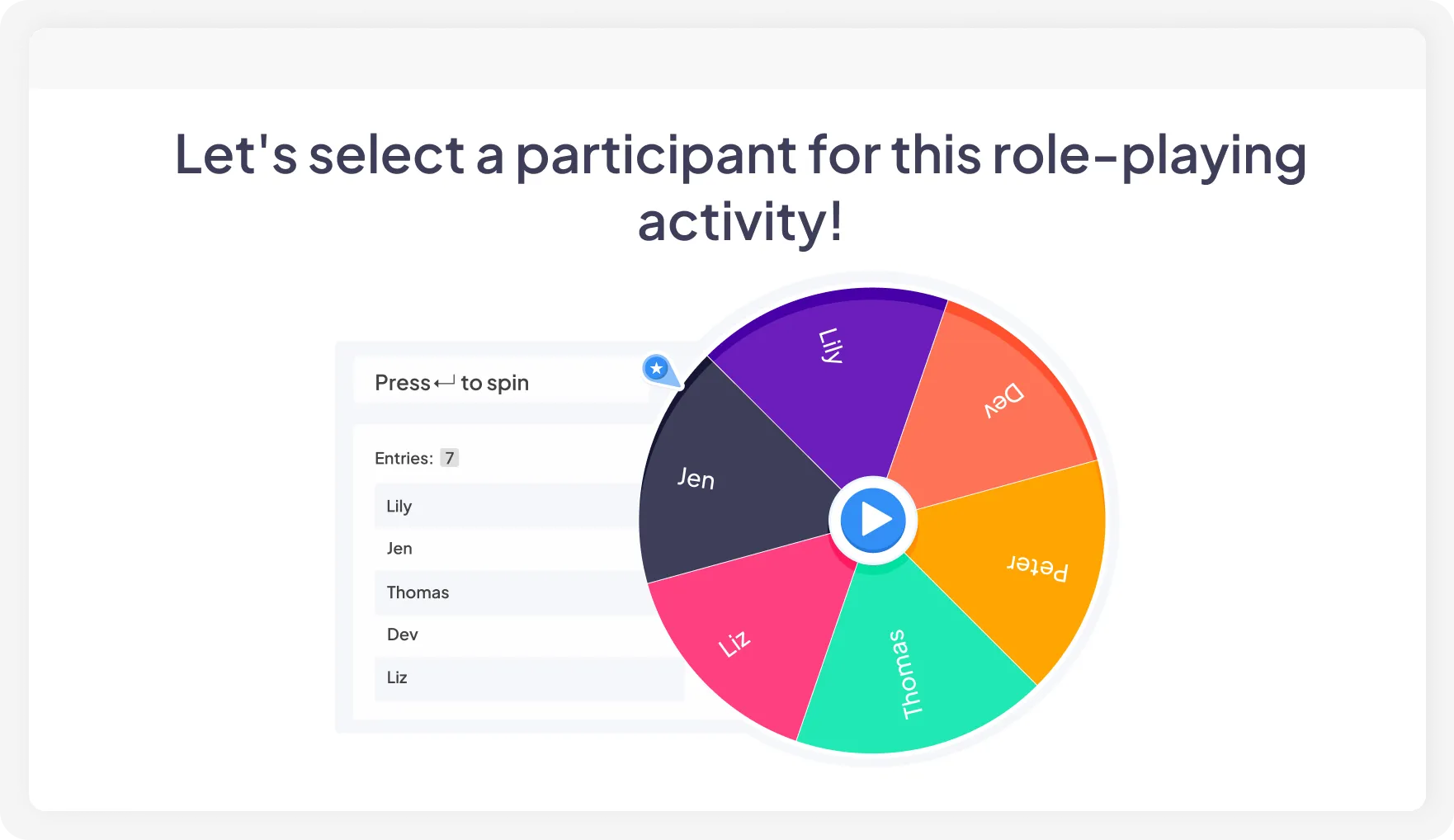
Add questions or dares to a spinner and assign one to each team member at random. The suspense of watching the wheel land is itself an engagement mechanism, and the randomness feels fair in a way that going "around the room" never does.
Keep the questions workplace-appropriate but personal enough to be interesting: favorite travel destination, worst job they ever had, one skill nobody on the team knows they have.
On AhaSlides, you can add up to 5,000 entries to a spinner and share your screen during a Zoom or Teams call. Participants can also enter their own names, which works well for randomly assigning teams or choosing who presents first.
2. Mood GIFs
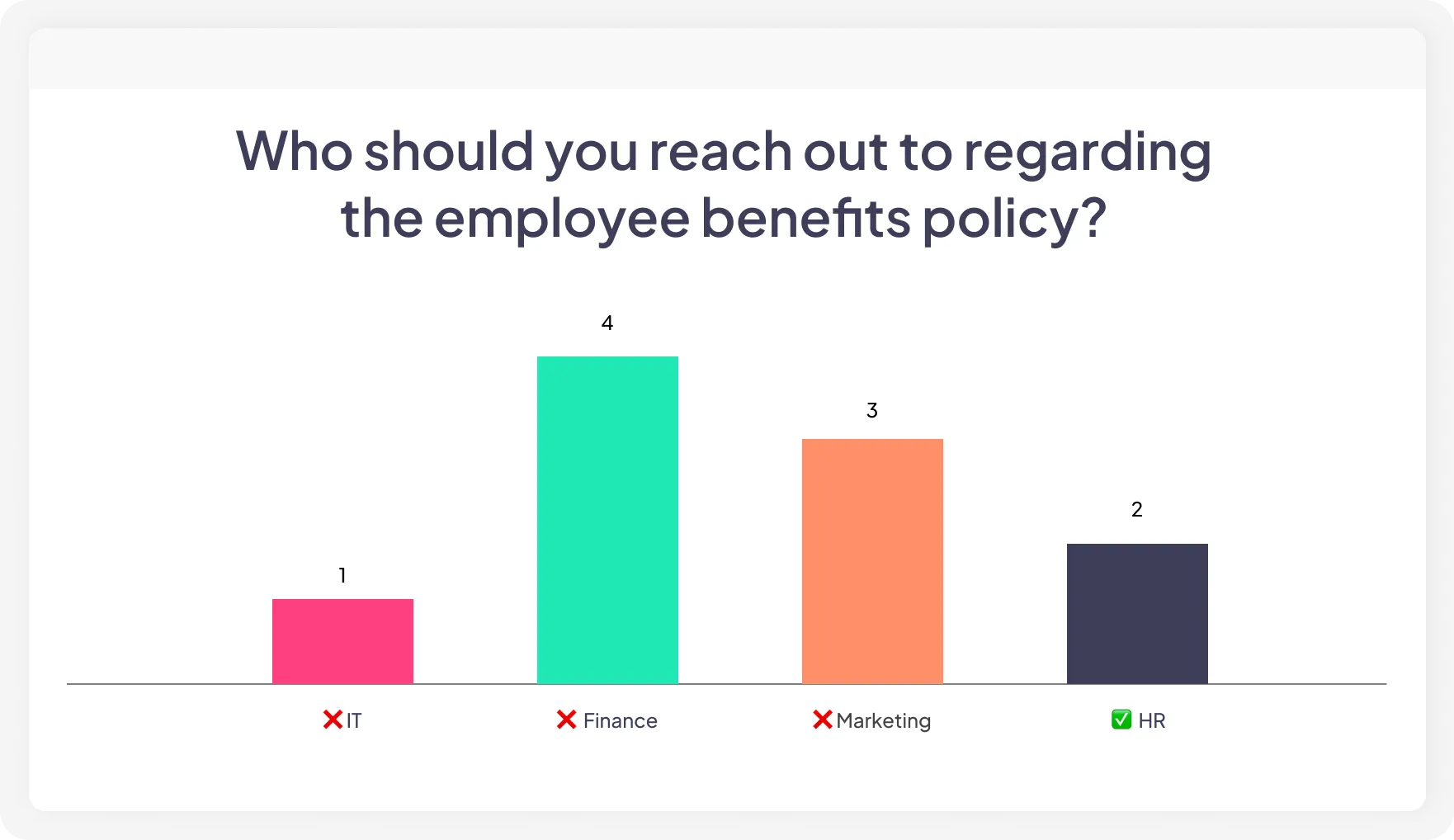
Show 6-10 GIFs or images and ask participants to vote on the one that best matches how they're feeling right now. Results appear as a chart, so the whole room can see the spread in seconds.
This works because it's low-stakes, visual, and mildly absurd. A collapsed pavlova and Arnold Schwarzenegger sipping tea communicate more about someone's Monday than "I'm fine, thanks." It also gives facilitators a quick read on energy levels before the session proper begins.
On AhaSlides, use the image choice slide type. Add GIFs from the built-in library, uncheck "this question has correct answers," and you're set.
3. Hello, from...
Ask everyone to name where they grew up or currently live, then display the answers as a word cloud. Places mentioned by multiple people appear larger, which often surfaces unexpected connections: two colleagues from the same mid-size city who've never spoken, for example.
It's one of the simpler icebreaker games on this list, but it gives every person a moment to be known beyond their job title.

4. What will you do to pay attention today?
Ask the room, openly and without judgment, what they're planning to do to stay engaged during the meeting. Answers can be funny ("pace around my apartment"), practical ("put my phone face down"), or honest ("drink a third coffee and hope for the best").
The question itself signals that you as the facilitator are aware the meeting could lose people, and that you're treating participants like adults. That tends to land well.
Use an open-ended slide and, if your group is new to each other, enable anonymous submission. You can set a one-minute time limit to keep things moving.
5. Share an embarrassing story
Each person submits one embarrassing story anonymously. You reveal them one at a time and the group reacts.
This one has research behind it. A 2017 study by Leigh Thompson (Kellogg School of Management) and collaborators at Harvard and Cornell found that teams who opened a brainstorming session by sharing embarrassing stories generated 26% more ideas across 15% more categories than teams who shared proud stories instead [1]. The mechanism is self-disclosure lowering self-censorship: when people have already said something embarrassing, they're less worried about being judged for a half-formed idea.
On AhaSlides, use an open-ended slide, remove the name field, hide answers until they're all in, then reveal them one by one. The 500-character limit keeps it from turning into a monologue.
6. Desert island inventory
Ask each team member: "You're stranded on a desert island. Name one thing you'd bring." They submit their answers, then vote anonymously for their favorite.
From solar-powered satellite phone to an entire library to a hammock, the range of answers tells you a lot about how people think. It also gets brains into a creative, hypothetical mode before any actual problem-solving begins.
Use a brainstorming slide on AhaSlides: submission round, then voting round, then reveal the winner.
7. Trivia showdown
A live quiz is one of the most reliable ways to get a room engaged fast. Everyone has a stake, the pace is quick, and the leaderboard creates energy that's hard to manufacture any other way.
Keep it short: 5-8 questions works better than 20 for a pre-meeting warm-up. Mix categories so it's not a geography specialist's clean sweep. Team mode turns individual competition into collaboration, which changes the dynamic entirely.
AhaSlides supports multiple quiz formats: multiple choice, type-the-answer, match pairs, correct order, and sound clips. Team mode, a lobby chat, and a live leaderboard are all available.
A few newer AhaSlides formats give the same warm-up a different feel:
- Duck Race is a playful random picker: a line of cartoon ducks races across the screen and one crosses the line first, chosen at random. It is a fun, low-stakes way to break the ice, hand out a task, give away a small prize, or just pick a winner, and it is live in AhaSlides now. Use it to decide who shares first or takes the meeting notes without anyone having to volunteer; more creatively, run it at the end of a session to give away a reward and send people off on a laugh.
- True or False is a fast quiz where people swipe true or false on each statement. Use it for a quick "how well do you know the company" round of light statements; more creatively, as a rapid myth-busting round about your own team's history.
- Fill in the Blanks shows a sentence with missing words that people either free-type or choose from a drop-down. Use it to complete a well-known quote or a line from the company handbook; more creatively, have the team finish inside-joke sentences about a recent project.
- YouTube Quiz is a newer format, still in development: paste a YouTube URL and AI drafts quiz questions from the video. Use it for a quick check on a clip the team was asked to watch; more creatively, turn a viral video everyone has seen into an instant team challenge.
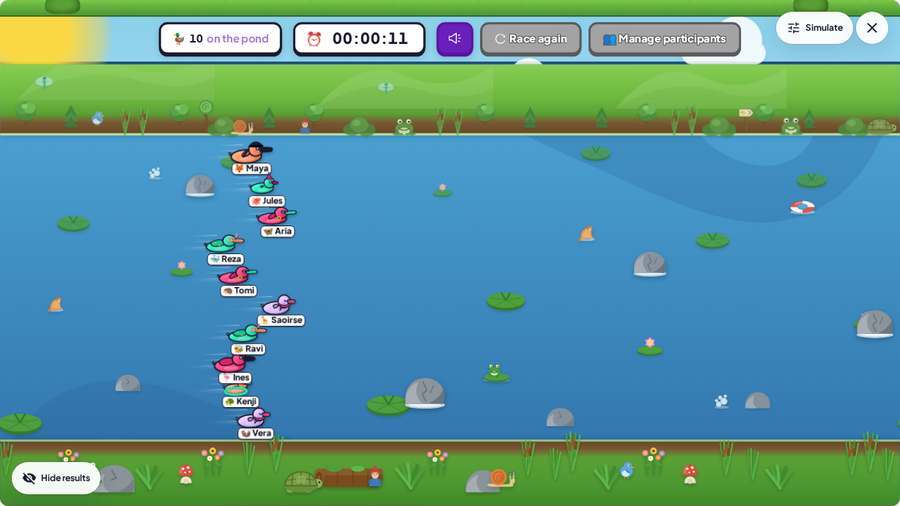
Beyond the quiz family, AhaSlides ships 30+ interactive slide types and adds new ones roughly every month. The range spans standard formats - Pick Answer (multiple-choice quiz), Categorise, Match Pairs, Correct Order, Type Answer, Word Cloud, Open Ended, Q&A, Rating Scale, Spinner Wheel, Brainstorm and Idea Board - alongside newer ones like True or False, This or That, Fill in the Blanks, Draw Answer, 2x2 Matrix, Split the Points, Duck Race and a YouTube-to-quiz tool, so almost any icebreaker on this list can run as a live, phone-based activity.
8. You nailed it
Ask the team to name one colleague who's done something worth recognizing recently. No specifics required. Just the name.
Collect answers in a word cloud. The names that appear largest are the ones most people mentioned. It takes two minutes and has an outsized effect on morale, particularly for people who do solid work that rarely gets called out publicly.
If you want broader coverage, ask for three names per person instead of one.
9. Pitch a movie
Give everyone five minutes to develop an original (and ideally ridiculous) movie concept. Each person pitches their idea to the group in 30-60 seconds. The group then votes on which one deserves funding.
This icebreaker builds the exact skills that matter in the meeting that follows: framing an idea quickly, presenting it clearly, and handling the reaction of the room. It also tends to surface people who are good at creative pitching but rarely get to show it in a standard meeting format.
Use a multiple-choice slide on AhaSlides to collect votes, with each movie title as an option. Hide results until voting closes.
10. Grill the gaffer
The facilitator or team lead sits in the hot seat. Anyone can ask any question, anonymously or not, and the lead has to answer honestly.
The premise is a role reversal. Most icebreaker games put the pressure on participants. This one puts it on the person who usually controls the agenda, which tends to level the room quickly. It's particularly effective with teams that are new to each other or where there's a significant seniority gap.
Use AhaSlides' Q&A slide. Turn on anonymous questions, set no limit on submissions, and answer live.
11. One-word icebreaker
Name a topic or ask a question, then give each person five seconds to respond with a single word. No full sentences, no second chances. Go fast and go around the whole group.
The time pressure is the point. There's no opportunity to polish an answer, so people say whatever came to mind first. That immediacy creates a different kind of honesty than deliberate responses produce.
Examples: "Describe this project in one word." "Name one vegetable." "One word for how you feel about Mondays."
12. Draw battle
Use your video call platform's whiteboard feature to run a collaborative drawing challenge. Assign each participant a different body part and give everyone the same brief: draw a cat eating an apple. Each person draws only their assigned part without seeing the others.
Reveal the combined drawing at the end. The results are reliably absurd and reliably funny, which is exactly the point.
This works entirely in-person or via Zoom, Microsoft Teams, or Miro's whiteboard.
AhaSlides' Draw Answer slide type runs the same idea natively: everyone sketches on their own phone and the drawings appear together on the shared screen within seconds. Use it as a quick "draw how your week is going" warm-up; more creatively, give the whole team the same absurd prompt (the cat eating an apple included) and vote on the funniest result.
13. Who is the liar?
A variation of Two Truths and a Lie, but structured as an elimination game. One person doesn't receive the topic given to the rest of the group, making them the "liar." Each person describes the topic in turn without being too direct. The liar has to bluff based on what they hear.
After each round, the group votes on who they think the liar is. If they guess wrong, the game continues. If they guess right, the liar is out. If two players remain and one is the liar, the liar wins.
Works best with groups of 6-10. Larger groups can run parallel games.
14. Five things in common
Split into groups of 3-4. Each group has 10 minutes to find five things everyone in their group shares, but work-related similarities don't count.
The restriction is what makes it work. "We're all in the marketing department" is easy. Finding that all four people grew up with a dog, hate the smell of gasoline, and have never eaten a mango takes actual conversation.
Use AhaSlides' open-ended slide with a countdown timer. Groups submit their five shared traits at the end. Reading the results aloud often triggers more connections.
15. The marshmallow challenge
Teams of 4-5 receive: 20 uncooked spaghetti sticks, 1 yard of masking tape, 1 yard of string, and one standard marshmallow. Goal: build the tallest free-standing structure with the marshmallow on top. Time: 18 minutes [2].
The rules matter: the marshmallow cannot be split, the structure cannot be leaned against anything, and no additional materials are allowed. Tallest standing structure when time is called wins.
Tom Wujec, who has run this challenge with thousands of teams, found that business school students consistently underperform kindergarteners. Kids start by placing the marshmallow on top early and iterating. Adults spend most of their time planning and run out of time to test [2]. That observation alone makes for a useful post-activity conversation.
This one requires in-person setup, but the debrief transfers well to hybrid sessions.
16. Never have I ever
One person makes a "never have I ever" statement about something they genuinely haven't done. Anyone who has done it holds up a finger or puts a thumb down, depending on how you're running it.
The game works in an office, on a video call, or in a hybrid setup where some people are remote. Keep the statements light and work-safe, and the session moves quickly. Five or six rounds is usually enough before it eats into meeting time.
We've used this at AhaSlides. The round that produced the most reaction: someone said "never have I ever been to a live concert" and more than half the room had to respond.
17. Simon says
One person is designated as Simon. They call out physical actions ("Simon says touch your nose"), and participants must only follow instructions prefaced by "Simon says." Anyone who follows an instruction given without that prefix is eliminated.
It's a classic for a reason. It works across all ages, needs no materials, and takes under five minutes. For in-person or hybrid sessions where some participants are on camera, it's an easy way to get people physically moving before a long meeting.
Why icebreaker games work
The case for icebreakers isn't just anecdotal, and it isn't just about making meetings feel warmer.
Google's Project Aristotle research found that psychological safety, the feeling that you can speak up without being judged, is the single most important factor in high-performing teams [3]. Icebreaker games build the conditions for that safety directly. They normalize participation before anything important is at stake. They make leaders human. They give quieter people a structured way to contribute before the conversation gets high-stakes.
The 2017 Kellogg/Harvard/Cornell embarrassing stories study points to a specific reason why this works: self-disclosure lowers self-censorship [1]. When someone has already said something personal or slightly awkward, they're less worried about being judged for a half-formed idea. That's the state you want people in before a brainstorm or a difficult discussion.
None of this requires a long warm-up. Five minutes of the right activity is enough to shift the energy in a room. That's a good trade.

When to use them
A few scenarios where icebreaker games pay off.
The most obvious is at the start of any meeting where you need people to actually participate. A group that has already spoken up once is more likely to speak up again. That dynamic compounds over the course of a session.
They're particularly valuable with new teams, where the default is deference to whoever is most senior. A well-run icebreaker creates a temporary horizontal structure where everyone has equal standing before the real agenda kicks in.
After a merger or restructure, two teams with different cultures need repeated low-stakes interactions before trust builds. Icebreakers at the start of shared meetings accelerate that process in a way that formal introductions rarely do.
They also work as a closing activity. Ending with something light gives people a reason to leave feeling like they spent time with colleagues rather than sitting through a calendar obligation.
Sources
[1] Thompson, L., Wilson, E.R., & Lucas, B.J. (2017). "Research: For Better Brainstorming, Tell an Embarrassing Story." Harvard Business Review. https://hbr.org/2017/10/research-for-better-brainstorming-tell-an-embarrassing-story
[2] Wujec, T. "The Marshmallow Challenge." https://www.tomwujec.com/marshmallow-challenge
[3] Duhigg, C. (February 25, 2016). "What Google learned from its quest to build the perfect team." The New York Times Magazine. https://www.nytimes.com/2016/02/28/magazine/what-google-learned-from-its-quest-to-build-the-perfect-team.html