



Most meeting invitations fail before anyone opens them. The subject line is vague, the purpose is missing, or the invite arrives the morning of the meeting itself. Recipients guess at what's expected of them, and some quietly decline or ignore it altogether.
This guide covers what actually goes into an effective meeting invitation email: the structure, the timing, the subject line, and the common mistakes that tank attendance before the meeting even starts.
Why most meeting invites underperform

A meeting invitation is doing more work than it looks like. It's asking someone to block time on their calendar, prepare for a conversation, and commit to being present. An invite that doesn't give them a reason to do all three will get deprioritized.
Research from scheduling tool providers consistently flags a few repeat problems: invites sent with less than 24 hours' notice leave attendees unprepared [1], subject lines that don't state the purpose reduce open and acceptance rates, and oversized guest lists dilute accountability — meetings with seven or more participants tend to have higher rates of passive attendance [1].
None of this is fixed with a better template alone. But a well-constructed invitation removes the friction points that cause people to decline, defer, or show up unprepared.
The six elements of a meeting invitation email
1. Subject line
The subject line determines whether the invite gets opened and accepted promptly. Keep it under 60 characters and make the meeting's purpose immediately clear. Personalized subject lines that reference the recipient's team, project, or role get meaningfully higher open rates than generic ones [2].
What works:
- "Q2 budget review — 30 min, Thursday 10am"
- "Feedback session: [Name]'s onboarding plan"
- "Project Phoenix kickoff — June 5, 2pm"
What doesn't:
- "Meeting"
- "Quick sync"
- "Following up"
Vague subject lines force the recipient to open the invite just to understand why they're being asked to attend. That extra step costs you.
2. Purpose statement
The first thing your email body should answer is: why does this meeting need to happen, and why does this person need to be there?
One or two sentences is enough. "We need to align on the Q3 campaign timeline before the agency brief goes out Friday" tells the recipient everything they need to know. It's specific, it has a deadline, and it implies that their input matters.
Compare that to "Let's catch up on the project" — which doesn't justify the time block at all.
3. Date, time, and location
Include the full date (not just "Thursday"), the time with time zone, and the location or video link. For recurring invites, confirm whether this is a one-time change or an ongoing schedule. If you're scheduling across time zones, mention the local times for both parties.
For hybrid or remote teams: always put the video link at the top of the details section, not buried at the end. It's the first thing a remote attendee will need.
4. Agenda
Sharing an agenda before the meeting is one of the highest-leverage things you can do. It lets attendees prepare, it sets expectations, and it gives you something to return to if the conversation drifts.
A practical agenda doesn't need to be elaborate. For a 30-minute meeting, three or four bullet points with estimated times are enough:
- Review updated project timeline (10 min)
- Identify blockers and owners (10 min)
- Confirm next steps and due dates (10 min)
If you need attendees to review a document or prepare something beforehand, say so explicitly. Don't assume they'll figure it out from context.
5. Attendee list
Include only the people who need to be there. If someone's attendance is optional, mark them as optional in the invite rather than leaving it implicit. Inviting everyone who might have an interest in the topic is a fast way to fill a room with people who feel they have no reason to contribute.
For larger meetings, a brief note on who's expected to speak or decide — versus who's there to observe — removes ambiguity and helps people calibrate how much preparation they need.
6. RSVP request
Ask people to respond. A simple line like "Please confirm by Wednesday so I can adjust the agenda if needed" creates a mild social obligation and gives you enough lead time to follow up with non-responders.
For meetings where attendance is genuinely required, follow up directly with anyone who hasn't accepted two days out [1]. Don't assume silence means acceptance.
Subject line examples by meeting type
Different meeting types call for different subject line approaches. Here are examples across common workplace scenarios:
Status updates
- "Weekly product sync — [date]"
- "Sprint review: [project name], Friday 3pm"
Decision meetings
- "Go/no-go decision: [initiative name] — needs your input"
- "Budget approval: final review before Friday deadline"
One-on-ones
- "1:1 check-in — [your name] + [their name], [date]"
- "Career conversation: [name], 30 min"
Training and workshops
- "Leadership workshop: session 2 of 4, [date]"
- "Onboarding: new hire orientation, [date], 9–11am"
Stakeholder briefings
- "[Project name] update for [stakeholder name/team]"
- "Quarterly review: [team name], [date]"
Timing your invitation
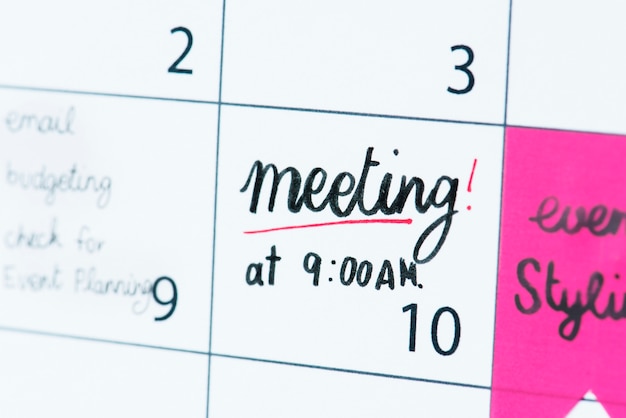
How far in advance you send the invite depends on what the meeting requires.
For routine internal meetings — weekly syncs, 1:1s, team standups — adding people to a recurring calendar event handles the scheduling work upfront. One-time invites for these should still go out at least a day ahead.
For anything that requires preparation — presentations, decision meetings, workshops, cross-functional reviews — send the invite at least a week in advance. This isn't just courtesy; it's practical. People need time to prepare materials, gather data, or loop in colleagues before they can contribute usefully.
For strategic or leadership-level meetings, two weeks is a safer window. Calendars at that level fill fast, and a last-minute invite is likely to get declined regardless of how well it's written.
Avoid scheduling important meetings on Monday mornings or Friday afternoons. Both time slots carry higher no-show rates in practice, and they put the meeting in a position where it will be rushed or deprioritized.
Email templates for common scenarios
Template 1: Standard team meeting
Subject: [Meeting purpose] — [date], [time]
Hi [name / team],
I'd like to schedule [X minutes] to [state the specific purpose].
Details:
- Date: [day, date]
- Time: [start time – end time, time zone]
- Location / link: [room name or video URL]
Agenda:
1. [Topic 1] — [X min]
2. [Topic 2] — [X min]
3. [Topic 3] — [X min]
[Any pre-read or preparation required — be specific.]
Please confirm by [date] so I can adjust if needed. Let me know if you have any questions beforehand.
[Your name]
Template 2: Decision-required meeting
Subject: Decision needed: [topic] — [date]
Hi [name],
We need to reach a decision on [topic] before [deadline]. I'm proposing a [X-minute] call on [date] to align and confirm next steps.
What we'll decide:
- [Decision 1]
- [Decision 2]
Background:
[One or two sentences of context, or link to a document.]
Please review [any attached material] before we meet. Confirm your attendance by [date].
[Your name]
Template 3: External or client meeting
Subject: [Your company] + [their company]: [topic], [date]
Hi [name],
Thank you for making time to connect. I'd like to [state the purpose — e.g., discuss the scope of X, walk through the proposal, review progress on Y].
Details:
- Date: [day, date]
- Time: [start time – end time] [time zone] / [their local time]
- Location: [address or video link]
Agenda:
- [Item 1]
- [Item 2]
- [Item 3]
Please let me know if the time works or if you'd prefer to reschedule. I'm happy to adjust.
[Your name + title + contact info]
Inviting participants to prepare with interactive check-ins
One challenge with larger training or workshop-style meetings is that people arrive having done very different levels of preparation. A pre-meeting poll or short quiz sent alongside the invitation gives you a read on where the group is starting from — and gives attendees a reason to actually review any materials you've shared.
With AhaSlides, you can attach a live poll or pre-session quiz link directly in the meeting invitation email. Trainers and L&D teams use this to check baseline understanding before a workshop starts, surface questions before they become in-session tangents, and make the opening of the session more productive because you already know what needs covering.
After the meeting, the same platform handles follow-up surveys, so you can capture feedback while it's still fresh rather than sending a separate form later.
Common mistakes to fix before you send
Sending too late. An invite that arrives the morning of the meeting leaves no time for preparation. Even for informal check-ins, same-day invites should be reserved for urgent situations.
No agenda. "We'll figure it out in the room" is not a plan. An agenda with even rough time allocations improves the quality of the meeting and the quality of the invitation.
Too many attendees. Every person added to an invite increases the chance someone will feel their attendance is optional. Keep the list tight and mark non-essential attendees as optional.
Burying the video link. For remote attendees, the link is the most important piece of information in the invite. Put it near the top, not as an afterthought.
Vague subject lines. "Meeting" tells nobody anything. Be specific enough that someone can accept or decline based on the subject line alone.
No RSVP ask. If you need a headcount or want to know who's coming, ask. Don't assume an accepted invite means the person has the meeting on their radar.
Frequently asked questions
How long should a meeting invitation email be?
Short enough to read in under a minute. The body of the email should cover the purpose, logistics, agenda, and any required preparation. For a standard internal meeting that's typically four to eight lines plus the agenda bullets. External or client meetings may need one or two extra sentences of context, but the goal is still to be scannable. Long paragraphs in an invite signal that the meeting itself may not be well-organized.
What if someone doesn't respond to the invitation?
Follow up directly. A short message two days before the meeting is reasonable: "Just checking you got the invite for [meeting name] on [date]. Let me know if you can make it or if you need to reschedule." Calendar tools show you who has accepted, declined, or not responded, so you can target your follow-up to the right people rather than sending a group reminder that everyone ignores.
Should you send a reminder before the meeting?
For most routine meetings, the calendar event itself is the reminder. For meetings that required preparation or where attendance is critical, a brief message the day before is worth the two minutes it takes to send. Keep it short: a single line confirming the meeting, where to find the link, and any final preparation notes. Don't resend the full invitation text.
Sources
[1] Let's Calendar. Calendar invite best practices for corporate webinars and training events. https://www.letscalendar.com/2025/07/09/calendar-invite-best-practices-for-corporate-webinars-and-training-events/
[2] Stripo. Crafting high-impact invitation email subject lines: Boost your open rates with data-driven strategies. https://stripo.email/blog/crafting-high-impact-invitation-email-subject-lines-boost-your-open-rates-with-data-driven-strategies/
[3] Cal.com. Meeting invitation email writing tips and template. https://cal.com/blog/how-to-write-a-meeting-invitation-email-that-gets-a-response