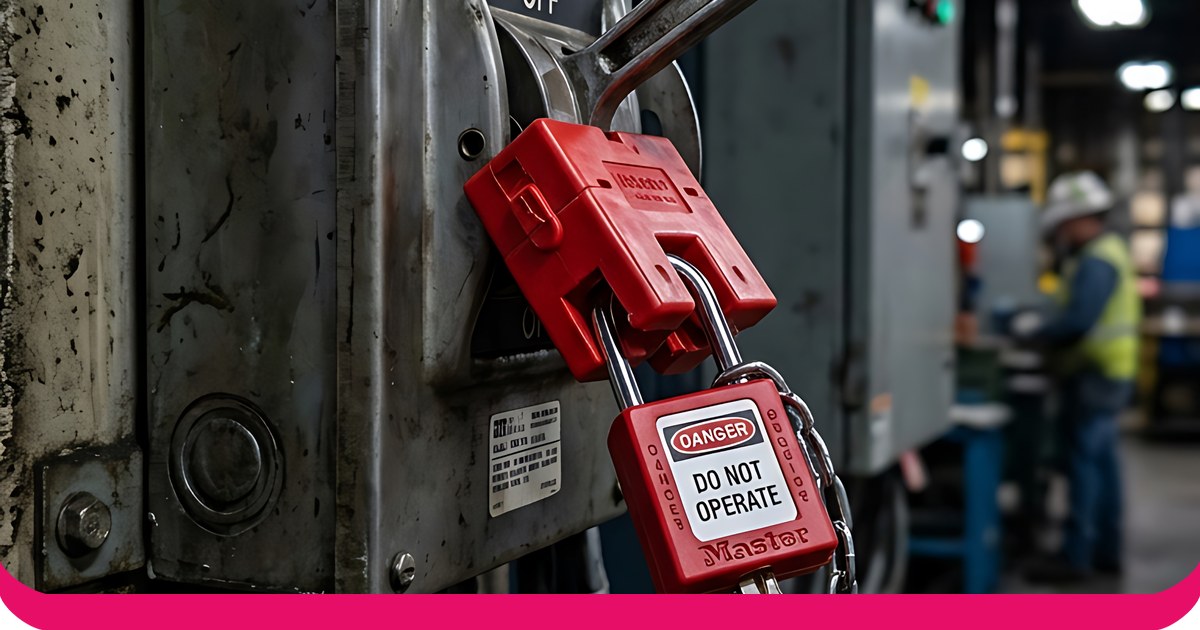
OSHA estimates that compliance with its lockout/tagout standard prevents 120 fatalities and 50,000 injuries each year (OSHA fact sheet FS-3529). Most people never lock a machine themselves, but they work next to the ones that are being serviced. This quiz has 25 questions in 5 rounds of 5, each with its answer and the paragraph of 29 CFR 1910.147 it comes from.
It is written for affected employees (people who operate a machine being serviced, or work in the area where it happens) and for the other employees nearby. It checks awareness. It does not teach anyone to apply a lock, which is the job of an authorised employee trained on your own site's procedure. Where the quiz and your written procedure differ, your procedure governs. The standard also does not cover construction or agriculture (1910.147(a)(1)(ii)).
Round 1: hazardous energy basics
1. Which of these is an energy source under the standard: electrical, hydraulic, thermal, or all three?All three. The standard lists electrical, mechanical, hydraulic, pneumatic, chemical, thermal or other energy. Source: 1910.147(b), "Energy source".
2. What kind of work does the standard cover?Servicing and maintenance of machines where unexpected energisation, start-up or a release of stored energy could injure someone. Source: 1910.147(a)(1)(i).
3. A machine has been switched off at the control panel. Can you assume it cannot move?No. It may still hold stored or residual energy, such as pressure or a raised part, which must be relieved, disconnected or restrained once the lock or tag is on. Source: 1910.147(d)(5)(i).
4. Is a push button an energy isolating device?No. Push buttons, selector switches and other control circuit devices are not. A manually operated circuit breaker, a disconnect switch, a line valve or a block is. Source: 1910.147(b), "Energy isolating device".
5. Does cleaning or unjamming a machine count as servicing?Yes, where you could be exposed to unexpected start-up or a release of hazardous energy. The definition names lubrication, cleaning and unjamming. Source: 1910.147(b), "Servicing and/or maintenance".
Our pick: question 3. "It is switched off" is the assumption behind a lot of near misses, and the answer changes how people look at a stopped machine.
Round 2: authorised, affected and other employees
6. Who is an authorised employee?A person who locks out or tags out machines or equipment to perform servicing or maintenance on them. Source: 1910.147(b).
7. Who is an affected employee?Someone whose job requires them to operate or use a machine being serviced under lockout or tagout, or to work in an area where that servicing is done. Source: 1910.147(b).
8. An operator's duties change and now include servicing the machine. What are they now?An authorised employee. An affected employee becomes one when their duties include servicing or maintenance covered by the standard, and authorised employees have their own training. Source: 1910.147(b); training in (c)(7)(i)(A).
9. What must affected employees be instructed in?The purpose and use of the energy control procedure. Source: 1910.147(c)(7)(i)(B).
10. What must other employees, who only work near the equipment, be told?About the procedure, and about the prohibition on trying to restart or re-energise machines that are locked or tagged out. Source: 1910.147(c)(7)(i)(C).
Our pick: question 8. It is where a job change can leave a training gap, and one definition answers it.
Round 3: locks, tags and what they mean
11. What is the difference between a lock and a tag?A lock is a physical restraint. A tag is a warning device and does not hold anything in place. Source: 1910.147(c)(7)(ii)(A).
12. A device can be locked out. Can the employer use a tag instead?Only if the employer can show the tagout system gives full employee protection, equivalent to lockout. Otherwise the programme must use lockout. Source: 1910.147(c)(2)(ii) and (c)(3).
13. A device cannot be locked out. What does the energy control programme use?A tagout system. Source: 1910.147(c)(2)(i).
14. You find a tag on a switch. May you remove it if the job looks finished?No. A tag is not removed without the authorisation of the authorised person responsible for it, and it is never to be bypassed, ignored or defeated. Source: 1910.147(c)(7)(ii)(B).
15. Can a lockout lock also be used on a tool cabinet?No. Lockout and tagout devices must be the only devices used for controlling energy and must not be used for other purposes. The employer provides them. Source: 1910.147(c)(5)(i) and (ii).
Our pick: question 11. It is the shortest way to explain why a tag asks for trust while a lock holds the device.
Round 4: your role while equipment is locked out
Two rules from the standard sit beside this round: retraining when your job or the procedure changes (1910.147(c)(7)(iii)), and a check of the procedure at least once a year ((c)(6)(i)).
16. Who removes a lock?The employee who applied it. There is one narrow exception: where that person is not available, the employer may direct removal under a documented procedure that gives equivalent safety. Source: 1910.147(e)(3).
17. A machine is locked out and you need it running. Can you restart it?No. Never try to restart or re-energise locked or tagged equipment. Source: 1910.147(c)(7)(i)(C).
18. When the locks come off, who is told before the machine starts?Affected employees. They must be notified that the lockout or tagout devices have been removed. Source: 1910.147(e)(2)(ii).
19. What protects the lock when one shift hands over to the next?Specific procedures for shift or personnel changes, including an orderly transfer of lockout or tagout protection between off-going and oncoming employees. Source: 1910.147(f)(4).
20. A crew works under a group lockout. Who has primary responsibility?An authorised employee, for a set number of employees working under the protection of the group device. Source: 1910.147(f)(3)(ii)(A).
Our pick: question 17. "Just for a second" is how many restarts begin, so the answer needs no exceptions.
Round 5: real-life scenarios
These five are generic and written for training. They are not reports of real incidents.
21. A conveyor jams. A colleague says it has stopped and reaches in to clear it. What should happen?Nobody reaches in. Unjamming is servicing, so the energy control procedure applies and an authorised employee isolates the machine first. Source: 1910.147(b), "Servicing and/or maintenance".
22. You start a shift and find a lock and a handwritten note on a machine. What do you do?Leave it alone and ask your supervisor or the authorised employee who applied it. The standard expects an orderly transfer of protection at shift change. Source: 1910.147(f)(4).
23. A machine is tagged but has a hasp that could take a lock. What should you do?Report it to your supervisor. Where a device can be locked out, the programme must use lockout unless the employer has shown a tag gives equal protection. Source: 1910.147(c)(2)(ii).
24. An outside contractor arrives to service your equipment. What must the two employers do?Inform each other of their lockout or tagout procedures. The on-site employer also makes sure its own employees understand the contractor's restrictions. Source: 1910.147(f)(2).
25. A colleague asks you to press start because "the lock is only for show". What do you say?No, and you tell your supervisor. Only the employee who applied the lock removes it, apart from the employer's narrow documented exception, and the prohibition on restarting locked equipment applies to everyone nearby. Source: 1910.147(e)(3); (c)(7)(i)(C).
Our pick: question 25. It practises saying no to a colleague, which is the hard part of the rule.
How to run it with AhaSlides
Use the 25 questions as they are. One round takes about 5 minutes, which fits a toolbox talk.
- Pick Answer: one slide per question, with the answer revealed after the vote. Turn on the leaderboard to run it as a team game.
- Word Cloud: "Which machine in our area stores energy?" The answers show where your own risks sit.
- Rating Scale: "How sure are you who may remove a lock?" from 1 to 5, asked before and after.
- Open Ended: "What would you ask the person who locks out this machine?" so authorised employees can answer in the next meeting.
- Q&A: an anonymous question box, so people can ask what they would rather not say in front of a supervisor.
To turn the quiz into a full session, start from the Lockout/tagout awareness (affected employees) course template and add your own questions.
Tips for the session
- Run one round per toolbox talk. Five questions leave time to discuss the ones people split on. For a wider programme, pair it with the workplace safety quiz and the workplace safety topics for toolbox talks.
- Reuse the OSHA estimate. Open with the 120 fatalities and 50,000 injuries a year that OSHA estimates compliance prevents, and call it what it is: an OSHA estimate, not a count of your site's incidents.
- Finish by walking your own procedure. Take the group to one machine and read its written procedure aloud. Anything that differs from the quiz answers is the useful finding. For the wider picture, read about manufacturing safety training mistakes.
Frequently asked questions
What is lockout/tagout?
A set of practices that isolate hazardous energy and keep machines from starting up during servicing, under 29 CFR 1910.147. It covers the lock or tag, the procedure and the training around them.
What is an affected employee in lockout/tagout?
Someone who operates a machine being serviced under lockout or tagout, or works in the area where servicing is done (1910.147(b)). Affected employees are instructed in the purpose and use of the energy control procedure.
Can a tag be used instead of a lock?
Only where a device cannot be locked out, or where the employer shows the tag gives equal protection (1910.147(c)(2) and (c)(3)). A tag is a warning device and does not physically hold the device.
Who can remove a lockout device?
Normally the person who applied it. The standard allows only a narrow exception, under a documented employer procedure, when that person is not available (1910.147(e)(3)).
How often must lockout/tagout procedures be inspected?
At least once a year, by an authorised employee other than the ones using the procedure being inspected (1910.147(c)(6)(i)(A)).
Where to start
Pick Round 4 for your next toolbox talk, then ask your safety lead to check your site's written procedure against questions 16 to 20. Build the session from the ready-made template.