


Event management is not one job. Running a product launch for a Fortune 500 company looks almost nothing like coordinating a charity gala or managing a three-day trade show floor. The skills overlap in places: budgeting, vendor coordination, and timeline management. But the pressures, stakeholders, and success metrics are different in each case.
The global events industry was valued at roughly $1.29 trillion in 2024 and is projected to nearly double by 2034 [1]. That growth is spread across a wide range of event categories, and the professionals working in it tend to specialize. Hire the wrong type for your event and you'll find out why the distinctions matter about three weeks before the date.
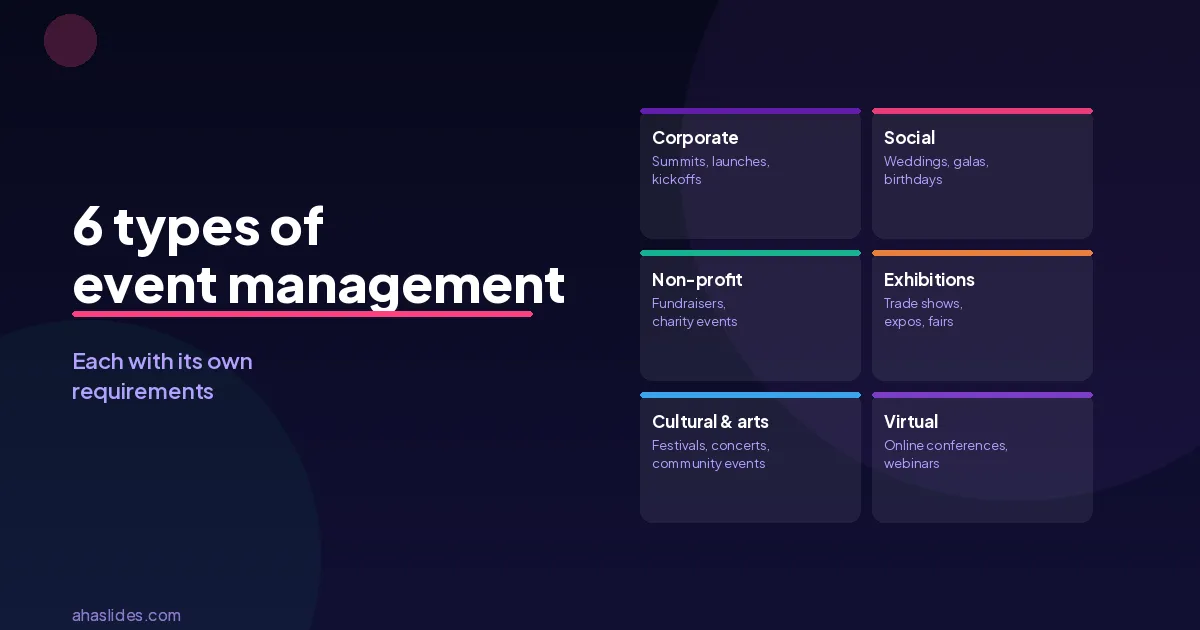
Below are the six main types of event management, what defines each category, and what actually makes them work.
1. Corporate event management
Corporate events are organized by businesses for internal or external audiences: employees, clients, partners, investors, or prospects. The defining characteristic is that the event serves a business objective, whether that's training staff, announcing a product, recognizing performance, or closing deals.
Common formats include annual conferences and leadership summits, product launches and press briefings, sales kickoffs and incentive trips, team-building sessions and company retreats, and client appreciation dinners.
Corporate event managers work inside a defined approval structure. Budget sign-offs, brand guidelines, legal reviews, and stakeholder alignment are constant features of this work. Flexibility is limited compared to other categories. A keynote for 800 employees with live streaming can't be moved the day before because a venue fell through.
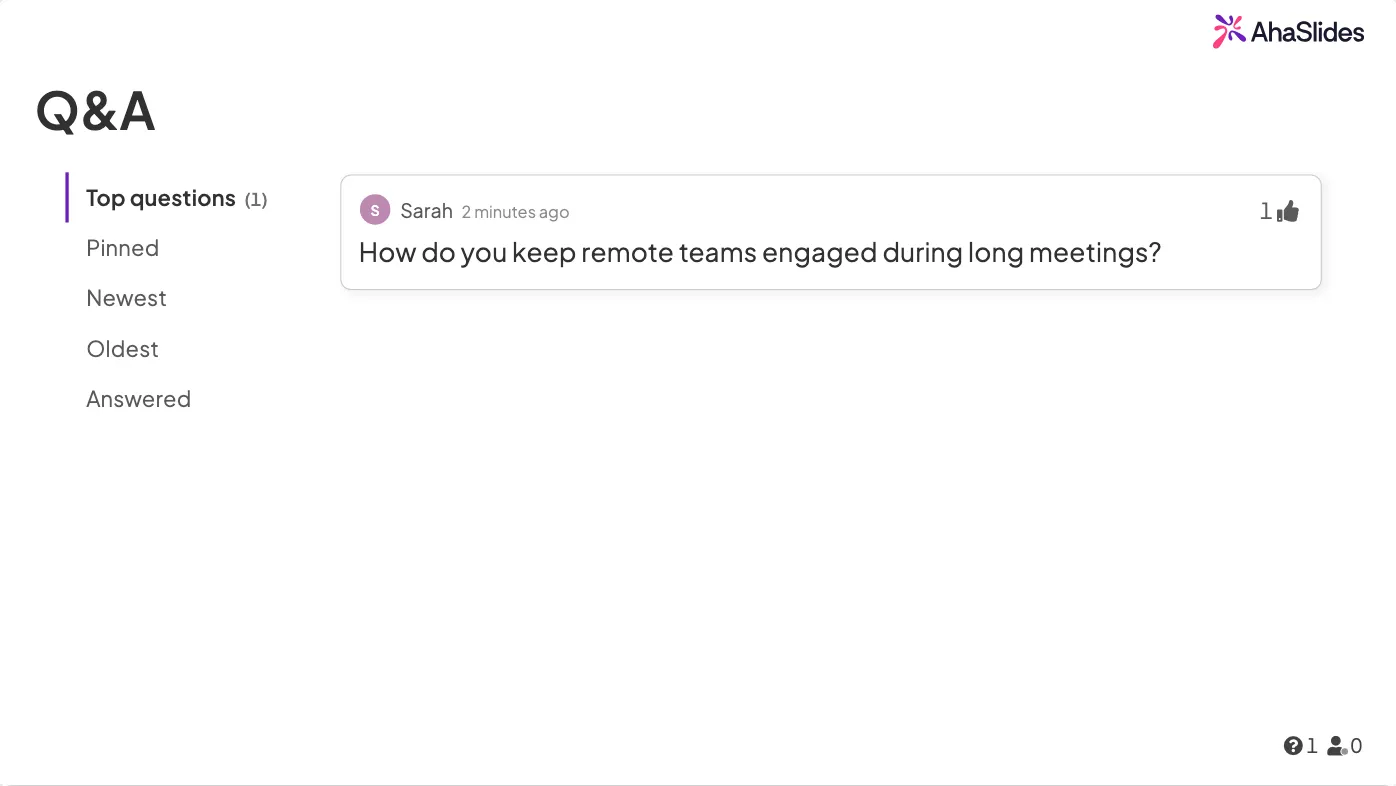
The skills that matter most here are project management, vendor negotiation, and communication across seniority levels. Corporate events are also where audience engagement tools tend to get the most use. Live polls, Q&A sessions, and real-time surveys help speakers connect with large rooms and give organizers data on whether the event actually landed. AhaSlides integrates directly into presentations for exactly this purpose: running live polls and word clouds during a keynote without switching tools or disrupting the session flow.
2. Social event management
Social events cover gatherings built around relationships and celebration rather than business outcomes. Weddings, milestone birthday parties, anniversary dinners, baby showers, and holiday parties all fall here. The client is typically an individual or family rather than an organization.
What sets social event management apart from every other category is the emotional weight. Get the logistics wrong at a product launch and someone writes a post-mortem. Get them wrong at a wedding and someone cries.
Social event managers typically handle venue selection and decor coordination, catering and entertainment booking, invitation management and guest logistics, day-of coordination and vendor supervision, and contingency planning for weather, vendors, and timing.
Referrals and reputation drive most business in this segment. Clients often have strong and sometimes conflicting opinions among family members, which means communication and negotiation skills are at least as important as operational ones.
3. Non-profit and fundraising event management
Non-profit events are designed to raise money, build awareness, or deepen relationships with donors and supporters. Galas, charity auctions, walkathons, benefit concerts, and donor cultivation dinners are typical formats.
The core challenge is financial, and it's unforgiving: non-profit events operate on tighter margins than corporate ones, often rely heavily on donated services and in-kind contributions, and must demonstrate clear ROI to boards and donors. A gala that raises $200,000 but costs $180,000 to produce is technically successful but practically not very efficient, and organizations often have to justify those numbers to stakeholders who didn't attend.
Key responsibilities include sponsorship solicitation and recognition, volunteer recruitment, training and coordination, auction item procurement and management, donor stewardship before, during and after the event, and impact reporting and follow-up communications.
Non-profit event managers also tend to handle more of the marketing and communications work themselves, since large communications teams are rare in smaller organizations. Knowing how to write a compelling invitation, manage a donor database, and process donations on-site is part of the job in a way it isn't in other categories.

4. Exhibitions and trade show management
Trade shows and exhibitions bring together buyers, sellers, and industry peers in a highly structured competitive environment. Think CES, SXSW trade floors, MAGIC Apparel, or any regional industry expo. The event itself is simultaneously the product being sold to exhibitors who pay for booth space, and the service being delivered to attendees who come to see the market.
This category requires a different mental model than most other event types. The event manager isn't serving one client: they're simultaneously managing the expectations of hundreds of exhibitors, thousands of attendees, and a venue with its own constraints. According to a 2025 industry report, US event marketers planned to exhibit at more than 40 in-person regional trade shows per year on average [2], roughly one every nine days. That pace is only sustainable with strong systems.
Trade show management typically covers floor plan design and exhibitor placement, booth construction oversight and utility coordination, registration and badge management at scale, speaker and panel session programming, press and media logistics, and on-site security and crowd flow management.
The skills here lean heavily toward operations and systems thinking. Large trade shows have hundreds of moving parts running in parallel, and a failure in one area, registration software crashing on opening morning, for instance, creates compounding problems that require fast decisions under pressure.
5. Cultural and arts event management
Cultural events celebrate heritage, community, and creative expression. Festivals, art fairs, music concerts, film screenings, theatrical performances, and public ceremonies all fall into this category. Many are recurring annual events with established audiences and long planning cycles.
A major difference from other categories is that cultural events often involve public space (parks, streets, public plazas) which introduces permitting requirements, city agency coordination, and public safety protocols that don't apply to venue-based events. A city street festival with 20,000 attendees requires working with police, fire, public works, and the parks department, in addition to the usual vendor and entertainment logistics.
Cultural event managers typically handle permit applications and city agency coordination, artist booking, contracts and riders, volunteer and staff scheduling at scale, site design, fencing and crowd routing, accessibility and ADA compliance, and sponsorship and ticketing.
This category rewards deep knowledge of a specific community or art form. A jazz festival manager who understands how musicians work, what riders typically require, and how audiences move through a venue will always outperform a generalist learning on the job.
6. Virtual event management
Virtual events became a significant category during 2020 and have remained one as organizations recognized their practical advantages: lower cost, broader reach, and the ability to record and repurpose content. The global virtual events market was valued at around $235 billion in 2025 and is projected to grow at roughly 22% annually through 2029 [3].
Virtual event management is technically demanding in ways that in-person events aren't. Platform selection, streaming infrastructure, speaker tech checks, engagement tools, on-demand access, and real-time troubleshooting all fall to the event team. When someone's audio drops during a keynote, there's no AV technician in the room: the event manager is the first line of response.
Common virtual event formats include webinars and virtual conferences, online trade shows and product showcases, live-streamed award ceremonies, and hybrid events with both in-person and remote attendees.
Hybrid events deserve special mention because they're essentially two events running in parallel, and the common failure mode is building an excellent in-room experience while largely ignoring the remote audience. Virtual attendees who feel like an afterthought don't come back. AhaSlides is built for exactly this gap: running live polls, open Q&A, and word clouds pulls remote participants into the same conversation as the in-room audience, rather than leaving them watching a stream and hoping someone reads the chat.
By 2025, roughly 74% of event planners had adopted hybrid formats in some form [3], and the line between "virtual" and "in-person" event management continues to blur as a result.
How the types overlap
Most event professionals specialize, but the categories are not perfectly sealed. A corporate conference might include a gala dinner (social), an exhibition floor (trade show), and a livestream for remote employees (virtual), all under one event umbrella. A large non-profit gala might involve entertainment coordination that looks more like cultural event management than fundraising logistics.
The practical takeaway: when evaluating an event manager or agency for a specific project, the category experience matters more than general event experience. Someone who has run 50 corporate conferences may struggle with a fundraising gala, not because they lack skills, but because the client relationship and success metrics work differently.
A useful example: a tech company running its annual customer summit might engage a corporate event manager for the conference program, a trade show specialist for the exhibition floor, and rely on virtual event expertise for the hybrid livestream. Each brings category-specific knowledge the others don't have. The event director coordinating all three needs enough fluency in each area to brief them correctly and catch problems before they compound.
Key skills across all six types
Despite the differences, a few skills show up consistently across every category:
Budget management. Events are defined by a fixed date, which removes the option of pausing work when money gets tight. Managing a budget in real time, with committed vendor contracts, is a non-negotiable skill.
Vendor relationships. The best event managers have a roster of reliable vendors they've worked with before: caterers, AV companies, print shops, security firms. They know exactly what each one needs to perform well.
Contingency thinking. Every event has a version of "what happens if the main speaker cancels two hours before showtime." Event managers who haven't thought through these scenarios in advance make worse decisions under pressure than those who have.
Audience engagement. This applies whether you're running a live conference, a virtual summit, or a hybrid event. Passive audiences disengage quickly. Building in interactive moments, live polls, open Q&A, small-group discussions, keeps attendance from turning into presence without participation. Tools like AhaSlides make this straightforward to implement without disrupting the session flow.
Common mistakes to avoid
Even experienced event professionals run into the same patterns across different event types. These are the ones that cause the most avoidable problems.
Treating all event types as interchangeable. The instinct to apply a proven process from one category to another can backfire fast. A corporate event manager hired to plan a fundraising gala may bring strong logistics skills but miss the donor stewardship and volunteer coordination that make or break that format. When evaluating someone's experience, ask specifically about the event type you're running, not just event management in general.
Underestimating virtual audience dropout. Many organizations running hybrid or virtual events focus most of their energy on the in-room experience and treat the remote feed as an add-on. Remote attendees who don't feel engaged stop watching, often within the first 20 minutes. Scheduling interactive moments (a poll, a live Q&A, a word cloud) at regular intervals gives virtual participants a reason to stay active rather than passively streaming in the background.
Setting the budget without a contingency line. A budget built to exact cost with no buffer is a budget that will fail. Standard practice is to hold back 10–15% of the total as a contingency reserve. Vendors change pricing, equipment fails, headcounts shift, and weather disrupts outdoor plans. Teams that skip the contingency line end up making compromises on the day of the event rather than before it.
Starting vendor outreach too late. Popular venues, AV companies, and catering teams book out months in advance, particularly during peak seasons. Event managers who begin outreach late often end up with second-choice vendors, or first-choice vendors charging rush fees. Building a preferred vendor list and making initial contact early in the planning cycle, even before the budget is fully approved, is one of the clearest separators between experienced and inexperienced planners.
Sources
[1] AWS Marketplace / Global Events Industry Market Size Report. Global Events Industry Market Size, Share 2025–2034. https://aws.amazon.com/marketplace/pp/prodview-25q63e3yfw6ga
[2] Momencio. 50 Key event industry statistics (New 2026 report inside). https://www.momencio.com/50-event-industry-statistics-for-2025/
[3] Nunify. Top Event Planning Statistics, Facts & Trends [2025 Update]. https://www.nunify.com/blogs/event-planning-statistics-facts-trends