
Most presentations are not keynotes. They are a Monday update, a five-minute pitch, a book report due on Friday. You rarely have time to design something spectacular, and your audience rarely needs you to. They need the point, clearly, and then they need you to stop.
Below are 27 simple presentation examples you can copy, with a slide-by-slide outline for each, followed by the tips we use to keep our own decks short.
What makes a presentation simple?
A simple presentation has one message, few slides and little text per slide. That is not only a matter of taste. In a review of multimedia learning research, psychologist Richard Mayer describes the coherence principle: people learn more deeply when extraneous material, such as decorative pictures, sounds or video, is left out. The principle held in 18 of 19 experimental tests.
Some of the most-watched talks show the same thing. Sir Ken Robinson's Do schools kill creativity? (TED2006) is one speaker talking without slides, making a clear argument. In How great leaders inspire action (TEDxPuget Sound, 2009), Simon Sinek explains his "Golden Circle" by sketching three circles on a flip chart, with no slides. You do not need to go that far, but it shows how little design a strong idea needs.
Quick reference
Simple presentation examples for work
These work in PowerPoint, Google Slides or any other tool, and none needs more than a clean template and large titles.
1. Introduction
3-5 slides: your name, the topic overview and the agenda. Use a simple layout and large titles so people can follow from the back of the room.
2. Informational
5-10 slides conveying facts through short points and images. Stick to one idea per slide, stated in the headline.
3. How-to guide
5 or more slides that demonstrate steps visually. Use one screenshot or photo per step and keep the text to a short instruction.
4. Meeting recap
3-5 slides summarising what was discussed, the decisions made, next steps and who owns each one. A short list works best here.
5. Job interview
5-10 slides highlighting your experience, skills and results, ideally with one example per skill. Add a photo of yourself on the first slide if the format suits it.
6. Announcement
2-3 slides alerting people to news, a deadline or an event. Use a large font and put the date and the action you need on the first slide.
7. Photo report
5-10 slides of images telling a story, such as a site visit or event, with one or two sentences of context beneath each photo.
8. Progress update
3-5 slides tracking work to date against goals, with one metric, chart or screenshot per slide.
9. Thank you
1-2 slides expressing thanks after a project, event or opportunity. Personalise it with names and one specific moment.
10. Sales presentation
8 slides that keep the focus on the customer, not on your company history:
- Their goal: what the customer is trying to achieve, in their words.
- The problem: what stands in the way today.
- The cost: what the problem costs them in time, money or risk.
- Your solution: how you remove the problem, in one sentence.
- How it works: one screenshot or diagram, or switch to a live demo.
- Proof: a short case study, a result or a customer quote.
- Options and price: two or three packages at most.
- Next step: one clear action, such as a trial or a follow-up call.
11. Product demo
5-7 slides that frame a live demo: the problem, a before and after, then the demo itself, three key features with one benefit each, and a slide for questions. Keep the slides light; the product does the talking.
12. Company overview
6-8 slides for new clients, partners or new starters: who you are, your mission, what you offer, who you serve, a few numbers (customers, years, locations), the team and how to get in touch.
13. Case study
5-6 slides that tell one customer story: the client and their challenge, what they tried before, the solution, the results with real numbers, a quote from the client and what others can learn from it.
14. Project proposal
6-8 slides to win approval: the problem or opportunity, the goal, the approach, the timeline, the budget and resources, the risks and how you will manage them, and the decision you need from the room.
15. Marketing plan
7-9 slides covering the objective, the target audience, key messages, channels, timeline, budget and how you will measure success. Put one number on the goal slide so everyone knows what success looks like.
16. Quarterly business review
6-8 slides for a client or leadership team: the goals agreed last quarter, results against each goal, wins, what did not go to plan and why, priorities for next quarter and any support you need. Lead with results, not activity.
Simple pitch deck example
17. Pitch deck
When you pitch to investors, a short, clear deck respects their time. Venture capital firm Sequoia's guide to writing a business plan runs from company purpose, problem and solution through "why now?", market, competition, business model, team and financials to vision. This simple 11-slide outline for an early-stage start-up is loosely based on it, with traction and milestones added:
- Title: company name and tagline.
- Problem and solution: the problem you solve and your solution, in a sentence each.
- Product: core features and benefits, with a screenshot or diagram.
- Market: your target customer, the size of the opportunity and why now is the right time.
- Business model: how you make money and how you will win and keep customers.
- Competition: the main alternatives and what makes you different.
- Traction: early metrics, pilot results or customer quotes.
- Team: founders and advisers, and why they are the right people.
- Milestones and use of funds: what you will achieve and how the money will be spent.
- Financials: basic projections and what you are asking for.
- Close: thank the investors and restate the opportunity.

Guy Kawasaki's well-known 10/20/30 rule is a handy check for any pitch: ten slides, no longer than twenty minutes and no font smaller than thirty points.
Simple business plan presentation example
18. Business plan
For a business plan, the goal is to present the opportunity clearly and win support. Slidesgo's free Professional Business Plan template fits this outline:
- Slide 1, introduction: who you are and who is on the team.
- Slide 2, business overview: the name and purpose of the business, the product or service, and the target customers.
- Slides 3-4, operations plan: how the business runs day to day and any operational advantages.
- Slides 5-6, marketing plan: how you will reach and win customers.
- Slides 7-8, financial projections: revenue, costs and profit, with the key assumptions.
- Slides 9-10, future plans: growth plans, the capital needed and how it will be used.
- Slide 11, close: thanks, contact details and next steps.
Simple presentation examples for students
Students present often, and a simple structure makes it easier to speak confidently.
19. Book report
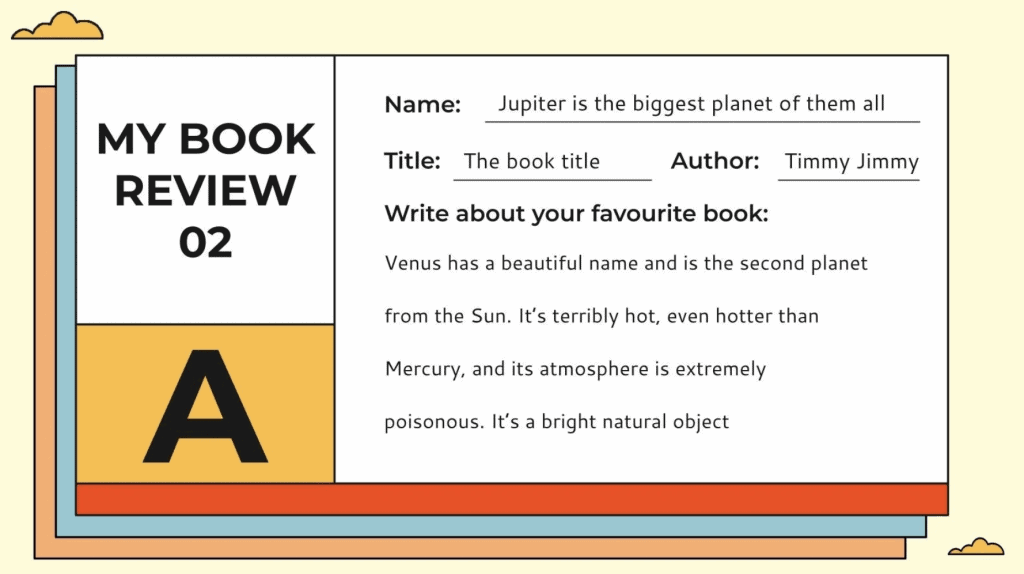
Title, author, a short summary of the plot and characters, then your opinion, over a few slides. Slidesgo's free Colorful Book Report template is a ready-made starting point.
20. Science experiment
Introduction, hypothesis, method, results and conclusion, each on its own slide. Include photos of the experiment if you can.
21. History report
Pick 3-5 important dates or events and give each a slide with two or three points on what happened and why it mattered.
22. Compare and contrast
Choose two or three subjects and give each a slide, or use one comparison slide with the similarities and differences side by side. Slidesgo's free Comparison Infographics has ready-made layouts.
23. Movie review
Title, genre, director, a short summary, then your review and a rating out of five.
24. Biographical presentation
A title slide, then 3-5 slides covering the person's key dates, achievements and life events in order.
25. How-to presentation
Demonstrate a process step by step over 4-6 slides, with an image for each step and a one-line instruction.
26. Research presentation
8-12 slides that follow the shape of a research paper: title, background, research question, method, results (one chart per slide), discussion, conclusion and references. Put the main finding on the conclusion slide in one sentence.
27. Three Minute Thesis
The simplest presentation format of all. In the Three Minute Thesis competition, developed by the University of Queensland, research students explain their work in three minutes or less, with a single static slide and no animations, sound or video. Use the one slide for an image that makes your research memorable, not for text.
Tips for giving a simple presentation
A simple deck still needs a confident delivery. These are the habits that help us most:
- Open with the audience, not your slides. A quick icebreaker game or a question picked at random with a spinner wheel gets people talking in the first minute.
- Keep it short. Aim for ten slides or fewer unless the content genuinely needs more.
- One idea per slide. Put the point in the headline and support it with one image, chart or a few words.
- Cut anything that does not help. Decorative clip art, background music and interesting-but-irrelevant facts make it harder to follow, as the coherence principle suggests.
- Use clear section headers so people know where they are.
- Rehearse until you can talk through each slide without reading it, and time yourself so you finish early rather than late.
- State your conclusion clearly and leave it on screen while you take questions.
- Offer a handout for extra detail instead of cramming it onto slides.
- Build in participation. A short online quiz, a live poll or an audience Q&A keeps people involved.
- Gather ideas and feedback live with a word cloud or a brainstorm slide.

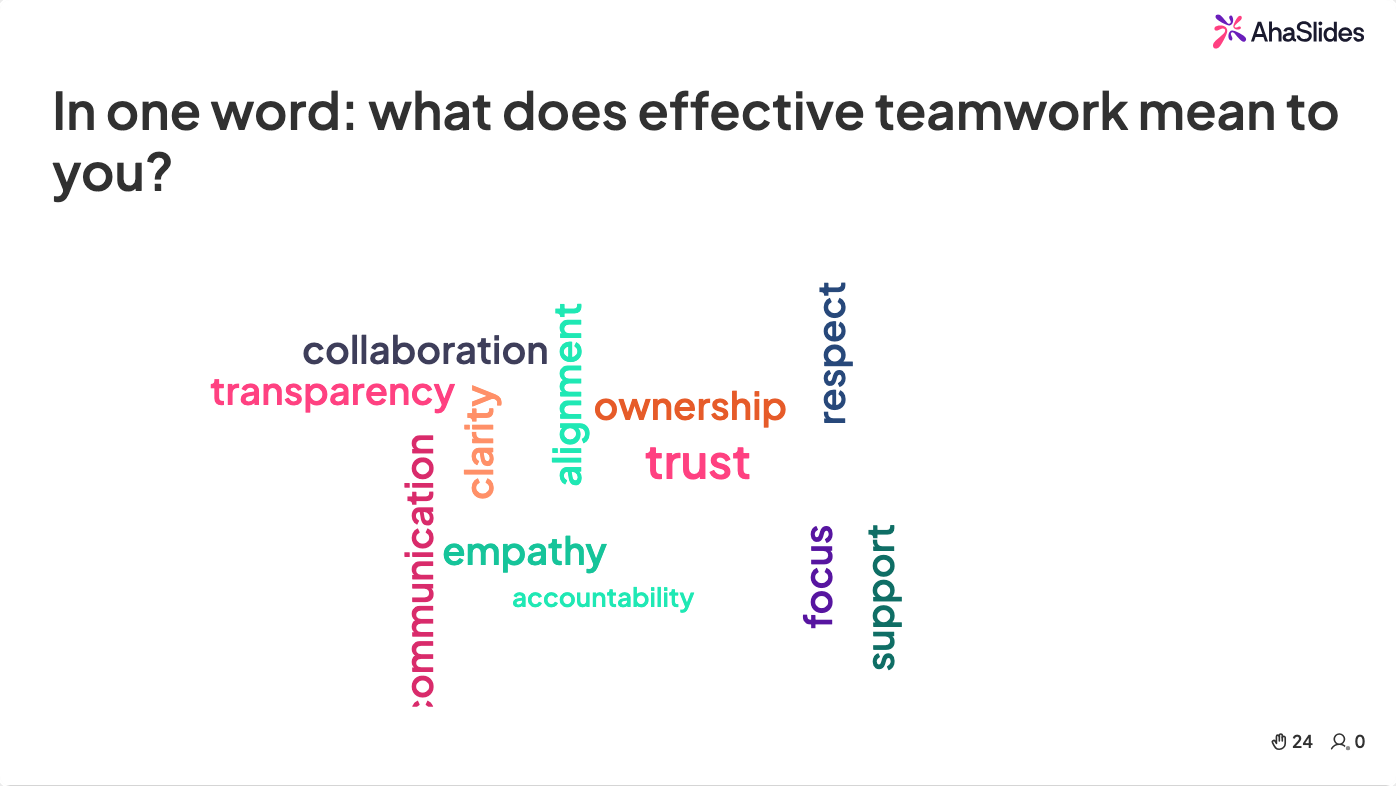
In our own sessions, the simplest interactive slide is often the most useful. A one-word question such as "What does effective teamwork mean to you?" on a word cloud takes seconds to answer from a phone, and the most common answers appear largest, giving you a talking point built from the room.
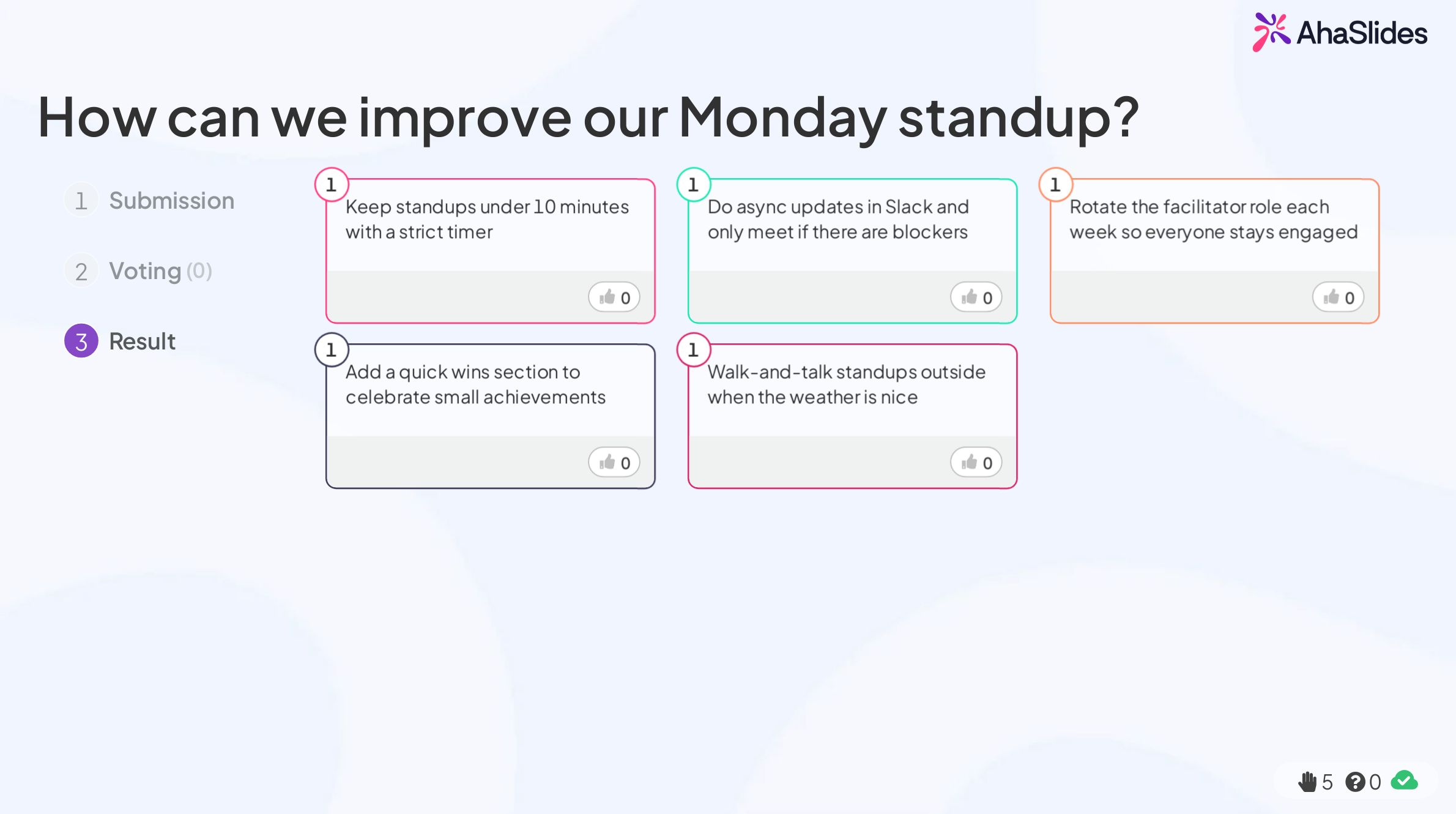
For bigger questions, a brainstorm slide collects ideas first, then lets everyone vote so the best suggestions rise to the top.
You can add these slides to a deck in minutes, or start from a ready-made deck in the AhaSlides template library. For more on structure, see our guides to presentation format, types of presentations and easy topics for presentations.
Frequently asked questions
What are some examples of simple presentation topics?
- How to care for a new pet
- Safety tips for using social media
- Breakfast foods from around the world
- A simple science experiment
- A book or film review and recommendation
- How to play a popular sport or game
What is a good 5-minute presentation?
- Book review: introduce the book, its main characters and plot, and give your opinion in 4-5 slides.
- News update: summarise three current stories, one or two slides each, with images.
- Profile of an inspiring person: their background and achievements in four slides.
- Product demonstration: the features and benefits of one product in five slides.
What is the easiest topic for a presentation?
The easiest topics are ones you already know well:
- Yourself: a short introduction to who you are
- Your favourite hobby or interest
- Your hometown or country, with a few interesting facts and places
- Your study or career goals
- A past class project and what you learned from it