Round 1
Chinese and Korean lucky foods
Why dumplings, fish, noodles and rice cake soup are on the table.
- Pick answer
- Match pairs


Seven questions on festive foods and their symbolism in Chinese, Korean, Japanese and Vietnamese New Year celebrations, plus a taste poll. Japan's osechi belongs to 1 January rather than the lunar calendar. Suits food fans and classrooms.
Why dumplings, fish, noodles and rice cake soup are on the table.
Japan's New Year box meal and Vietnam's sticky rice cakes, then a taste poll.
Every question, grouped by round. Answers stay hidden until you tap.
What is the significance of eating uncut noodles during Lunar New Year?
Represents long life and longevity
Fun fact: Yi mein noodles are traditionally not cut, so each strand is eaten whole. They are also eaten on birthdays, which is why they are called longevity noodles.
Match the Chinese New Year foods to their symbolic meanings
Fun fact: Fish is a pun: yú sounds like 'surplus', so leftovers are kept as a wish for abundance. In some areas the head and tail are saved until New Year's Day, so the year starts and ends with surplus.
What is the most iconic Korean dish served during Lunar New Year?
Tteokguk (rice cake soup)
Fun fact: Eating tteokguk on New Year's Day is traditionally said to add a year to your age. The oval slices of rice cake are said to look like old coins.
What is the name of the traditional Japanese New Year’s meal?
Osechi Ryori
Fun fact: Osechi is packed into stacked lacquered boxes called jūbako and made in advance, so cooks can rest. It is eaten during the first three days of the Japanese New Year.
What does the Bánh Chưng symbolize in Vietnamese culture?
The Earth and its square shape
Fun fact: Square bánh chưng is said to stand for the earth and round bánh dày for the sky. In legend, Prince Lang Liêu created the cakes as an offering to ancestors.
Match the Vietnamese dish with its primary ingredient.
Fun fact: The fried roll is called chả giò in southern Vietnam and nem rán in the north, and rice paper is its traditional wrapper.
What is the primary difference between Bánh Chưng and Bánh Tét?
Bánh Chưng is square, and Bánh Tét is round.
Fun fact: Bánh tét is traditional to central and southern Vietnam and wrapped in banana leaves. Bánh chưng, more common in the north, is wrapped in lá dong leaves.
Which Lunar New Year cuisine do you want to try most?
Press View and claim to open the slides, then make your own copy.
Add team names, a prize and any questions of your own.
Start the quiz on your big screen or share your screen.
Players join on their phones and play live.
About 5 minutes for all 8 questions.
Yes. This quiz is written for all ages.
Yes. Share your screen on Zoom or Teams and put the join code in the chat. Everyone answers on their own device.
Yes. Once you have your own copy, every question is yours to edit.
More for Lunar New Year.
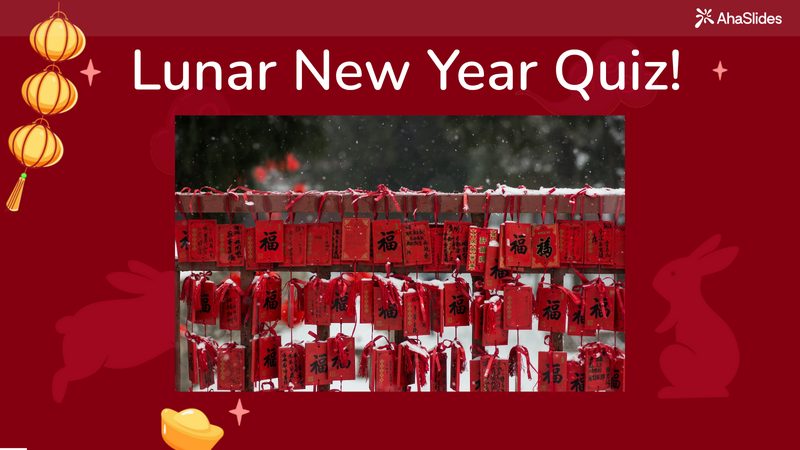
Zodiac animals, traditions and food in a 20-question Lunar New Year quiz.
A Lunar New Year team session with six open prompts (favourite things, games, food, decorations, challenges) and four quiz questions on the zodiac, Seollal and festive food. Suits a workplace or class; mostly discussion.
A back-to-work discussion template: seven open prompts (wishes, holiday stories, childhood games, favourite foods) plus five short Lunar New Year questions on customs and the zodiac. Mostly conversation, not a scored quiz.