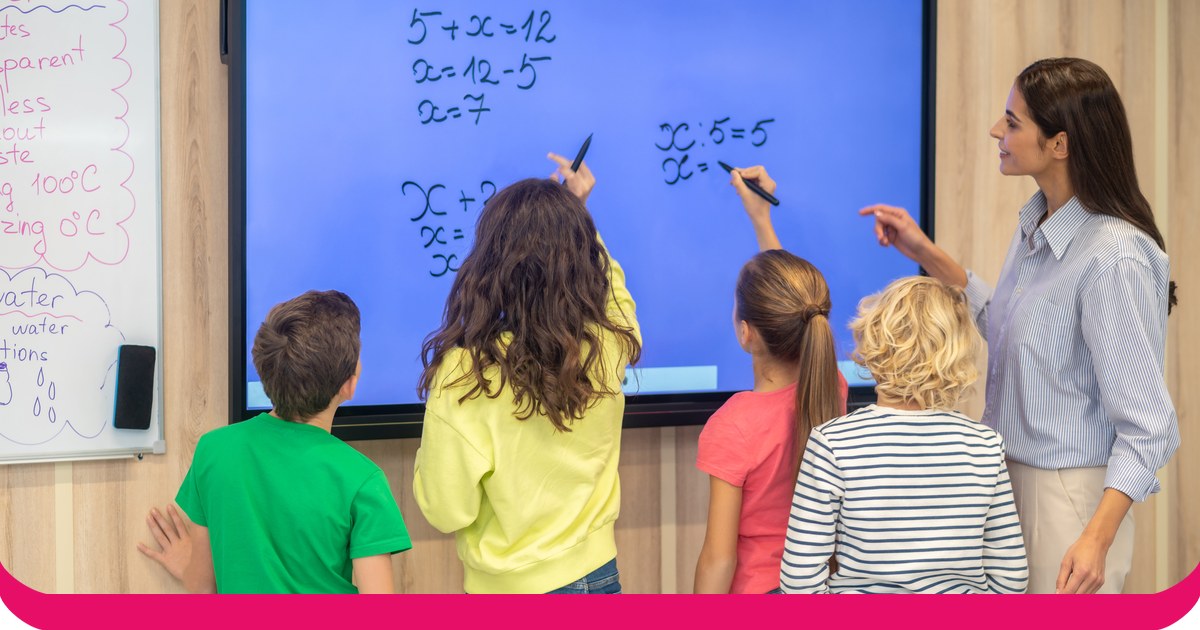
Need fun games to play in class? The 18 below need little preparation and work across grade levels from elementary to high school. Most of them need no app at all: a board, paper or a set of word cards will do.
A review published in Educational Psychologist sets out the foundations of game-based learning [1]. A later meta-analysis of K-16 studies found that digital games improved learning compared with non-game conditions (g = 0.33) [2].
For picking teams or the next player, a Spinner Wheel on the board keeps it fair. For a simple name draw, see our Wheel of Names alternatives.
Why fun games to play in class are worth the time
Games make students do something with what they are learning: compete for points, work with a team or solve a puzzle.
Five reasons to use them:
- Attention: A game gives students something to follow and respond to, and it is harder to drift off when something is at stake.
- Motivation: Students who look forward to class activities come in with their heads already in the material.
- Collaboration: Team formats teach students to negotiate, share knowledge, and build on each other's answers.
- Confidence: Low-stakes games make it easier for students to try an answer they are not sure of.
- Retention: Bring a favourite game back through a unit instead of saving it for one Friday, so review sessions before assessments are not a one-off.
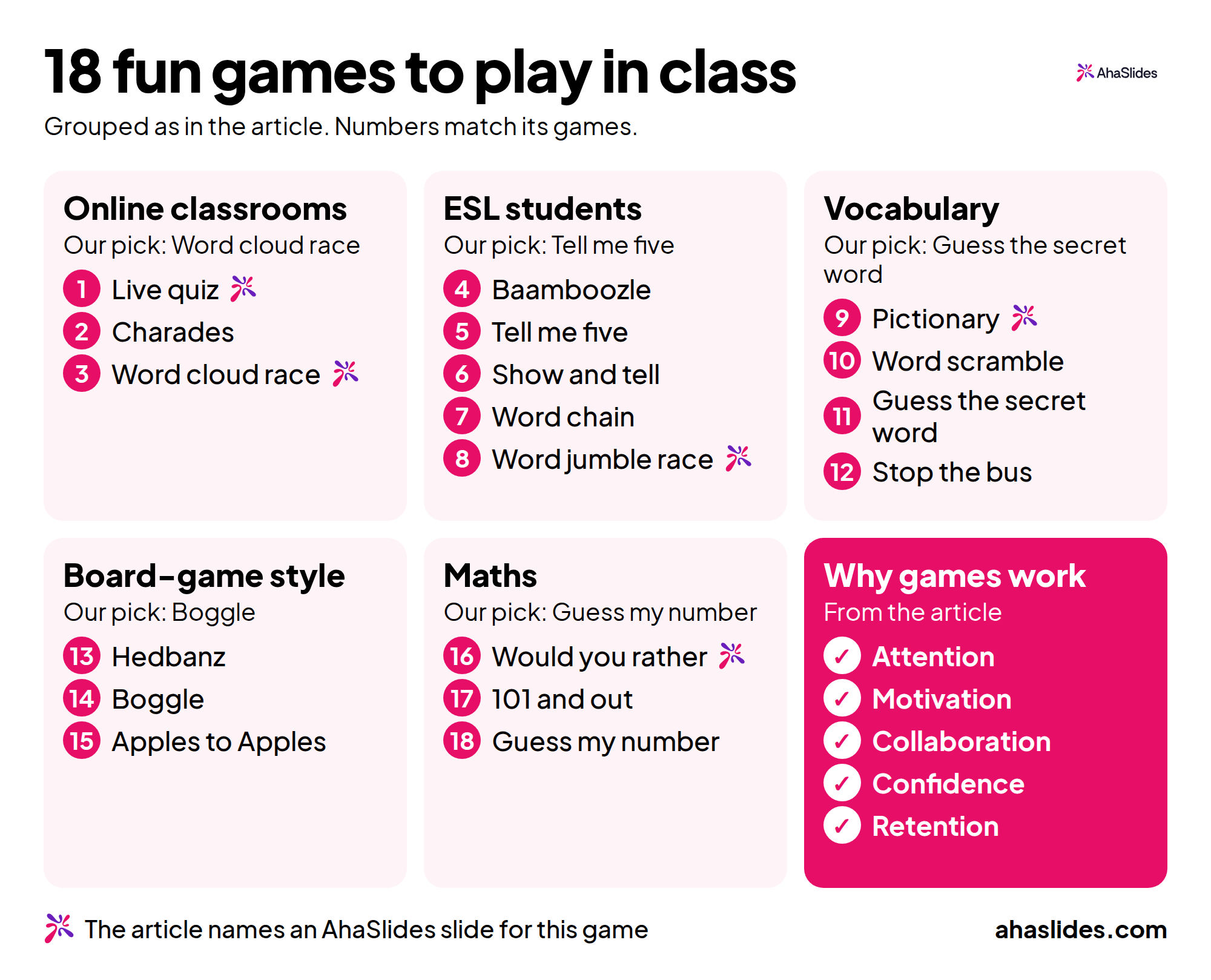
Games for online classrooms
Our pick: Word cloud race, because every student answers at once, so nobody sits waiting for a turn. Teaching fully remote? Our guide to online classroom games has more ideas.
1. Live quiz
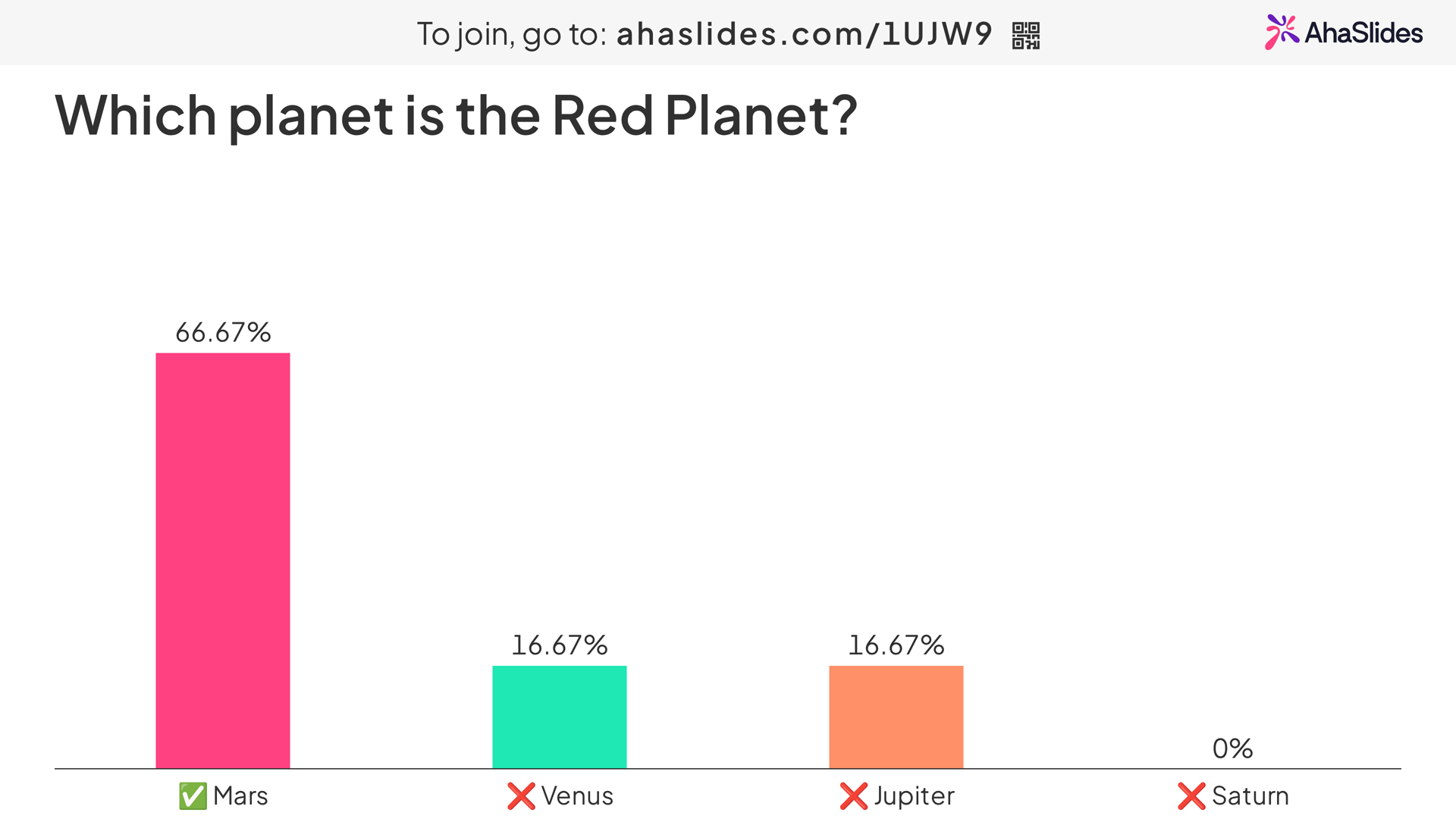
A live quiz is a quick way to review a lesson. Students join on their devices using an access code, answer questions simultaneously, and watch a live leaderboard update after each round. The competitive pressure can draw in students who switch off during review.
In AhaSlides you can build a quiz from scratch or start from a template, so a review round does not eat your planning time.
Short of time? The Online classroom game template has ten short games for live or remote lessons, with leaderboards between them, so you only need to swap in questions from your own unit.
2. Charades
Charades works in person or on a video call. Students are given a word or phrase to act out using only physical gestures, no speaking. Teammates guess before time runs out. Playing in pairs or small teams works best.
For a subject-specific twist, restrict words to vocabulary from the current unit.
3. Word cloud race
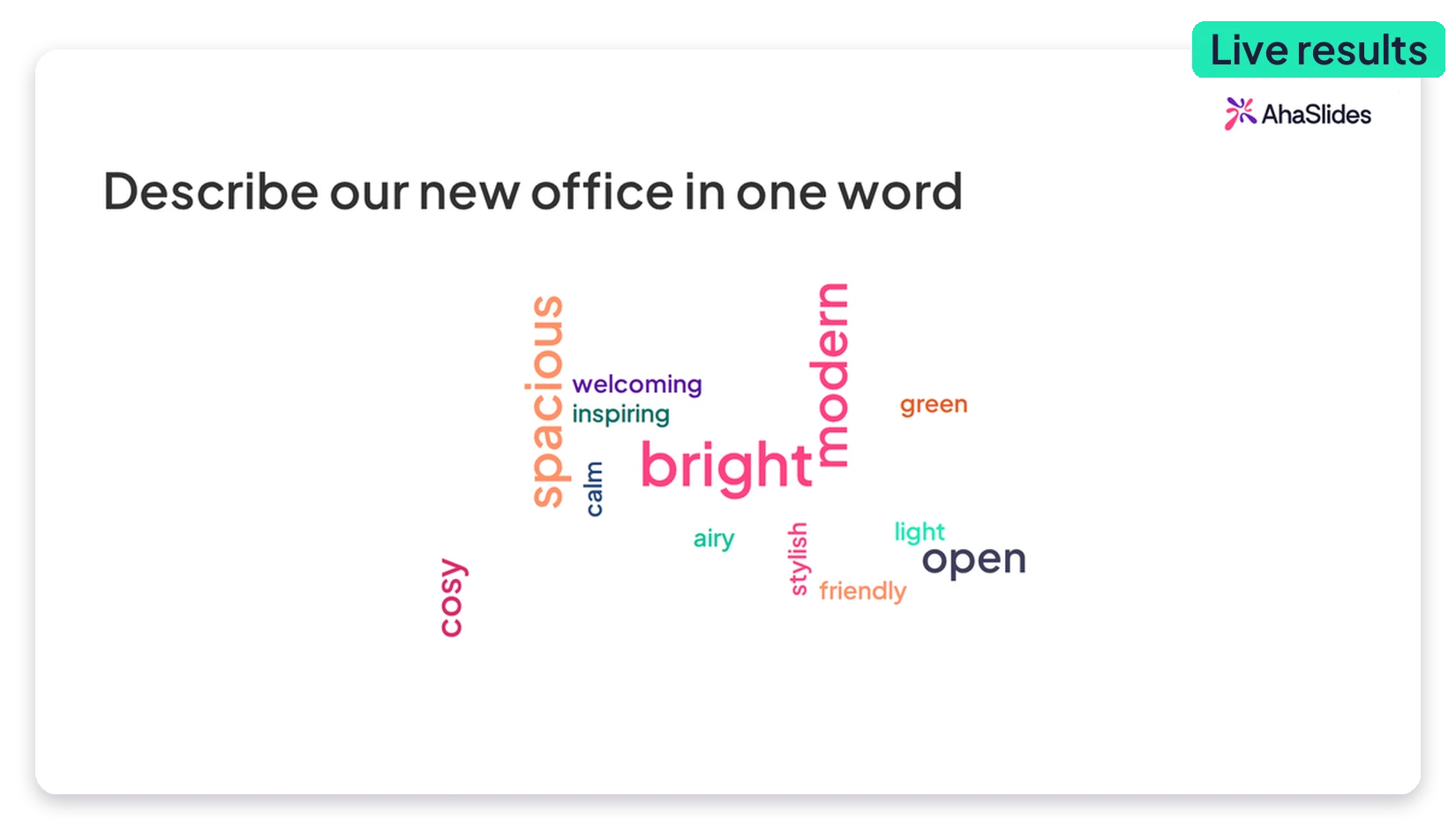
Give the class a category and ask everyone to submit as many examples as they can before the timer runs out. A live Word Cloud fills in as answers arrive, with the most popular responses appearing largest. Start the discussion with the biggest words: they show what most of the class thought of first.
In AhaSlides, a Word Cloud slide updates in real time as answers arrive.
Games for ESL students
Our pick: Tell me five, because it takes no preparation and 20 seconds is enough to get every group talking.
4. Baamboozle
Baamboozle is a game board platform with a large library of pre-made games, language games included. As of November 2026, its site lists over 4 million teacher-made games and says they play from one screen, with no student devices needed. Divide students into two teams and have them take turns selecting questions from the board. Correct answers earn points. It suits vocabulary review and grammar practice.
5. Tell me five
Divide students into groups and give each group a category (for example: types of weather, kitchen utensils, or things you find in a hospital). Each group has 20 seconds to name five things belonging to that category. The fastest group to call out five correct items wins the round. The timer leaves no room to overthink, so students say what comes to mind.
6. Show and tell
Students choose or are assigned a topic and bring an object or image that relates to it. Each student presents the item and tells a short story or memory connected to it. For a twist, have the class vote on the best story or the most unexpected object. It gives students practice at speaking and at using vocabulary in context.
7. Word chain
Start with any word. A student must respond with a word that begins with the last letter of your word. Play passes around the room. Any student who hesitates too long or repeats a word already used is out. For a more advanced version, restrict submissions to a single category, such as animals or cities.
8. Word jumble race
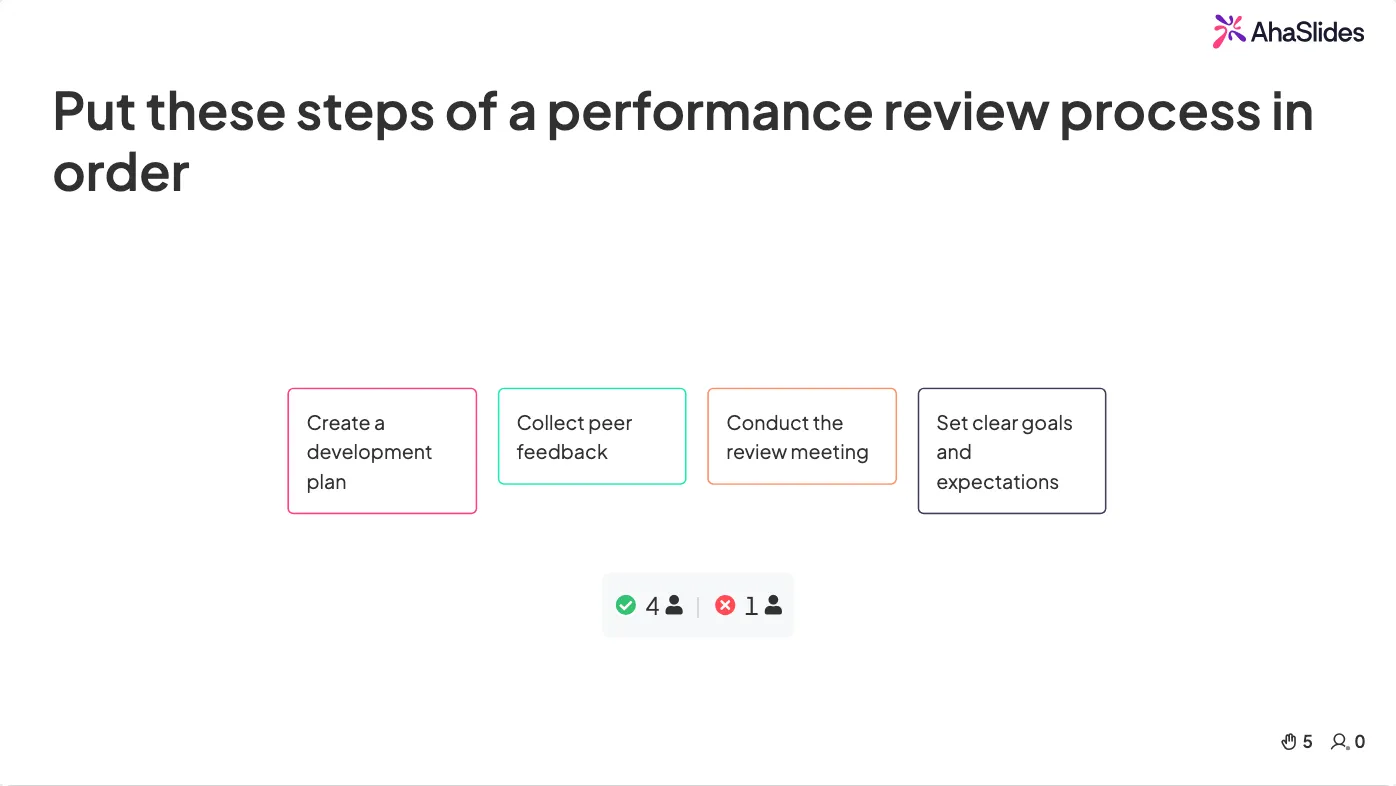
Prepare sentences by cutting them into individual words. Divide the class into small groups and give each group a set of word cards. On your signal, groups race to assemble the sentence in the correct order. This works well for practising grammar, syntax, and word order. In a digital classroom, the Correct Order slide type in AhaSlides does the same job: students drag shuffled words into order on their own devices.
Vocabulary games
Our pick: Guess the secret word, because all you need is one word and a handful of clues, and students learn it by association.
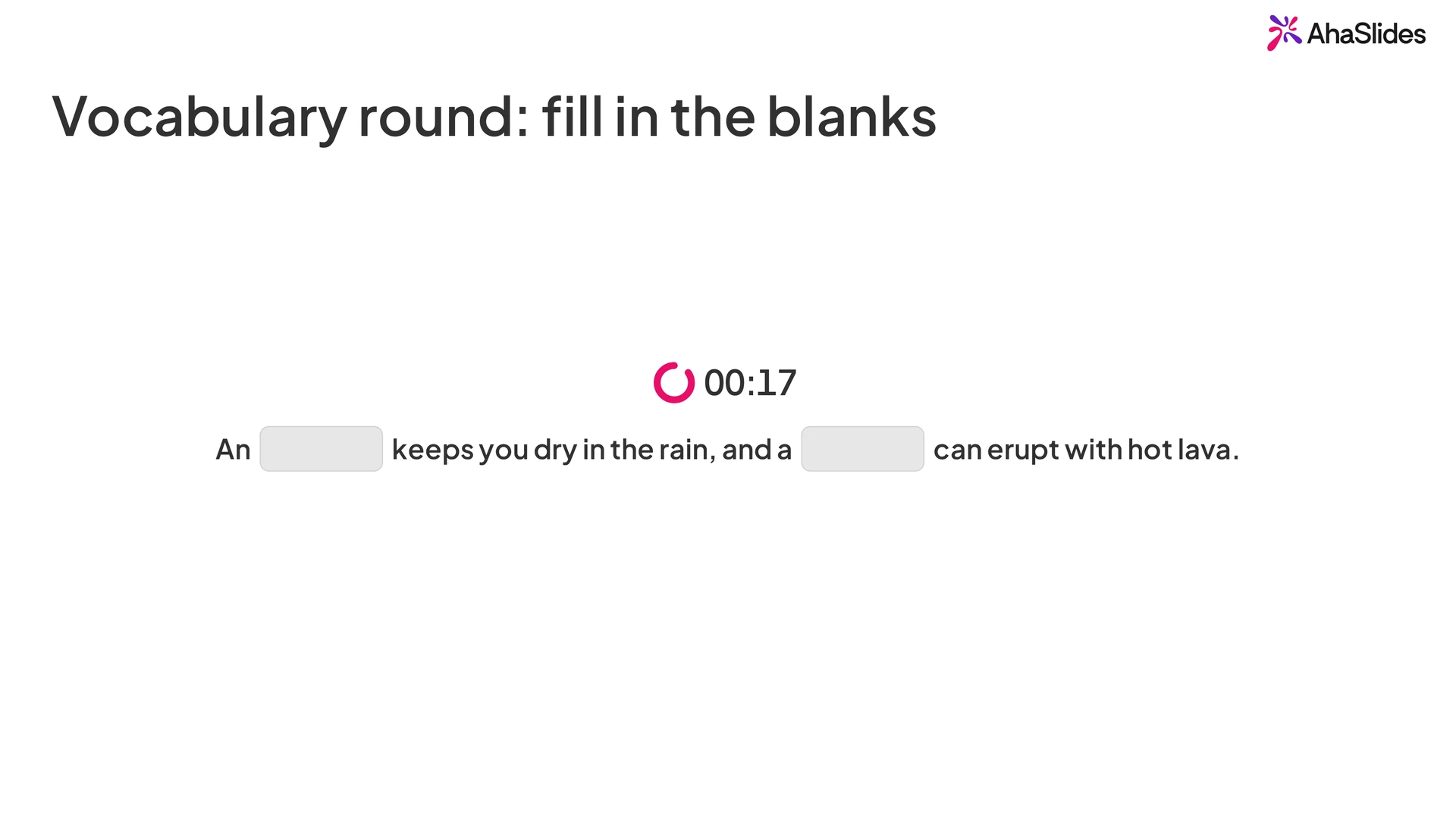
Warm up with a cloze round. A fill in the blanks game is a quick way to check a unit's key words: write a sentence on the board with a word missing, and let teams race to name it. To take the marking off your plate, build the round with Fill in the Blanks in AhaSlides. Type a sentence, blank out the key words, and students fill the gaps on their phones. Scoring is automatic.
Here is a round in a science lesson.
A teacher blanks key words in a science sentence, students type answers on their phones and the correct words show on the big screen.
The Fill in the blank template gives you fifteen questions in three rounds, from easy to hard, ready to rewrite with this week's words.
9. Pictionary
One student draws a word or phrase on the board (or in a shared digital whiteboard on a video call) while the rest of the class guesses. Drawings are timed, typically 20 to 30 seconds, to prevent overthinking. Play individually or in teams. Use subject-relevant vocabulary to keep the game tied to lesson content.
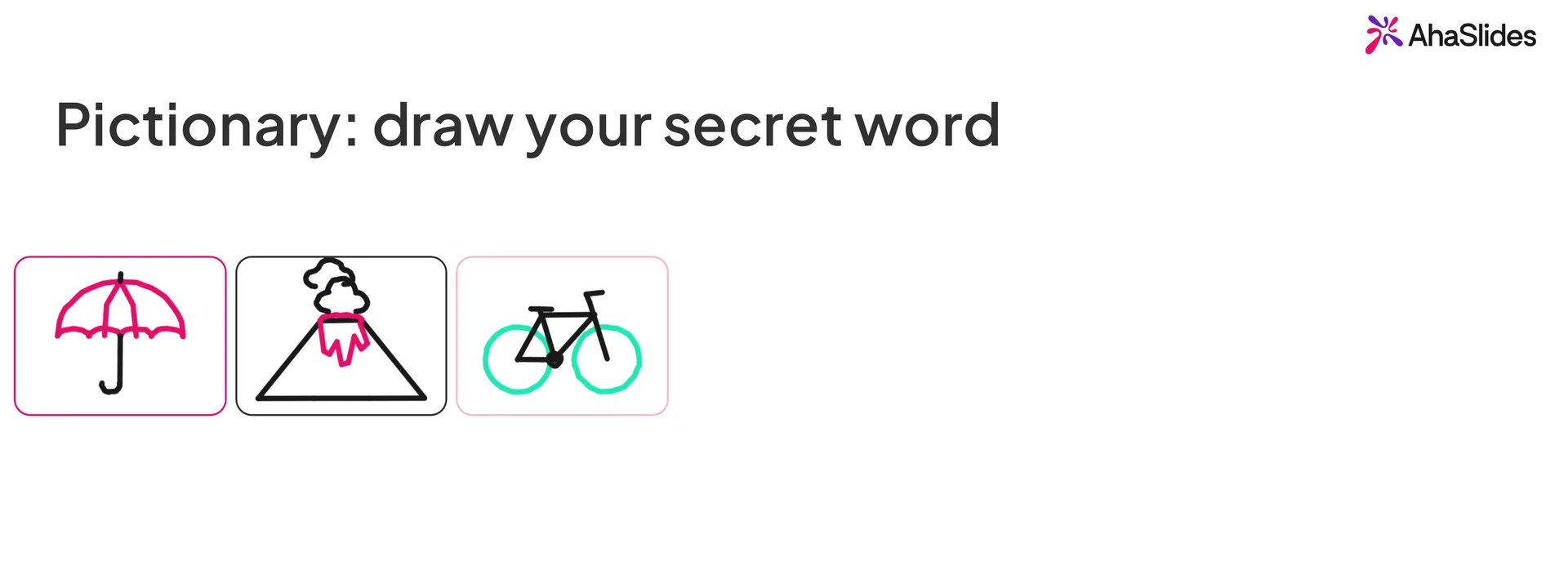
Get everyone drawing. On the board, one student draws while the rest watch. With Draw Answer in AhaSlides, every student sketches on their own phone at the same time. Hand out secret words on slips of paper, set the prompt to something like "Draw your secret word", then enlarge each drawing on the big screen and let the class guess. Draw Answer has no scoring or leaderboard, so keep team points on the board.
10. Word scramble
Prepare a list of scrambled target words and give students a set amount of time to decode them. Themed rounds work well: for example, scramble science vocabulary after a unit on ecosystems, or scramble historical terms before an exam. The first student to unscramble the full list wins.
11. Guess the secret word
Think of a target word and give students a series of related words as clues. For example, if the secret word is "migration", you might say "birds", "season", "pattern" and "route". Students call out guesses as clues accumulate. Students learn the word from the clues around it, by association.
12. Stop the bus
Divide the class into teams. Choose a letter and reveal a set of categories (for example: countries, food items, sports). Teams race to write one word per category beginning with that letter. The first team to complete every category shouts "Stop the bus!" Correct entries earn points. Rotate letters and categories across rounds.
Board-game style activities
Our pick: Boggle, because a 4x4 grid on the board and three minutes is all it takes, with nothing to buy.
13. Hedbanz
Print cards with animals, objects or vocabulary items, and have each student hold one against their forehead without looking at it. Students ask yes/no questions to guess what is on their card before time runs out. It is good practice at asking useful questions.
14. Boggle
Display a 4x4 grid of random letters and give students three minutes to write down as many words as they can find. Words must be formed from adjacent letters, moving in any direction. Longer words score higher. This works as a quiet individual activity or as a team competition. Free printable grids are widely available.
15. Apples to Apples
One player (or the teacher) draws a description card with an adjective. All other players select from their hand the noun card they think best matches that adjective. The judge picks the best match. The player whose card is chosen collects the description card. The first player to reach an agreed number of description cards wins. No boxed set? Write your own adjective and noun cards. It works best with older students and practises vocabulary and reasoning.
Maths games
Our pick: Guess my number, because it needs no materials and gets students using mathematical vocabulary out loud.
16. Would you rather
Present two mathematical scenarios, such as: "Would you rather have 12 cookies for $3.00 or 10 cookies for $2.40?" Students choose an option and justify it with maths. All students can submit responses simultaneously using a classroom poll. The follow-up discussion surfaces different reasoning strategies.
17. 101 and out
Groups take turns spinning a spinner (or rolling a die). Each spin gives a number. Players can use the number at face value or multiply it by 10. The goal is to reach exactly 101 or as close as possible without going over. Groups that exceed 101 are out. For older students, use decimal values or require division decisions to increase the challenge.
18. Guess my number
Think of a number between 1 and 100. Students ask yes/no questions to narrow it down: "Is it odd?" "Is it greater than 50?" "Is it a multiple of 7?" The student who correctly guesses the number picks the next one. This develops number sense, logical deduction, and mathematical vocabulary without any materials or setup.
Get started with AhaSlides
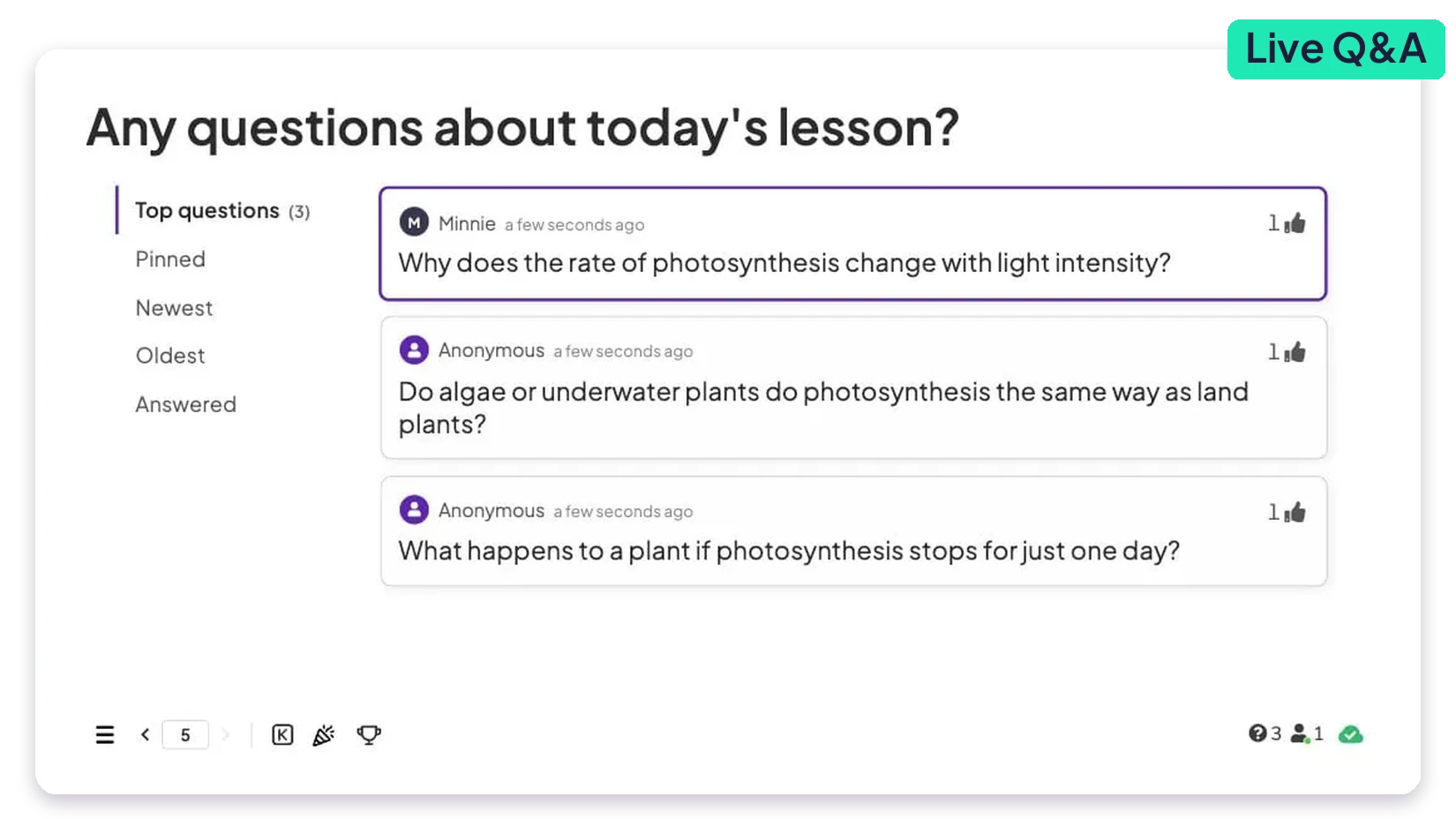
AhaSlides is an all-in-one engagement platform for teams and classrooms. Several games on this list run on it: live quizzes with leaderboards, Word Cloud, Poll, Draw Answer, Fill in the Blanks and Correct Order. It also has Open Ended and Q&A slides, and none of them need a download. Students join using an access code on any device, so you spend less time handing out materials and marking, and more time with your class.
The Free plan covers up to 50 live participants at a time, with unlimited presentations. See the pricing page for paid plans.
Frequently asked questions
Are these games suitable for all grade levels?
Most of the games above work from elementary to high school. A few, such as Boggle and Apples to Apples, suit older students better. Each game can be adapted by adjusting vocabulary difficulty or time limits.
Do I need special materials?
No. Most games on this list need only a whiteboard, printed word cards or a free digital tool. None require buying a physical board game.
Can I use these games for icebreakers?
Yes. Charades, Show and tell, Guess my number and Word chain all work as icebreakers at the start of term or when introducing a new class group.
How do I manage behaviour during games?
Set rules before the game starts: explain how points are earned, define what counts as unsportsmanlike conduct, and clarify what happens if a dispute arises. Agreeing the rules up front means fewer arguments mid-game.
Sources
[1] Plass, J. L., Homer, B. D., & Kinzer, C. K. (2015). Foundations of game-based learning. Educational Psychologist, 50(4), 258-283. https://doi.org/10.1080/00461520.2015.1122533
[2] Clark, D. B., Tanner-Smith, E. E., & Killingsworth, S. S. (2016). Digital games, design, and learning: A systematic review and meta-analysis. Review of Educational Research, 86(1), 79-122. https://doi.org/10.3102/0034654315582065