
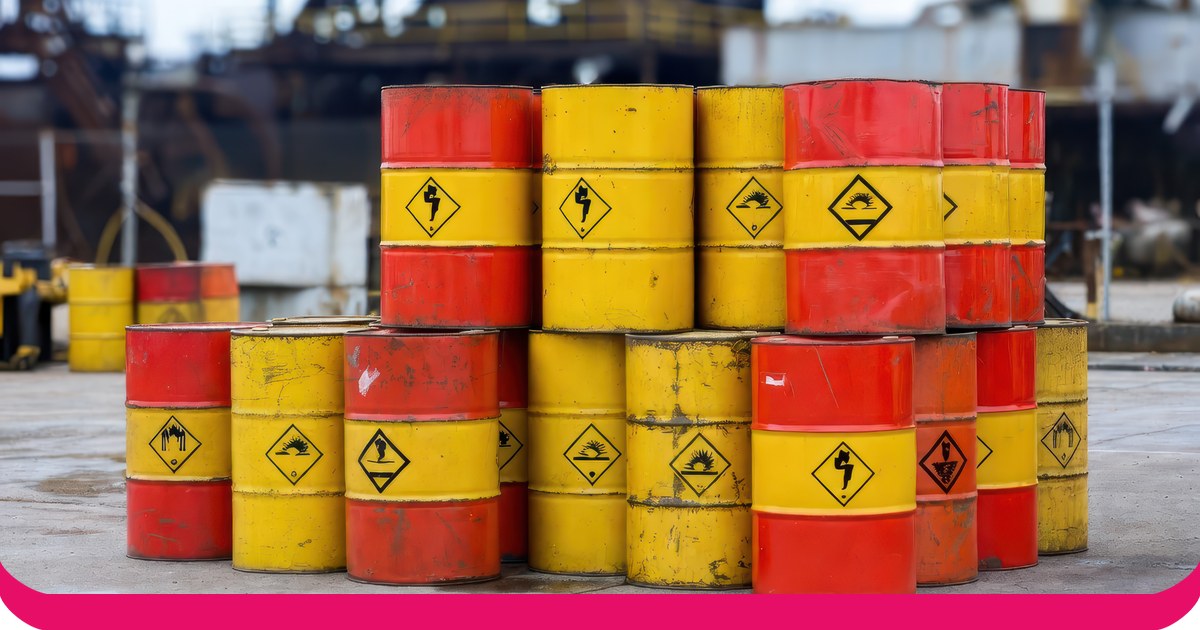
Hazard Communication (29 CFR 1910.1200) is the second most frequently cited standard on OSHA's preliminary list for fiscal year 2026, 1 October 2025 to 31 August 2026, after fall protection in construction (OSHA: top 10 most frequently cited standards). A poster of symbols on the wall does not show whether a team can read a label. A quiz does.
This quiz has 24 questions in 4 rounds, each with its answer and the source it comes from. The Globally Harmonized System (GHS) has 9 pictograms, but they are not one list everywhere. OSHA's pictogram QuickCard shows all 9 and marks the environment pictogram as non-mandatory, so OSHA requires 8. Canada's WHMIS 2015 uses a different set of 9. Round 1 names the 9 GHS symbols, rounds 2 and 3 cover US labels and safety data sheets, and round 4 covers WHMIS.
Where this quiz and your own site's hazard communication programme differ, your programme governs.
Round 1: name the symbol
Each question describes the symbol in words. The answer is the hazard it stands for. Source: OSHA QuickCard 3491, "HCS Pictograms and Hazards".
Set A
1. A flame. What kind of hazards does it mark?Fire hazards: flammables, pyrophorics, self-heating chemicals, chemicals that emit flammable gas, self-reactives and organic peroxides.
2. A flame over a circle. What does it mark?Oxidisers, which can cause or intensify a fire.
3. A gas cylinder. What does it mark?Gases under pressure, and chemicals under pressure.
4. A test tube pouring onto a hand and a metal bar. What does it mark?Corrosion: skin corrosion and burns, eye damage, and chemicals corrosive to metals.
5. A bomb exploding. What does it mark?Explosives, and some self-reactive chemicals and organic peroxides.
Our pick: question 2. People confuse the flame with the flame over a circle, and the difference is whether the chemical burns or feeds a fire.
Set B
6. A skull and crossbones. What does it mark?Acute toxicity at the fatal or toxic level.
7. A person with a star burst on the chest. What does it mark?A serious long-term health hazard: carcinogens, mutagens, reproductive toxicity, respiratory sensitisers, target organ toxicity and aspiration hazards.
8. An exclamation mark. What does it mark?Less severe hazards: skin and eye irritants, skin sensitisers, acute toxicity at the harmful level, narcotic effects and respiratory tract irritation.
9. A dead tree and a fish. What does it mark, and does OSHA require it?Aquatic toxicity, the environment pictogram. OSHA lists it as non-mandatory, so it is one of the 9 GHS symbols but not one of the 8 OSHA requires.
Our pick: question 7. The picture looks mild, and the hazards behind it are among the most serious on a label.
Round 2: labels and rules
A label on a container shipped under the US rule must carry six elements. Source: 29 CFR 1910.1200(f)(1) and Appendix C.
10. What six elements must a shipped container label carry?A product identifier, signal word, hazard statement or statements, pictogram or pictograms, precautionary statement or statements, and the name, US address and US telephone number of the chemical manufacturer, importer or other responsible party. Source: 1910.1200(f)(1)(i) to (vi).
11. A chemical has two hazards that both use the flame pictogram. How many flames go on the label?One. A pictogram may appear only once on a label. Source: Appendix C, C.2.3.4.
12. Can a label use a red diamond border with nothing inside it?No. A square red frame set at a point without a hazard symbol is not a pictogram and is not permitted on the label. Source: Appendix C, C.2.3.1.
13. A chemical is fatal if swallowed. Which pictogram goes on the label, the skull and crossbones or the exclamation mark?The skull and crossbones. Where the skull and crossbones is included, the exclamation mark does not appear for acute toxicity. Source: Appendix C, C.2.1.2.
14. Is the exclamation mark ever optional?Yes. It is permitted, but not required, for hazards not otherwise classified, with the words "Hazard Not Otherwise Classified" or the letters "HNOC" below it. Source: Appendix C, C.2.3.3.
Our pick: question 13. It teaches the one rule that explains why a deadly chemical shows the skull and not the exclamation mark.
Round 3: safety data sheets
A safety data sheet (SDS) has 16 sections in a set order. Employers must keep one in the workplace for each hazardous chemical they use. Source: 1910.1200(g)(1) and (g)(2).
15. How many sections does an SDS have, and is the order fixed?16, in a set order, from Section 1, Identification, to Section 16, Other information. Source: 1910.1200(g)(2).
16. Which section holds first-aid measures?Section 4. Source: 1910.1200(g)(2)(iv).
17. Which section tells you what to do after an accidental release or spill?Section 6, Accidental release measures. Source: 1910.1200(g)(2)(vi).
18. Where do you find exposure controls and the personal protection to wear?Section 8, Exposure controls and personal protection. Source: 1910.1200(g)(2)(viii).
19. Does OSHA enforce the information in sections 12 to 15?No. Those are ecological, disposal, transport and regulatory information, and OSHA states it will not enforce them because they are outside its jurisdiction. They still appear on the SDS to match the GHS. Source: Note 1 and Note 2 to 1910.1200(g)(2).
Our pick: question 17. Spills are where people reach for an SDS in a hurry, so knowing the section number saves minutes.
Round 4: GHS and WHMIS
Canada aligned WHMIS with the GHS. The questions below use the Canadian Centre for Occupational Health and Safety (CCOHS) fact sheet on WHMIS pictograms, last revised 28 May 2026.
20. How many pictograms does WHMIS 2015 use?Nine: flame, flame over circle, gas cylinder, corrosion, exploding bomb, skull and crossbones, health hazard, exclamation mark and biohazardous infectious materials. Source: CCOHS.
21. Which WHMIS pictogram has no place among OSHA's eight?Biohazardous infectious materials. Source: CCOHS; 1910.1200 Appendix C.
22. Does WHMIS list the environment pictogram?No. It is not among the nine that CCOHS lists. Source: CCOHS.
23. How many of OSHA's eight symbols appear in the WHMIS set?All eight. Both lists share flame, flame over circle, gas cylinder, corrosion, exploding bomb, skull and crossbones, health hazard and exclamation mark. Source: CCOHS; OSHA QuickCard 3491.
24. Does every WHMIS hazard category need a pictogram?No. Some categories, such as aerosols category 3 and flammable liquids category 4, require none, but the label and SDS section 2 still need the signal word and hazard statement. Source: CCOHS.
Our pick: question 24. It heads off the assumption that a label with no pictogram has no hazard.
How to run it with AhaSlides
Use the 24 questions as they are. One round takes about 5 minutes, which fits an induction or a toolbox talk.
- Pick Answer: one slide per question, with the answer revealed after the vote. Turn on the leaderboard to run it as a team game.
- Word Cloud: "Which symbol do you see most at work?" The answers show where your own risks sit.
- Rating Scale: "How sure are you of what each symbol means?" from 1 to 5, asked before and after the quiz.
- Open Ended: "Which label could you not read?" Bring the answers to your safety lead.
Start from the Hazard communication & GHS course template. Teams in Canada can use the Canada: WHMIS 2015 (classroom portion) template alongside it.
Tips for the session
- Run it as a 10-minute refresher at induction. Rounds 1 and 2 are enough for new starters. Keep rounds 3 and 4 for those who handle chemicals.
- Reuse the OSHA ranking. Tell the group that Hazard Communication is second on OSHA's preliminary list for fiscal year 2026, and that a label read wrongly is the everyday version of that figure. For a wider programme, pair it with the workplace safety quiz and 100 workplace safety topics.
- Hold up your own labels. Bring three containers from your store room and ask the group to find the six label elements. Anything missing is a finding worth reporting. For more ways to keep a session lively, see interactive games for training sessions and planning a training session.
Frequently asked questions
How many GHS pictograms are there?
The GHS has 9, including the environment pictogram. OSHA requires 8 of them on US labels and lists the environment pictogram as non-mandatory (OSHA QuickCard 3491).
What are the OSHA hazard communication pictograms?
Flame, flame over circle, gas cylinder, corrosion, exploding bomb, skull and crossbones, health hazard and exclamation mark. Each pictogram uses one of eight standard symbols (29 CFR 1910.1200 Appendix C, C.2.3.2).
What is the difference between GHS and WHMIS pictograms?
WHMIS 2015 adds a biohazardous infectious materials pictogram and does not list the environment pictogram (CCOHS).
How many sections does a safety data sheet have?
16, in a set order. OSHA does not enforce the information in sections 12 to 15 (29 CFR 1910.1200(g)(2)).
Where to start
Run Round 1 at your next induction, then ask your safety lead to check that your store-room labels carry all six elements. Build the session from the ready-made template.