Gap fill exercises look simple: take a sentence, remove a word, ask learners to put it back. Yet the way you remove the word, and whether you give learners options, changes what the exercise tests, how hard it feels and how fast you can mark it.
This guide walks through six types of gap fill exercises, from a gentle banked task for beginners to an exam-style open cloze. Each type has a worked example, an answer key and a note on when it earns its place in a lesson. Everything is ready to copy into a worksheet or run live.
At a glance: the six types
| Type | Learner does | Best for | Level |
|---|---|---|---|
| 1. Word bank (banked) | Picks from a shared list of words | New grammar or vocabulary | A1 to A2 |
| 2. Multiple-choice (drop-down) | Picks from 2 to 4 options per gap | Fast checks, large classes | A1 to B1 |
| 3. Open sentence gap | Types the missing word, no options | Revision and diagnostics | A2 to B2 |
| 4. Open cloze passage | Fills gaps across a short text | Exam practice, reading skills | B1 to C1 |
| 5. Hint-led gap | Types the word from a first letter or root | Scaffolded recall | A2 to B2 |
| 6. Listening gap fill | Hears the text, fills the gaps | Listening for detail | A2 to C1 |
What is a gap fill exercise?
The British Council’s TeachingEnglish site defines a gap-fill as a practice exercise in which learners replace words missing from a text, with the words chosen and removed to practise a specific language point. A cloze, also called a cloze test, by contrast removes words at regular intervals, for example every fifth word, and is more often used for reading skills or general review.
The idea of removing words at fixed intervals goes back to Wilson Taylor, who introduced the cloze procedure in 1953 as a way to measure how readable a text is. Teachers later borrowed it for language learning because supplying a missing word forces learners to use grammar, vocabulary and context at once.
In practice the terms overlap, and learners searching for “text with gaps exercises” want both. The useful split is not gap fill versus cloze. It is banked versus open.
Banked or open: the choice that shapes the task
A banked gap fill gives learners the answers up front, either as a word bank above the text or as a short list of options per gap (a drop-down on screen). The learner recognises the right form. An open gap fill gives no options, so the learner has to produce the word from memory.
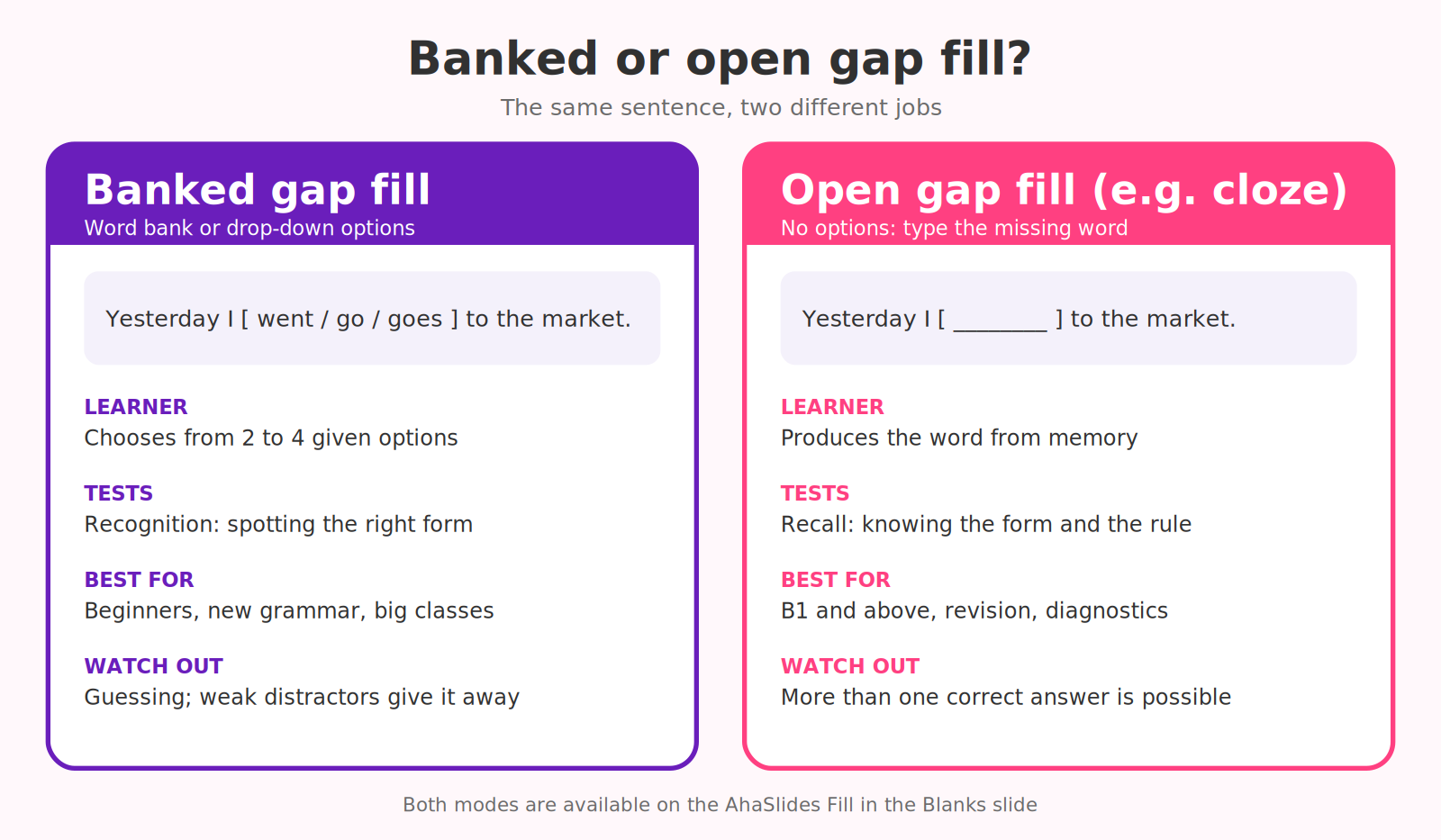
Neither is better. Banked tasks lower the stakes and keep marking objective, which suits new language and big groups. Open tasks show you what learners can really recall, which is what you want before an exam or when you suspect a class has only half learned a rule.
Run both modes live in one deck
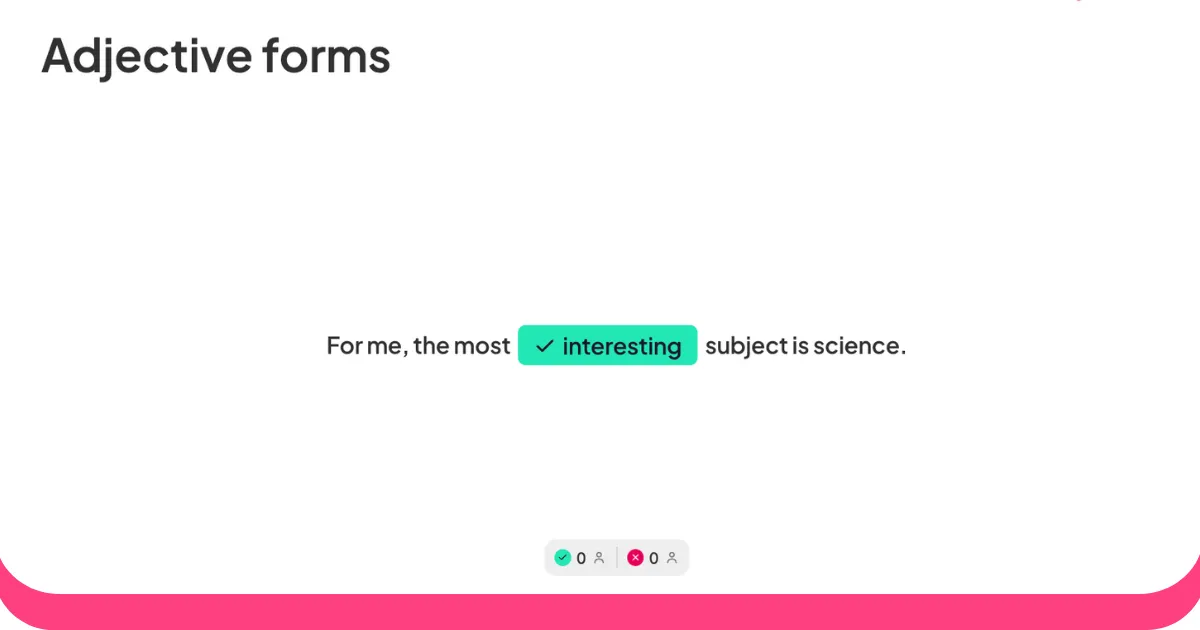
Printing worksheets works, but live delivery lets you see results as they arrive. The AhaSlides Fill in the Blanks slide has both modes built in: learners either type each missing word or pick from a drop-down, and you can accept alternative spellings such as colour and color for one gap. Here is a banked slide and an open slide from a deck we built for this guide:
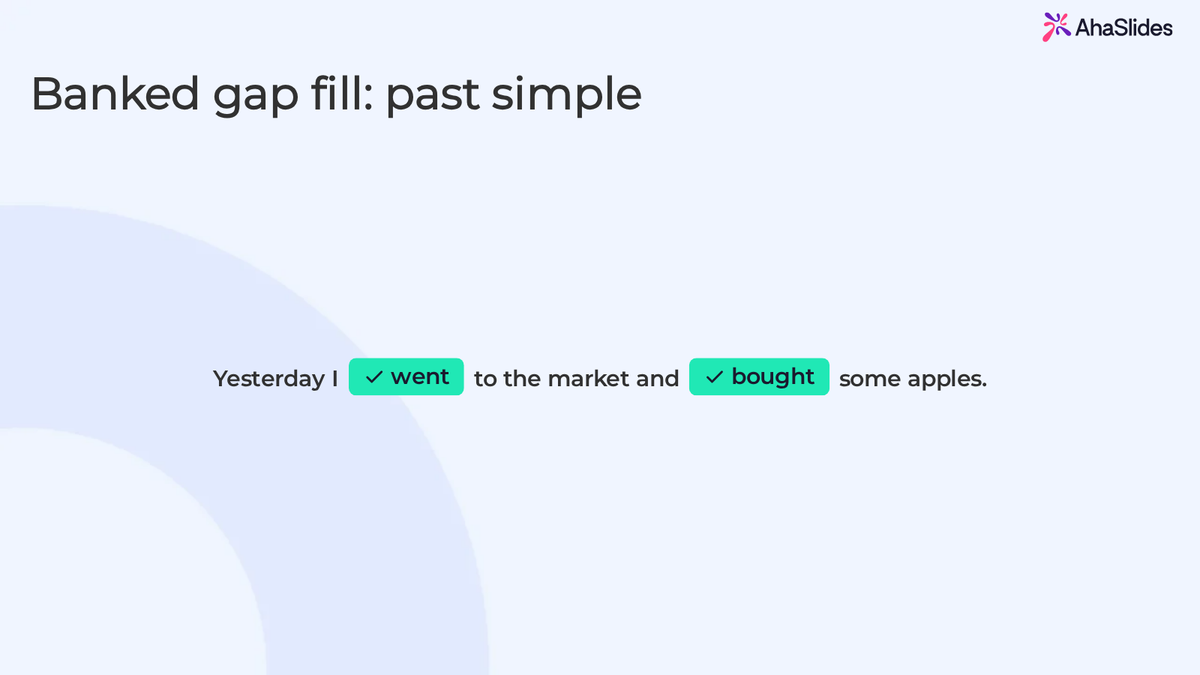
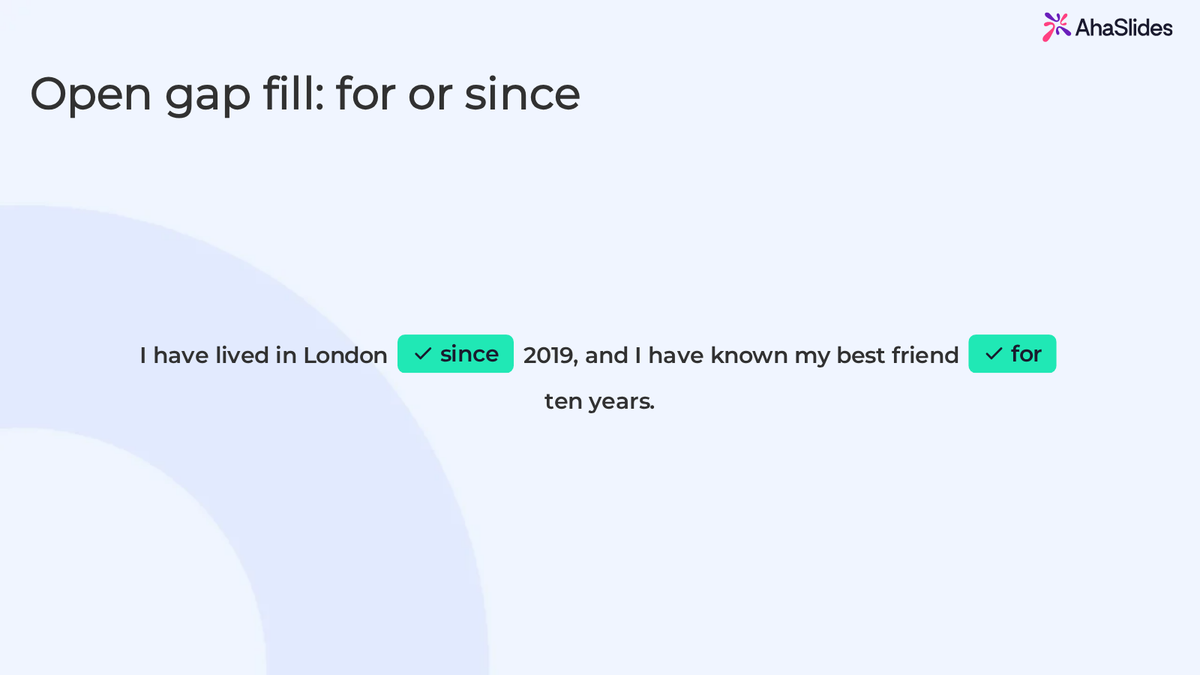
Both screenshots are the template preview with the answer key revealed. During play, learners see the gaps on their own phones and submit from there. The deck below contains four ready-made slides, two banked and two open, which you can copy and edit for your own class.
Type 1: word bank gap fill
What it is. A short text or set of sentences with gaps, plus a box of words to choose from. Include one or two extra words so learners cannot finish by elimination.
When to use it. Straight after you present new grammar or a vocabulary set, when you want success to be likely.
Example (past simple). Word bank: went, bought, wrote, played, slept, ate
- Last Saturday we ______ to the beach.
- Before we left, I ______ a new hat at the shop.
- At the hotel I ______ a postcard to my grandmother.
- In the afternoon the children ______ football.
Answer key. 1. went 2. bought 3. wrote 4. played. (slept and ate are the extra words.)
Tip. Put the bank in a different order from the gaps, and use words that fit more than one gap grammatically, so learners must read the sentence, not just match shapes.
Type 2: multiple-choice (drop-down) gap fill
What it is. The banked idea with the options attached to each gap. Two to four choices per gap is the usual range: enough to make learners think, few enough to read in seconds.
When to use it. Quick comprehension checks, large classes, or a warm-up that needs no marking time.
Example (prepositions of time). Choose at, on or in.
- The film starts [at / on / in] 7.30 p.m.
- We have a quiz [at / on / in] Friday.
- My birthday is [at / on / in] June.
Answer key. 1. at 2. on 3. in.
Tip. Good distractors are the mistakes your learners really make. If your students say “on June”, make on an option. Random wrong answers teach nothing.
Type 3: open sentence gap fill
What it is. Single sentences with one gap each and no options. The learner types or writes the word.
When to use it. Revision of a grammar point you have already taught, and quick diagnostics at the start of a unit.
Example (for and since).
- I have lived in London ______ 2019.
- I have known my best friend ______ ten years.
- She has worked here ______ she graduated.
Answer key. 1. since 2. for 3. since.
Tip. Check the sentence has one clear answer. “If it ______ tomorrow, we will cancel the picnic” accepts rains as the standard answer, which is tidy. “I ______ a good time” accepts had, am having, will have and more, which turns marking into an argument. When more than one answer is genuinely right, list them in the key before you start.
Type 4: open cloze passage
What it is. A short paragraph with six to ten gaps and no word bank, usually testing grammar words such as articles, prepositions, auxiliaries and pronouns. This is the format behind the open cloze task in the Cambridge English B2 First exam, where Reading and Use of English Part 2 has eight gaps, each needing one word, with one mark for each correct answer.
When to use it. Exam preparation, and any time you want learners to use context across sentences, not just inside one.
Example (everyday routines, B1).
Maya usually gets up (1) ______ half past six. She works for a company (2) ______ makes furniture, and she goes to work (3) ______ bus. If the bus is late, she walks (4) ______ the station instead. She has (5) ______ in the same office for four years, and has never looked for another job because she (6) ______ it very much.
Answer key. 1. at 2. that (or which) 3. by 4. to 5. worked (or been working, been) 6. likes (or enjoys, loves).
Tip. Gaps 2, 5 and 6 accept more than one answer, which is exactly the point to discuss afterwards. Open cloze is a good place to teach the habit of reading the whole sentence before choosing a word.
Type 5: hint-led gap fill
What it is. An open gap with a clue: the first letter, the number of letters or the root word in brackets. It sits halfway between banked and open.
When to use it. Vocabulary, word formation and collocations, where learners know the idea but not the exact form.
Example (word formation). Write the correct form of the word in brackets.
- She gave a very (IMPRESS) ______ presentation.
- It was an (ENJOY) ______ evening.
- Please fill in the (APPLY) ______ form.
Answer key. 1. impressive 2. enjoyable 3. application.
Tip. Keep hints consistent within one worksheet. Mixing first letters, root words and letter counts confuses learners about what is being asked.
Type 6: listening gap fill
What it is. Learners read a transcript with gaps while they listen to a recording, then fill the gaps. Songs, short dialogues and news clips all work.
When to use it. Listening for detail, connected speech and reduced forms, and a change of pace in a long lesson.
Example (dialogue). Record yourself and a colleague reading this short dialogue (about 20 seconds), or read it aloud with a partner. Learners fill in:
A: Are you free (1) ______ Thursday?
B: I have a meeting until two o’clock, but I’m free (2) ______ that.
A: Great. Shall we meet (3) ______ the café near the station?
Answer key. 1. on 2. after 3. at (or in).
Tip. Play or read it twice. Let learners fill in what they can on the first listen, then check and finish on the second. Choose gaps that carry stress or reduction, such as can versus can’t, so the task trains the ear.
How to design a good gap fill exercise
- Test one thing per gap. If a gap checks both the tense and the spelling of an irregular verb, you will not know which one the learner missed.
- Delete words that matter. Removing the in every line tests little. Choose the words that carry the point of the lesson.
- Give enough context. A sentence such as “He ______ it” has too many right answers. Add a time word or a second clause.
- Keep the text short and natural. Eight to ten gaps in a passage of 80 to 120 words is plenty at B1.
- Check every answer yourself. Ask a colleague to fill the gaps without your key. Any gap that two people fill differently needs fixing or an accepted-answers list.
- Plan the feedback. Learning happens when you discuss why an answer fits, not when the key appears.
Common mistakes to avoid
- Too many gaps. Beyond one gap in every six or seven words, a text becomes a guessing game, not a language task.
- Ambiguous answers. Always decide in advance which alternatives you will accept, and tell learners.
- Gaps with no clue to the answer. Learners should be able to work the answer out from the text, not from knowing your lesson plan.
- Marking the wrong skill. Decide whether you are testing grammar or spelling, and mark only that.
Match the type to the level
| Level (CEFR) | Start with | Move on to |
|---|---|---|
| A1 | Word bank, with pictures if possible | Drop-down gap fill |
| A2 | Drop-down gap fill | Open sentence gap fill, hint-led gaps |
| B1 | Open sentence gap fill | Short open cloze (6 to 8 gaps) |
| B2 | Open cloze passage | Exam-style cloze, listening gap fill |
| C1 | Open cloze with collocations and linkers | Authentic text with selective deletion |
How to run gap fill exercises in class
- Set the purpose. Tell learners what the exercise practises: “Today we are checking for and since.”
- Model one gap. Do the first item together and say why the answer fits.
- Let them work alone or in pairs. Pairs talking through a choice often learn more than solo learners who guess.
- Reveal and discuss. Go through each gap, ask for the reason, and note accepted alternatives.
For live groups, a screen-based version saves the marking step: each learner answers on their own device and you see which gaps caused trouble before you move on. If you enjoy game formats, our guide to the fill in the blank game shows how to add points and teams, and the list of ESL classroom games for all ages has more ideas for the same lesson.
Keep exploring the gap fill series
This is part of a short series on fill in the blank activities:
Frequently asked questions
What is the difference between a gap fill and a cloze?
A gap fill removes words chosen to practise a specific point, such as prepositions. A cloze removes words at regular intervals, such as every fifth word. In everyday teaching the two terms overlap, and many worksheets mix both approaches.
What is a banked gap fill?
A banked gap fill provides a bank of words, or a list of options per gap, so learners choose rather than produce the answer. It is easier to complete and mark, which makes it a good first step before open tasks.
What is an open cloze exercise?
An open cloze is a text with gaps and no options. Each gap needs one word, usually a grammar word. It is the format used in Part 2 of the Cambridge English B2 First Reading and Use of English paper.
How many gaps should a gap fill exercise have?
For a single sentence, one or two. For a passage of 80 to 120 words, six to ten gaps works well at B1 and above. Fewer gaps with better context beat many gaps with weak clues.
Can I run gap fill exercises online with my students?
Yes. Use a tool that supports both typed and drop-down answers and lets you accept more than one correct word. The AhaSlides Fill in the Blanks slide does both, and the template above is free to copy and edit.
Make your next gap fill interactive
Gap fill exercises work best when learners get feedback straight away. Copy the template, swap in your own sentences and run it with your next class.