
The imposter word game is a party game where everyone gets the same secret word except one player, the imposter, who gets a slightly different word. Each player gives a one-word clue, then the group votes on who they think the imposter is. It takes about 10 minutes, needs 4 or more players and nothing more than a way to pass on the words, so it works at a team meeting, a year-end party or on a video call.
You may also see it called "Who is the impostor?", Word Impostor or Guess the Imposter. It took off as a social media trend, mainly across TikTok and Instagram Reels (PlayLab! Magazine, Tampere University, February 2026).
It suits work because everyone has to listen closely. Gallup's 2025 report found that 22% of employees worldwide felt lonely a lot of the previous day, so a game where colleagues who rarely work together have to read each other's clues is an easy way to start a conversation, and nobody has to perform.
Below: the rules in five steps, rules for groups of 4 to 8, 9 to 20 and 20+, then 45 word pairs in 3 rounds (office, Christmas and year-end, AI and tech), each split into sets of 5 with Our pick for every round.
The imposter word game at a glance
- Players: 4 or more (5 to 8 is the easiest size to run)
- Time: 10 to 15 minutes per round
- You need: A list of word pairs and a private way to share them: folded slips, or direct messages
- Works: In a room, on a video call, or hybrid
- Win: The group wins by voting out the imposter; the imposter wins by staying hidden
How to play the imposter word game: the rules in 5 steps
- Pick a word pair. Pick a word pair, such as 'annual leave' and 'sick day'. The group gets the first word; the imposter gets the second.
- Deal the words in private. Every player gets their card without anyone else seeing it. The imposter knows who they are and has to bluff from the start.
- Give one-word clues. Go round the group once. Each player says one word linked to the secret word. Too vague and you look like the imposter; too specific and you hand the word to the imposter.
- Discuss for one minute. Who gave a clue that did not quite fit? The imposter tries to blend in.
- Vote. Everyone votes at the same time for who they think the imposter is. The player with the most votes reveals their card.
Scoring (optional). Every player who voted for the imposter scores 1 point. An imposter who survives the vote scores 2. A caught imposter can still win 1 point by guessing the secret word.
Variant: the blank-card version (the imposter gets only the category). Choose a secret word inside a category, such as "stapler" in "office kit". The group gets the word and the imposter gets only the category, so they know they are the imposter from the start. It is easier for first-time players to spot, so try the word-pair version first. The word pairs below work for both versions: use the first word of a pair as the secret word and its category as the hint.
Imposter game rules by group size
The game changes as the group grows. Use these imposter game rules to keep everyone involved, whatever the headcount.
| Group size | Imposters | Clue rounds | How to run it |
|---|---|---|---|
| 4 to 8 players | 1 | 1 | Say clues out loud in a circle, then one vote. About 10 minutes |
| 9 to 20 players | 2 | 2 | Collect clues on phones so nobody waits long for a turn. Vote out one player after each round |
| 20+ players | 1 per table | 1 per table | Split into tables of 6 to 8. Each table plays its own game; the host reads out the best bluff from each table at the end |
A bigger meeting should not mean fewer people get heard. With 20 or more players, a single circle takes too long and most people only listen, so split them into tables and let each table play at once. The host deals one word pair per table and keeps the scores.
How to deal the secret words
Dealing the words is the only step that needs care, because nobody may see anyone else's word.
- In a room: write each word on a slip, fold it and hand them out. Mark nothing on the outside.
- On a video call: send each player their word by direct message in Teams, Slack or Zoom chat, just before the round starts.
- Hybrid: use direct messages for everyone, including the people in the room, so remote colleagues are not the only ones on a different system.
Round 1: office imposter game words
Fifteen pairs from everyday work. Each pair lists the crowd word first, then the imposter's word.
Set A: meetings
- Meeting / Webinar
- Stand-up / Check-in
- Agenda / Minutes
- Presentation / Pitch
- Deadline / Target
Set B: office kit
- Stapler / Paper clip
- Printer / Scanner
- Whiteboard / Flip chart
- Lanyard / Name badge
- Coffee machine / Kettle
Set C: work life
- Commute / School run
- Lunch break / Coffee break
- Promotion / Pay rise
- Annual leave / Sick day
- Inbox / Spam folder
Our pick: pair 14, annual leave and sick day. Both mean a day away from your desk, so "sofa", "tissues" and "beach" split the group fast and the imposter is caught out within one round.
Round 2: Christmas and year-end imposter game words
Fifteen pairs for the end-of-year party (pick a theme from our year-end party themes and play the matching set). Set C works for any year-end celebration, including Lunar New Year.
Set A: festive food and drink
- Mince pie / Christmas pudding
- Turkey / Roast chicken
- Gingerbread / Shortbread
- Mulled wine / Hot chocolate
- Candy cane / Lollipop
Set B: traditions
- Advent calendar / Wall calendar
- Secret Santa / Yankee swap
- Christmas jumper / Scarf
- Snowman / Snow angel
- Carol singing / Karaoke
Set C: the year-end party
- Lucky draw / Bingo
- Awards night / Talent show
- Fireworks / Sparklers
- Countdown / Toast
- Red envelope / Gift card
Our pick: pair 22, Secret Santa and Yankee swap. Most offices have done one or the other, so clues such as "gift" and "surprise" fit both, and the round turns into a friendly argument about the rules.
Round 3: AI and tech imposter game words
Fifteen pairs for teams who spend their day on screens.
Set A: AI
- Chatbot / Search engine
- Prompt / Search query
- Robot / Drone
- Algorithm / Recipe
- Deepfake / Photo filter
Set B: gadgets
- Smartwatch / Fitness tracker
- Laptop / Tablet
- Earbuds / Headphones
- Smart speaker / Radio
- VR headset / 3D glasses
Set C: internet life
- Emoji / Sticker
- Meme / GIF
- Hashtag / Keyword
- Podcast / Audiobook
- Wi-Fi / Bluetooth
Our pick: pair 34, algorithm and recipe. A recipe is a set of steps, and so is an algorithm, so "steps" and "ingredients" sound safe to both sides until someone says "oven".
Writing your own imposter game words
Good pairs share three or four obvious clues and differ on one. Before the round, say three clues for each word in your head:
- If all three fit both words, the pair is too close and the imposter can never be caught.
- If none fit both, the pair is too far apart and the imposter is caught on the first clue.
- One or two shared clues is the sweet spot.
Inside jokes make the best imposter game ideas. Use your team's own words: two project code names, two office meeting rooms, or two favourite lunch spots near the office.
How to host the imposter game for a group on AhaSlides
AhaSlides is an all-in-one engagement platform for teams and classrooms. It cannot send a different secret word to each phone, so deal the words yourself first (see above). After that, these slides run the rest of the game on the big screen while everyone plays on their phones, with no app to install:
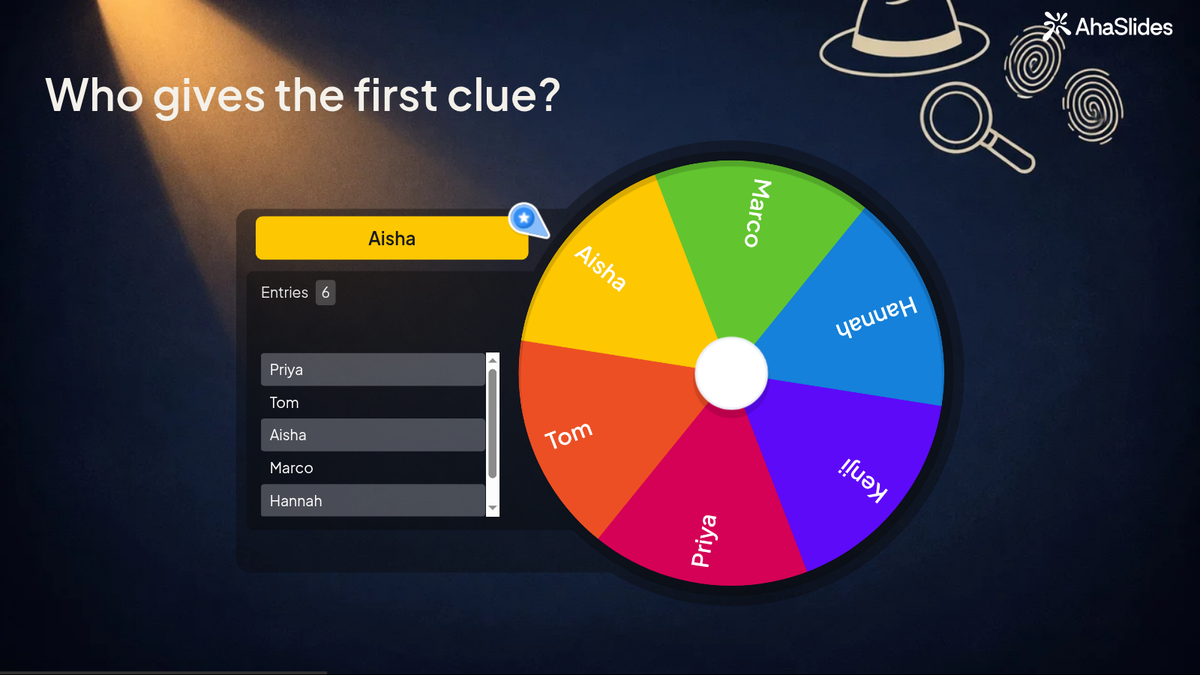
- Pick who goes first: Spinner Wheel. It can fill itself with the names of everyone who joins, so a spin decides who gives the first clue.
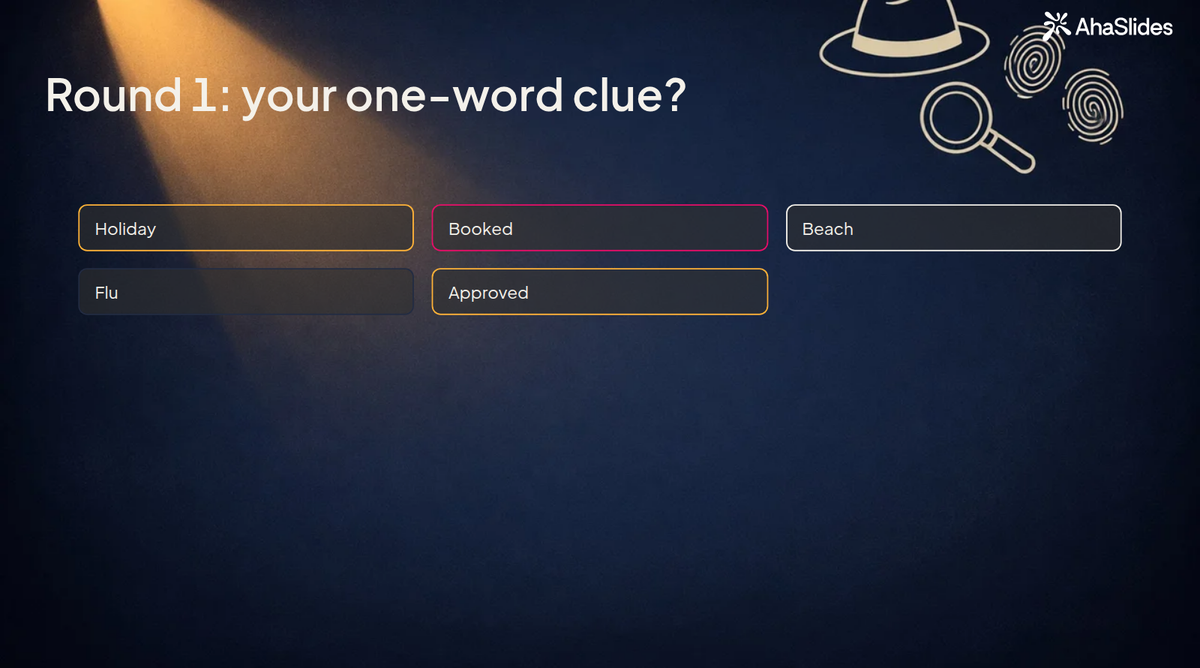
- Collect the clues: Open Ended. Ask "Your one-word clue?". Turn on Collect audience info with a name field, so every clue shows who wrote it, and pick the One by one layout to reveal the clues one at a time. Show results manually keeps the clues hidden until everyone has answered, so nobody copies. Open Ended accepts up to 500 characters, so remind players: one word only.
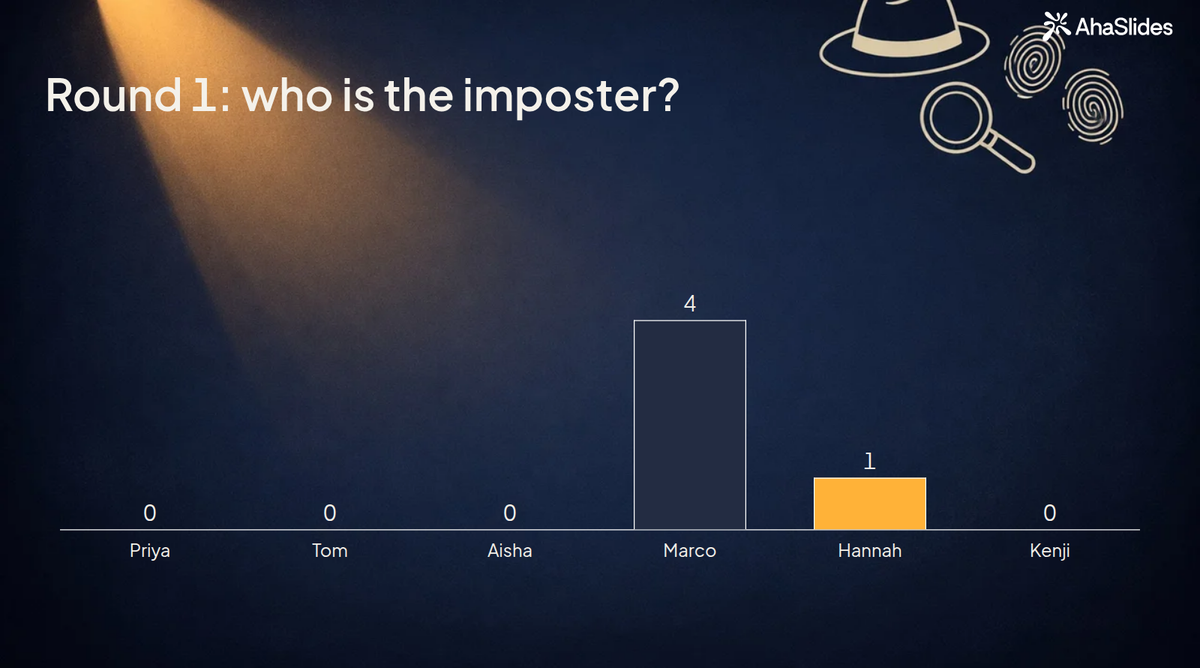
- Vote: Poll. List the players' names as options, with no answer ticked, so the group decides.
- Big groups: Random Group Maker. For 20+ players, it splits everyone who joins into named tables in a few seconds. Random Group Maker is on Global and US accounts first, and not yet on EU accounts.
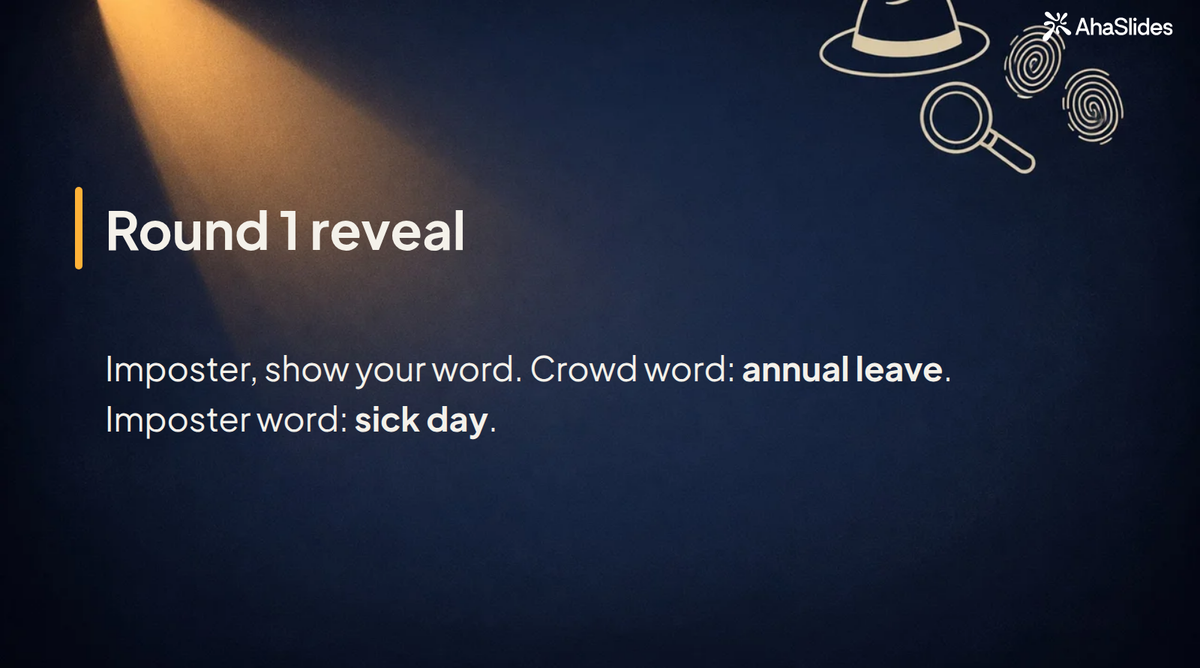
Want it ready-made? The Imposter word game template has 11 slides: a spinner for who clues first, then for each of two rounds a word-reveal slide, a clue wall, a "who is the imposter?" poll with no answer ticked, and a reveal. The blank-card variant is in the speaker notes. It leaves out the Random Group Maker, so add that slide yourself for 20+ players:
The template uses three interactive slide types (Spin the wheel, Open Ended and Poll), more than the free plan's limit of 2 per presentation. A free account still lets up to 50 people join: keep Open Ended for the clues and Poll for the vote, and pick the first player by hand. Adding Random Group Maker needs a paid plan too.
Tips for playing the imposter game at work
- Use it to mix teams. With 22% of employees worldwide feeling lonely a lot of the previous day (Gallup, 2025), seat people next to colleagues from other departments. Reading someone's clues is a fast way to learn how they think.
- Play a practice round first. Use an easy pair from Round 1 with the blank-card variant, so everyone sees how a round works before the points count.
- Keep the words work-safe. Avoid pairs about colleagues, politics, religion or bodies. The 45 pairs above are written for a mixed office.
- Put remote players first. On a hybrid call, let remote colleagues give the first clues, so they are not left to answer after everyone in the room has already reacted.
- Stop at three rounds. The game is best short. Three rounds, about 30 minutes, then move on to food or a caption this game round.
Frequently asked questions
What is the imposter word game?
It is a party game where every player gets the same secret word except one, the imposter, who gets a different word or none. Players give one-word clues and then vote on who the imposter is.
What is the "who is the impostor" game?
It is the same game under another name. "Who is the impostor?" is the question the group answers in the vote at the end of each round.
How many players do you need for the imposter game?
At least 4, and 5 to 8 is the easiest size. With 9 to 20 players use two imposters; with 20 or more, split into tables of 6 to 8.
What are good words for the imposter game?
Pairs that share one or two clues, such as "lunch break" and "coffee break" or "Secret Santa" and "Yankee swap". Pick a category your players all know, such as office life, Christmas or tech.
Can you play the imposter word game online?
Yes. Send each player their word by direct message, then collect clues and run the vote on a shared screen. On AhaSlides, players answer on their phones or laptops from the video call.
Related posts
- Planning more games for the same day? Our office games work at any time of year.
- For the festive party itself, pick from these office Christmas party games.
- Need a warm-up before the first round? Pick from these icebreaker games.
- Celebrating with remote colleagues? See our virtual year-end celebration ideas.