

The best employee survey questions are the ones you are ready to act on. Here are 100 of them in 10 rounds, from motivation and pay to managers, wellbeing and the day someone leaves. Each round is split into sets of five you can mix into your own survey, each has our pick, and six ready-made templates show which questions to combine.
Why care so much about the questions? Because people keep speaking up only when they can see that listening leads somewhere. Just 20% of employees worldwide were engaged at work in 2025, according to Gallup's State of the Global Workplace 2026 report. A short survey that asks the right things, followed by a clear "here is what you told us", is one of the simplest ways to find out why your own number looks the way it does.
How to read the lists: statements use a 1 to 5 agree scale (strongly disagree to strongly agree) unless the answer type is shown in brackets.
Round 1: engagement and motivation
These questions show whether people still want to give their best, and whether they plan to stay. For a deeper set built on engagement models, see our guide to the best employee engagement survey.
Set 1: energy and pride5 questions
1I feel motivated to do my best work here.
2I would recommend this company as a great place to work.
3I am proud of the work my team does.
4I can see how my work contributes to the company's goals.
5In the last month, what gave you the most energy at work?
Set 2: commitment5 questions
6I see myself still working here in two years.
Our pick
7When I go the extra mile, it gets noticed.
8I rarely think about looking for a job elsewhere.
9My work gives me a sense of achievement.
10What would make you more excited to come to work?
Our pick: question 6. A drop here is an early warning, long before a resignation.
Round 2: job satisfaction, pay and recognition
Satisfaction questions ask how people feel about the job itself and what they get for it. Our employee satisfaction survey guide covers the different types and when to run each.
Set 1: the job5 questions
11How satisfied are you with your job overall?
12My role makes good use of my skills.
13I have enough freedom to decide how I do my work.
14My goals for this quarter are clear to me.
15Which part of your job would you happily do less of?
Set 2: pay, benefits and recognition5 questions
16I feel fairly paid for the work I do.
17I understand how pay decisions are made here.
Our pick
18Which benefits matter most to you?
19In the last month, someone thanked me for good work.
20How satisfied are you with the recognition you get?
Our pick: question 17, because you can tell whether a pay complaint is about the number or about trust in how the number is set.
Round 3: managers and leadership
Managers shape whether people stay, so read these answers closely. For a full manager review, use our leadership survey questions.
Set 1: your manager5 questions
21My manager gives me useful feedback on my work.
22My manager checks in on how I am doing, not only on what I am doing.
23I can raise a concern with my manager without worrying about the consequences.
24My manager helps me clear blockers.
25What is one thing your manager could start doing to help you?
Set 2: senior leaders5 questions
26I trust the decisions senior leaders make.
27Leaders explain the reasons behind big decisions.
28I believe leaders act on what employees say in surveys.
Our pick
29Leaders behave in line with our company values.
30If you could ask the leadership team one question, what would it be?
Our pick: question 28. If people do not believe leaders act on surveys, every other answer is less honest than it looks.
Round 4: growth, learning and careers
These questions show whether people are learning, and whether they can see a future for themselves here.
Set 1: learning5 questions
31I have learned something new at work in the last three months.
32I get the training I need to do my job well.
33I have time set aside for learning.
34Which skill would you most like to build in the next year?
35Which way of learning suits you best?
Set 2: careers5 questions
36I can see a clear path for my career here.
37I have talked about my career goals with someone at work in the last six months.
38Promotions here go to the people who deserve them.
Our pick
39I could move to a different role or team here if I wanted to.
40What would make you more likely to grow your career here rather than elsewhere?
Our pick: question 38. A team forgives slow promotions more easily than unfair ones, and this answer shows which one you have.
Round 5: wellbeing and workload
These questions show whether the workload is sustainable, and whether people feel supported when it is not.
Set 1: workload and balance5 questions
41My workload is manageable most weeks.
42I can switch off from work outside working hours.
43How often do you feel exhausted at the end of a working day?
44Meetings leave me enough time for focused work.
45What is one task or meeting you would remove from your week?
Our pick
Set 2: support5 questions
46I feel comfortable taking time off when I need it.
47I know where to get support if I am struggling.
48My team would help if my workload became too much.
49It is safe to admit a mistake on my team.
50How would you rate your wellbeing at work this month?
Our pick: question 45. It gives you something specific you could change by next week.
Round 6: inclusion, belonging and culture
Ask these anonymously, and only show a group's results when enough people answered that nobody can be singled out.
Set 1: belonging and fairness5 questions
51I feel I belong on my team.
52I can be myself at work.
53People here are treated fairly whatever their background.
54Different points of view are welcome in team discussions.
55In the last year, I have seen or experienced behaviour at work that made me uncomfortable.
Set 2: culture and values5 questions
56Which three words describe our culture today?
Our pick
57Which three words would you like to describe our culture a year from now?
58Our company values guide how decisions are made.
59Teams here work well together across departments.
60Is there anything that stops you from speaking up in meetings?
Our pick: question 56. Ask it beside question 57, and the gap between the two answers is your culture plan in a few words.
Round 7: communication, tools and change
These questions show whether information reaches people, whether their tools help, and how they feel about change.
Set 1: communication5 questions
61I hear about changes that affect me in good time.
62I understand the company's priorities for this year.
63The information I need is easy to find.
64Which channel do you prefer for company updates?
65What is one thing you wish you had been told sooner this year?
Our pick
Set 2: tools and change5 questions
66The tools and software I use help me get my work done.
67When I have an IT problem, it gets fixed quickly.
68Recent changes in the company were explained clearly.
69I feel prepared for the changes coming to my role.
70How well does your working pattern (office, hybrid or remote) work for you?
Our pick: question 65. The answers show exactly where news gets stuck on its way to people.
Round 8: pulse survey questions for regular check-ins
A pulse survey is a short check-in of a handful of questions, sent weekly or monthly. Use one set at a time.
Set 1: weekly check-in5 questions
71How was your week?
72What went well this week?
73What got in your way this week?
Our pick
74Do you have what you need for next week?
75Is there anything you want your manager to know?
Set 2: monthly pulse5 questions
76How energised do you feel about your work this month?
77How was your workload this month?
78I felt recognised for my work this month.
79Compared with last month, how is your team doing?
80What is one thing we should change before next month?
Our pick: question 73, because a blocker you hear about on Friday can be fixed on Monday.
Round 9: onboarding, eNPS and exit
Our guide to Net Promoter Score survey questions explains how the score is worked out.
Set 1: new starters (30 to 90 days in)5 questions
81My first weeks matched what I was told when I was hired.
82I had my laptop, logins and access on my first day.
83I know who to ask when I am stuck.
84How confident do you feel in your role so far?
85What would have made your first month easier?
Set 2: eNPS and leavers5 questions
86How likely are you to recommend this company as a place to work?
87What is the main reason for your score?
Our pick
88What is the main reason you decided to leave?
89What could we have done to keep you?
90Would you consider coming back in the future?
Our pick: question 87. A score with no reason shows that something moved, not what to do about it.
Round 10: open and lighter questions
Open questions catch what your scales missed, and one light question at the start makes a long survey feel friendlier. For more light ones, try our fun survey questions.
Set 1: start, stop, keep5 questions
91What should we start doing?
92What should we stop doing?
93What should we keep doing?
94If you ran the company for a day, what is the first thing you would change?
95What is the best thing about working here that we never talk about?
Set 2: warm-ups5 questions
96Describe your week in one word.
97What is your go-to snack for a long afternoon?
98Which team outside your own would you like to spend a day with?
99What song should play when someone joins a meeting late?
100Who deserves a shout-out this month, and why?
Our pick
Our pick: question 100. It gives people a reason to open the results, and you a list of people to thank.
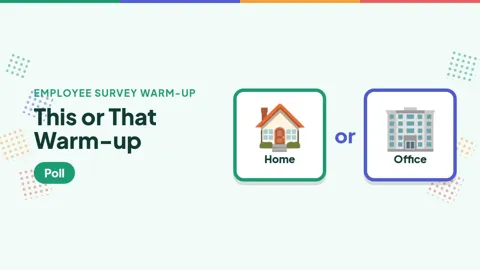
Warm the room up before the survey with a this-or-that poll:
Ready-made employee survey templates
Copy the question numbers into your survey tool, then add one or two of your own.
| Template | Questions | Length |
|---|---|---|
| Annual employee survey | 2, 6, 11, 16, 17, 21, 23, 26, 28, 32, 36, 41, 47, 49, 51, 53, 58, 62, 66, 69, 86, 87, 91, 92, 93 | 25 questions |
| Quarterly engagement check | 1, 6, 13, 21, 31, 41, 51, 62, 86, 87 | 10 questions |
| Weekly pulse | 71 to 75 | 5 questions |
| New starter survey (day 30) | 81 to 85 | 5 questions |
| Manager feedback survey | 21 to 25, 75 | 6 questions |
| Exit survey | 21, 38, 88, 89, 90 | 5 questions |
How to host it on AhaSlides
AhaSlides takes the heavy lifting out of engagement, making it easier to get people participating and understand what they really think. There are two ways to use these questions on it.
As a survey people answer in their own time. Go to Surveys in the left-hand menu, click New survey, then choose Create with AI, Use a template or Add a question (AhaSlides help: using the Surveys tool). The question types match the lists above:
- Rating scale for the agree statements and 1 to 10 questions
- Multiple Choice for questions 18, 35, 43, 64, 77, 79, 88 and 90
- Net Promoter Score for question 86
- Long answer for every open question
- Matrix to group a set of five statements on one screen
Responses are anonymous by default, and Require sign-in adds names when you need them. People answer from a link or QR code with no download, and results show completion and dropout rates, with an export to Excel or CSV. AI can draft a first version of the questions, but you still decide which ones are worth asking.
Live, when you share the results. Bring the findings to a team meeting or all-hands and ask people what they mean:
- Rating Scale: re-ask a headline question, such as question 41, and compare it with the survey score.
- Word Cloud: questions 56 and 57, so everyone sees the culture words side by side.
- Open Ended: question 80. Click Group into themes to cluster the answers, then ungroup to read what each person wrote.
- 2x2 Matrix: place the fixes people suggested on impact against effort, and agree which to start with.
- Look Back: bring last quarter's slide and its real results into this quarter's deck to show what changed.
Once the answers are in, a Team Retro slide helps the team turn them into action: people add ideas from their phones, you group them, everyone votes and the team agrees next steps. You can try the Survey to Action: Start, Stop, Keep Retro deck in Demo mode.
Want a head start? Start from the Pulse Check: Employee Survey Questions, Live template and swap in your own questions.
Tips for an employee survey people answer honestly
- Decide what you will do with each answer before you ask it. If no answer would change anything, cut the question.
- Pair a score with a reason. The number shows where to look, and the comment shows why. Questions 86 and 87 are the model.
- Keep one scale for the whole survey, so results compare cleanly. Our Likert scale examples show the wording for each point.
- Make it anonymous by default, and say so in the invitation. Ask for names only when you need to follow up, and say that too.
- Close the loop within a few weeks. With only one in five employees engaged worldwide (Gallup, 2026), the fastest way to lose people's trust is a survey nobody hears about again. Share three things you heard and one thing you will change.
Frequently asked questions
How many questions should an employee survey have?
Around 20 to 30 for an annual survey, and 3 to 5 for a weekly pulse. Fewer, sharper questions are easier to finish.
What are good questions to ask in an employee survey?
Questions you can act on, across motivation, the job, managers, growth, wellbeing, belonging and communication, plus at least one open question. "What got in your way this week?" is a good example, because every answer points at something to fix.
Should employee surveys be anonymous?
Usually, yes. People answer more honestly about managers, pay and behaviour when they cannot be identified. If you need names to follow up, say so before people start. Our anonymous survey guide covers how to set one up.
How often should you survey employees?
Once or twice a year for a full survey, with a short pulse weekly or monthly in between. Only survey as often as you can act on what you hear.
What is the difference between an engagement survey and a satisfaction survey?
An engagement survey asks how motivated and committed people are. A satisfaction survey asks how happy they are with the job, pay and conditions. Someone can be satisfied without being engaged, so most annual surveys include both, as rounds 1 and 2 do here.
Related posts
- Need more question ideas beyond the workplace? Browse our 65+ survey question samples for HR, training and customer feedback.
- Ready to share what you found? Our guide to survey result presentations shows how to present findings that get used.
- Worried about low turnout? Try these 6 ways to improve survey response rates.
- Want honest answers? Our anonymous survey guide shows how to set one up.
Host your employee survey on AhaSlides for free
Sign up, add your own questions and share the survey link. People answer on any device, with no app to download, and the results build up as they come in.