



Most people try to fit a 10-minute presentation into 5 minutes. They rush, skip transitions, and still run over. The problem isn't time management. It's that the idea was never clear enough to begin with.
Five minutes doesn't hide weak thinking. It exposes it immediately. That's actually the gift: the constraint forces you to know, with precision, what you actually want to say. Get that right, and 5 minutes is more than enough.
Here's how to make every second count.
Build your structure before your slides
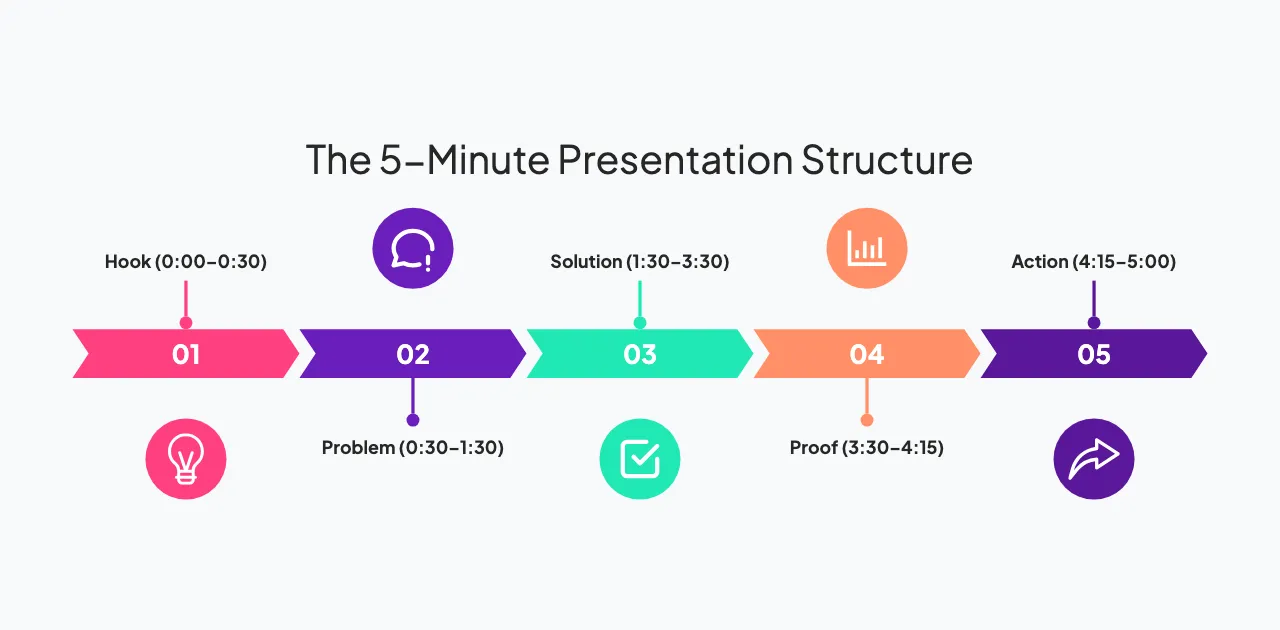
The biggest mistake presenters make is building slides before building a structure. Here's a framework that works every time:
Hook (0:00-0:30): Your first 30 seconds decide whether the audience actually listens to the next four and a half minutes. Open with a question, a surprising fact, or a scenario they recognize. Skip "Hello, today I'm going to talk about..." and try something like "Have you ever sat through a presentation and realized halfway through you had no idea what the point was?"
Problem (0:30-1:30): One minute to establish what challenge you're addressing. Make it specific. Make it relatable. Why does this matter, and to whom?
Solution (1:30-3:30): Two full minutes on your core message. What are you proposing, why does it work, and how does it solve the problem you just outlined? Support it with one or two examples, not five.
Five examples don't make a stronger case. They make a longer one.
Proof (3:30-4:15): Forty-five seconds of evidence. A stat, a case study, a testimonial, a quick demo. Skip this and your audience has no reason to believe your solution actually works.
Call to action (4:15-5:00): Tell them exactly what you want them to do. Think about this. Try this. Share this with your team. Be direct. Never end with "Thanks for listening" and hope they remember why they should care.
Your slides are competing with you
When time is short, the instinct is to load slides with information so nothing gets missed. That instinct is wrong. Fewer slides, less text, more room to breathe.
One principle covers most decisions: if your slide could be read and understood without you in the room, it's doing your job instead of supporting it. A graph showing revenue growth tells a story instantly. A single bold stat stops the eye. A 15-second clip proves a point experientially. These add something. A bullet list of your talking points adds nothing except a reason for your audience to stop listening to you.
One idea per slide. The moment you add a second point, you've split attention between reading and listening. You'll lose both.
Write a script, then cut it
Write a full script, not bullet points, but complete sentences, exactly as you'll say them. Then time each section individually. Overall timing is misleading. You can hit 5 minutes while spending 45 seconds too long on your opening and rushing everything that follows. Section timing catches that.
Your first draft will almost certainly run 7 or 8 minutes. Cut it down. Apply one test to everything you've written: if I remove this, does my core message still land? If yes, it goes. Background context, a second example that proves what the first already proved, company history, all of it. You're not trying to be comprehensive. Five minutes has no room for comprehensive.
Then record yourself. Not to cringe at, to catch the habits you can't see from the inside. Do you drop your pace right when you need momentum? Do you rush the call to action like you're embarrassed by it? One playback reveals more than ten mental rehearsals.

Use pacing as a tool
Silence isn't dead air. It's emphasis.
Rapid-fire delivery makes audiences anxious. Drag it out and you'll lose them. Varied pacing captures attention and keeps it.
Speak quickly through high-energy sections. Slow down when explaining something complex. Pause before key points. Two seconds of silence feels long to you and lands hard for your audience. It signals: pay attention, this matters.
Build pauses into your script deliberately. After a question, pause for them to think. After a surprising statement, pause for it to sink in. Before your call to action, pause to signal importance.
Engage your audience, even in 5 minutes
Five minutes doesn't mean monologue. Interaction doesn't have to slow you down. It can sharpen attention and make your message stick.
Ask a rhetorical question early to get people thinking. Request a quick show of hands to create a moment of connection. If you have 30 seconds to spare, pose a real question and let someone answer.
For larger or hybrid audiences, interactive tools make this even easier. A live poll asking "Would you use this?" takes 20 seconds and immediately tells you and your audience where the room stands. A word cloud that maps people's biggest challenges at the start of your presentation makes your solution land harder when you get there. Tools like AhaSlides let you build these moments in without technical setup or disruption to your flow.
Nail your opening and closing
Your first and last impressions carry more weight than everything in between.
Your opening needs to make people think "this matters to me" within 30 seconds. Not a joke, not small talk, but a question, a scenario, or a statement that creates immediate stakes. The audience decides fast whether to tune in or drift. Give them a reason to stay.
Your closing is the only part most people will clearly remember. Make it count. Land on one concrete action, one sharp reframe, or one direct challenge. Not "thanks for listening." Not "any questions?" Something they can carry out of the room.
Five minutes forces clarity in a way that longer formats never do. If your message is sharp before you start, 5 minutes is plenty. The constraint is the point. Use it.