


There's a reason people send TED Talks to each other. Not conference keynotes. Not corporate presentations. Not academic lectures. TED Talks specifically. Something about the format produces ideas that stick in a way that most presentations don't, and it's not the production quality or the venue or the red circle on the floor.
It's the structure. And the structure is learnable.
TED speakers are trained to do something most presenters never attempt: develop one idea thoroughly rather than covering a topic broadly. The difference sounds subtle. The result is a presentation that people remember and share versus one they politely forget.
This guide breaks down how TED Talks are built, what techniques make them work, and how to apply the same principles to any presentation you give, regardless of length, venue, or audience size.
TED Talk structure: the 18-minute advantage
TED's time limit isn't arbitrary. Eighteen minutes is the window where audiences can maintain deep focus and speakers can develop a coherent idea fully. Longer talks lose attention. Shorter talks don't give complex ideas room to breathe.
The constraint is a feature, not a limitation. It forces the kind of editorial discipline that most presentations never have to develop. When every minute counts, nothing extraneous survives. What's left is the idea itself, stripped of everything that doesn't serve it.
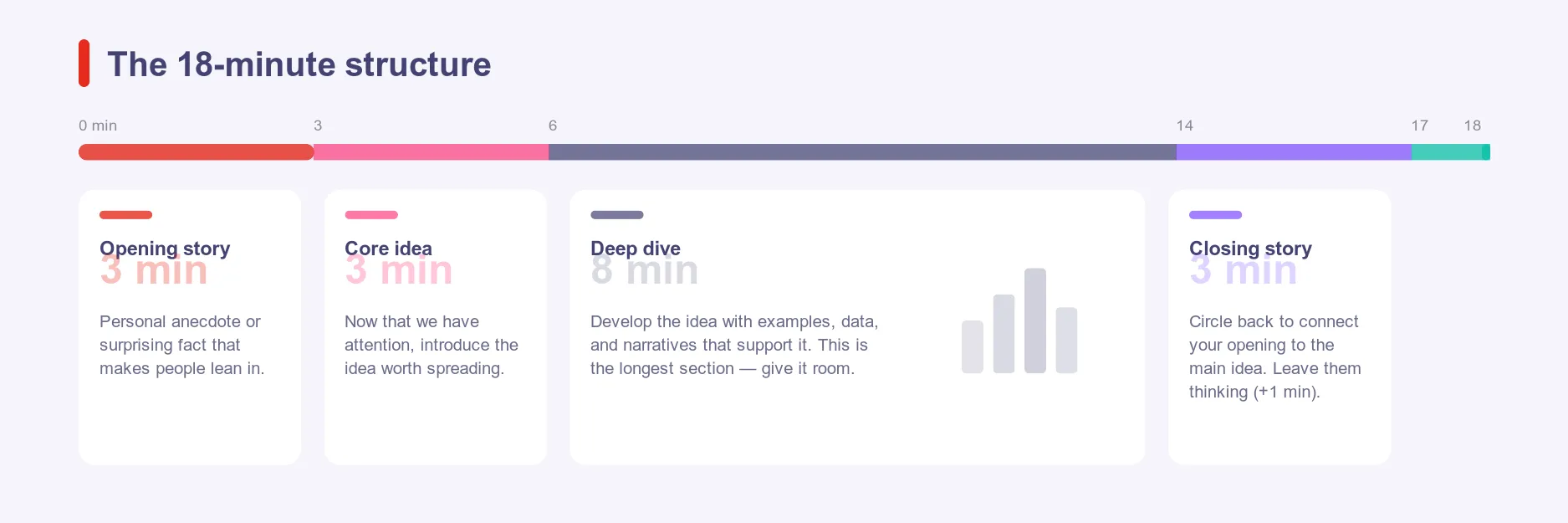
If you have eighteen minutes, a structure that works looks like this: three minutes for an opening story or scenario that earns attention, three minutes to introduce the core idea once you have that attention, eight minutes to develop the idea through examples, evidence, and narrative, three minutes to circle back and connect your opening to your conclusion, and one minute to leave the audience with something worth sitting with.
The proportions shift based on content. The pattern doesn't. You're not covering everything. You're developing one thing well.
Four TED Talk presentation techniques
These aren't production tricks or speaker personality quirks. They're structural and delivery choices that any presenter can make deliberately.
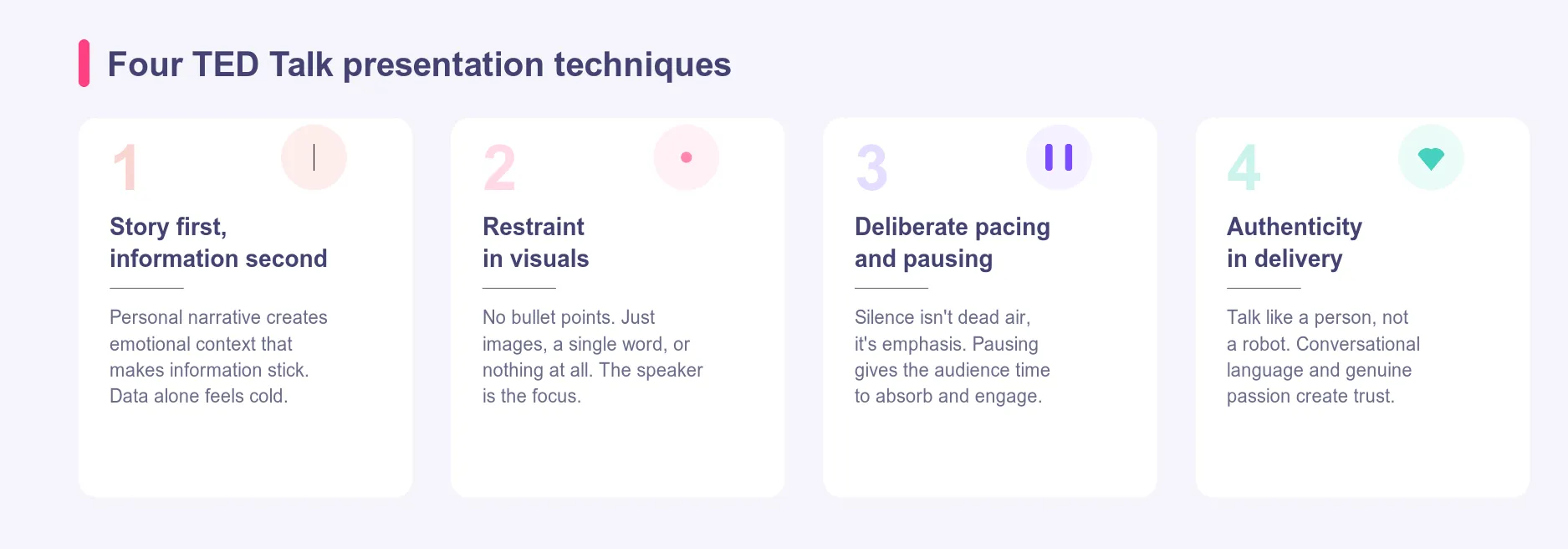
1. Story first, information second
TED speakers don't open with data. They open with a story that makes data matter. The difference isn't stylistic. It's neurological. Information presented without emotional context is processed and forgotten. Information anchored to a story gets stored differently, connected to something the audience already cares about.
The practical version of this is simple: before you introduce any piece of information, give the audience a reason to care about it. Not a generic reason. A specific one. A scenario they recognize, a problem they've experienced, a question they've wondered about. The information lands harder when it arrives as the answer to something the audience was already asking.
2. Restraint in visuals
Most TED Talks use minimal slides. Some use none at all. This isn't aesthetic preference. It's a deliberate choice about where the audience's attention should live.
When slides contain everything worth knowing, the audience reads them and stops listening. When slides contain almost nothing, the speaker becomes the primary source of information and the audience has no choice but to engage with them directly. TED presenters earn the audience's attention by removing the alternative.
The standard worth borrowing: your slides should raise questions, not answer them. A single image that illustrates your point does more work than a slide full of text that explains it.
3. Deliberate pacing and pausing
TED speakers don't rush. They pause after important ideas, sometimes for two or three seconds, long enough that the pause itself communicates that something just said was worth sitting with.
Most presenters treat silence as dead air to be filled. The best TED speakers treat it as punctuation. A pause before a key point builds anticipation. A pause after one gives the audience time to absorb it before the next idea arrives. Removing the rush between ideas creates the impression of a speaker in control, which is the impression that makes audiences trust what they're hearing.
4. Authenticity in delivery
The TED Talks people remember aren't the most technically polished ones. They're the ones where the speaker seemed genuinely invested in the idea they were sharing.
Authenticity in delivery means speaking conversationally rather than performing. It means showing genuine curiosity or passion rather than manufactured enthusiasm. It means occasionally stumbling or pausing to find the right word, because that's what thinking out loud actually looks like. Audiences trust speakers who seem like they're sharing something rather than selling something. The difference is almost impossible to fake and immediately obvious when it's absent.
What a well-structured talk actually looks like
The pattern that makes TED-style talks memorable isn't unique to any one speaker. It shows up consistently across the talks that get shared, quoted, and remembered years later. Breaking it down reveals why it works.
The opening doesn't announce the topic. It creates a question. The speaker shares something personal, describes a moment of confusion or discovery, or presents a scenario that makes the audience wonder where this is going. The topic isn't named yet. The audience is curious before they know what they're curious about.
The problem or tension arrives next. Something is wrong, misunderstood, or underappreciated about the world. The speaker isn't just sharing information: they're reframing something the audience thought they already understood. This is the moment that separates a talk from a lecture. A lecture delivers information. A talk changes how you see something.
The deep dive follows. This is the longest section and the one most talks get wrong by treating it as a list of supporting points rather than a developing argument. The best talks use this section to build: each story or piece of evidence adds something new rather than restating the same point with different examples. By the end of the deep dive, the audience should feel like they've traveled somewhere, not just received information.
The resolution connects back to the opening. The question raised at the start gets answered, but in a way that feels earned rather than convenient. The personal story that opened the talk reappears with new meaning. The scenario that seemed puzzling now makes sense. This circularity is what gives a talk its sense of completeness.
The closing is short and specific. One clear idea, one call to reflection or action, and then silence. The talks that end too long undermine everything that came before. Knowing when to stop is as important as knowing what to say.
The common thread across all of this is that the speaker is developing one idea rather than covering a topic. Covering a topic produces a survey. Developing an idea produces a talk worth remembering.
How to adapt TED Talk technique to your presentations
You don't need an eighteen-minute slot or a conference stage. The principles that make TED Talks work apply to a team meeting, a client pitch, a training session, or a five-minute standup. The format changes. The underlying logic doesn't.
1. Start with a story, not a thesis
Most presentations open with what they're going to cover. TED Talks open with something that makes the audience want to know what comes next. The difference is the difference between a presentation that earns attention and one that assumes it.
Your opening story doesn't need to be dramatic. It needs to be specific and relevant. A moment of confusion that led to an insight. A problem you encountered that your audience will recognize. A question you couldn't answer until you did the work you're now presenting. The story sets up the idea without stating it. The audience arrives at the idea with you rather than receiving it from you.
2. Develop one idea rather than covering a topic
This is the hardest discipline to develop and the one that makes the biggest difference. Most presentations try to cover everything relevant to a subject. TED Talks pick one angle and go deep.
Before you build anything, write one sentence that captures the single idea your presentation is developing. Not the topic. The idea. "Remote work increases productivity for individual tasks but decreases it for collaborative ones" is an idea. "Remote work" is a topic. If you can't write that sentence, you don't have a presentation yet. You have a subject.
3. Use visual restraint
Take the slides you've planned and ask of each one: does this raise a question or answer one? The ones that answer questions are doing your job for you. Cut them or reduce them to a single image or data point that prompts the audience to listen for the explanation rather than read it off the screen.
4. Practice deliberate pacing
Record a run-through and listen specifically for places where you're rushing. Mark them. Then practice those sections at half the pace you recorded, pausing after each major point for a count of three before continuing. It will feel exaggerated in practice. It will feel natural in delivery.
Taking it further with AhaSlides
TED Talks are monologues by design. They work because the speaker has done enough preparation that a single voice can hold a room for eighteen minutes. Most presentations don't have that luxury, and most presenters aren't at that level yet.
Interactive elements bridge the gap. When you build in moments of participation, you're not just keeping the audience engaged. You're getting real-time signal about whether your idea is landing before you've finished presenting it. A poll that asks the audience to weigh in on the problem you're about to address makes the problem feel personal before you've said a word about your solution. A word cloud mid-presentation shows you which ideas are resonating and which aren't. An anonymous Q&A surfaces the objections your audience has but won't raise out loud.
AhaSlides makes building these moments straightforward. Polls, quizzes, word clouds, and Q&A sessions sit inside your presentation flow so the shift from content to participation feels deliberate rather than disruptive. The TED format is worth learning from. But a presentation that invites your audience in is often more effective than one that performs for them.
Wrapping up
What makes a TED Talk work isn't the venue, the production quality, or the speaker's natural charisma. It's the discipline of developing one idea fully, anchoring it in story, and delivering it with enough restraint that the idea itself becomes the thing the audience remembers.
Those are choices. Every one of them is available to you in your next presentation, regardless of how long it is or where it happens.
Start with the story. Develop one idea. Cut everything that doesn't serve it.