Most teens can smell a forced icebreaker from the doorway. The ones that work share three traits: a low-stakes way to take part, a clear end point, and just enough silliness that nobody feels watched. This guide has seven games that fit that description, with rules, timings and the small facilitation choices that decide whether a room laughs or cringes.
Why icebreakers matter for teenagers
Belonging is not a nice extra for this age group. The US Centers for Disease Control and Prevention describes school connectedness as students feeling that adults and peers at school care about them as individuals and about their learning, and links it to better mental health, better attendance and higher grades. A good icebreaker is a small, cheap way to build it in the first ten minutes of a meeting, club or lesson.
Used well, icebreakers also:
- Lower the stakes of speaking up, because the first thing anyone says is a game move rather than an opinion.
- Surface shared interests, which is how friendships between people who have never met tend to start.
- Give quieter teens a role that is not "talk about yourself in front of everyone".
How to choose the right game
Match the game to the group rather than the other way round.
- Group size: pairs and small teams work almost anywhere. Anything that relies on one person performing in front of 30 will fail.
- Space: the sweets game needs room to move. The drawing game needs a whiteboard. Two Truths and a Lie needs nothing.
- Comfort level: with a new group, start with a game where everyone can do it at the same time. Save performance games for when people know each other.
- Time: every game below fits in 10 to 15 minutes if you set a timer and hold to it.
Ground rules that help every game: taking part is voluntary (offer a "pass"), no one is made the joke, and nothing personal or sensitive is required. Avoid topics such as religion, politics or family circumstances.
1. Teen interviews
Best for: new groups, up to about 30 people. Time: 10 minutes.
Split the group into pairs, or trios if the numbers are odd. Each person interviews their partner for two minutes, then swaps. Avoid groups larger than three, because the third person quickly becomes a spectator.
Give each pair a set of prompts, such as:
- What is your name, and what do you like being called?
- What is one thing you could talk about for ten minutes without preparing?
- What is one thing you and your partner both enjoy?
Then have each person introduce their partner to the group in one sentence. Introducing someone else is far less exposing than introducing yourself, which is why this works with shy teens.
Variation: give each pair a different topic (food, music, a place they would like to visit) so the introductions are not repetitive.
2. Sweet colour challenge
Best for: clubs and parties, 8 to 30 people. Time: 10 to 15 minutes.
You need a bag of multi-coloured sweets. Assign a task to each colour and display the list on a board or screen, using simple pictures if possible, as long lists of words confuse people. Each person picks one sweet at random and does the task for their colour.
Example tasks:
- Red: sing the chorus of a song.
- Yellow: do any action suggested by the person holding the closest green sweet.
- Blue: do a lap of the room.
- Green: invent a hairstyle for the person holding the red sweet.
- Orange: ask the person with a brown sweet to join you in a dance.
- Brown: choose a colour and set a task for everyone holding it.
Facilitation notes:
- Keep the tasks silly but not embarrassing or physically difficult.
- Let anyone swap their sweet, on the condition that they take two and do both tasks. That keeps the swap fair and adds a laugh.
- Check for food allergies first, and have a non-food option such as coloured cards or counters ready.
3. Team drawing relay
Best for: groups of 6 to 20. Time: 10 minutes.
This is an updated take on the classic "What's next" drawing game. You need a whiteboard or large sheet of paper per team, a marker and a timer.
- Split into teams of three to five and give each team a topic, such as "our dream school trip".
- Each person can add up to three strokes to the drawing, and no one may talk about the plan.
- Rotate every 30 seconds until time is up.
- Teams show their drawing and the others guess the topic.
Skip the judging panel from older versions of this game. A vote on the drawing the room found funniest, or the one that best matched its topic, keeps it friendly. Small prizes such as stickers work well for teenagers.
4. Two truths and a lie
Best for: groups of 4 to 8 (split larger groups). Time: 10 to 15 minutes.
Each player shares three statements about themselves, two true and one false, and the others vote on which is the lie. It works in a circle, in small groups or online.
Here is a fact to share with your group before you start. A 2006 meta-analysis by Bond and DePaulo found that people tell truths from lies correctly only about 54 per cent of the time, barely above chance. A 2023 reanalysis of more than 45,000 judgements found people judged about 71 per cent of truths correctly but only about 31 per cent of lies, so a believable, ordinary lie tends to work best.
Tips:
- Give players a minute to think before the game starts, so no one panics when it is their turn.
- Offer a "safe" prompt list for shy players, such as "a food I have never tried" or "a place I have been".
- Keep groups small so people can actually remember each other's statements. For groups of around five, this is far more effective than one big circle.
- Try the Two Truths and a Lie guide for variations and statement ideas.
5. Guess that film
Best for: drama, film and media clubs, teams of 4 to 6. Time: 15 minutes.
Each team secretly picks a film scene and acts it out in under three minutes while the others guess the title. The team that guesses the most titles wins.
Notes:
- Pick scenes that everyone in the room will recognise, since the game falls flat if nobody has seen the film.
- Cap each performance at three minutes so the game does not run over.
- Ban spoken quotes from the film if you want a harder version.
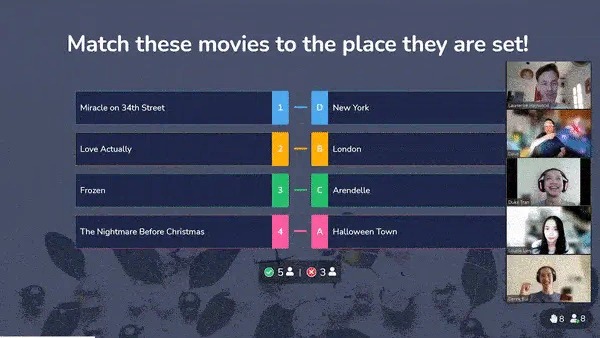
Online version: turn it into a Match Pairs question, where teens match films to where they are set or which character says which line. It plays well with a whole group at the same time.
6. Group word cloud
Best for: any size, especially large or quiet groups. Time: 5 minutes.
Ask one question the whole room answers in a word or two, for example "What is one word for how you feel today?" or "What is your go-to snack?". Everyone answers on their phone, and the responses build up into a shared picture on screen. Common words grow larger, which quickly shows what the group has in common.
Because everyone answers at once and no one has to speak aloud, this is one of the lowest-pressure games on the list. Try one question at the start of a session and one at the end, to see how the mood changed.
7. Quick-fire quiz
Best for: larger groups, or as a wind-up at the end of a session. Time: 10 minutes.
Use five to eight questions on things teens actually care about, such as music, games, films and social media, with a leaderboard between rounds. Because everyone answers on their own phone, no one has to speak in front of the room. Ready-made questions are in our trivia questions for teens, and the template library has ready-made quizzes you can edit.
How to run icebreakers online
The same games work on video calls with a few changes:
- Use breakout rooms of three or four for interviews and Two Truths and a Lie.
- Put the voting on a shared screen. Polls and word clouds let everyone answer at once, instead of talking over each other.
- Keep questions light and low-risk, and avoid anything that asks for personal detail on a shared screen.
- Send prompts in advance so quiet teens can think first.
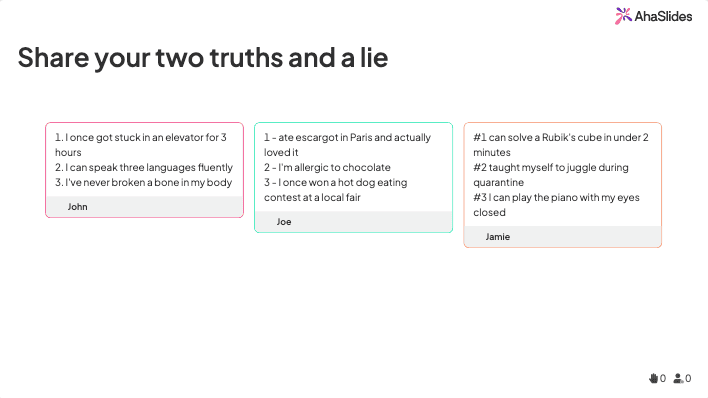
Here is a Two Truths and a Lie slide as it looks on AhaSlides. Each player's three statements appear on screen for the group to discuss before everyone guesses the lie.
And here is a Match Pairs question that suits the film game, with the answers revealed.
To pick who goes first, use the Spinner Wheel rather than nominating someone, so no one feels singled out.
Tips for running icebreakers with teenagers
- Go first yourself. A short, slightly silly example from you sets the tone better than any explanation.
- Start easy. Open with a game everyone plays together, and move to performance games only when the group has warmed up.
- Keep it short. Ten minutes is plenty. Stopping while people still want more is the whole point.
- Offer a way out. A "pass" card costs nothing and stops resentment.
- Debrief in one line. Ask what they learned about someone, so the game connects to the rest of the session.
Frequently asked questions
What are good icebreaker questions for teens?
Keep them light and answerable in a sentence, for example:
- What is a skill you would like to learn?
- What is a quirky hobby you have, and why do you like it?
- If you could have dinner with any celebrity, who would it be?
- What is the best thing you have watched or played recently?
When should you use an icebreaker?
Use one when people do not know each other, at the start of a club, class or event, or when energy has dropped mid-session. They also help when a group is mixing for the first time, such as at the start of a term.
What are the rules of a good icebreaker?
- Match the game to the group's interests and age.
- Choose games that suit the group size and space.
- Keep it short so it does not eat into the main activity.
- Keep content and language appropriate and avoid sensitive topics.
- Let people opt out.
How long should an icebreaker last?
Five to fifteen minutes is enough. If you are running several, keep the total under twenty minutes.
Looking for more? See our guides to party activities for teens, youth group games and games for teens.