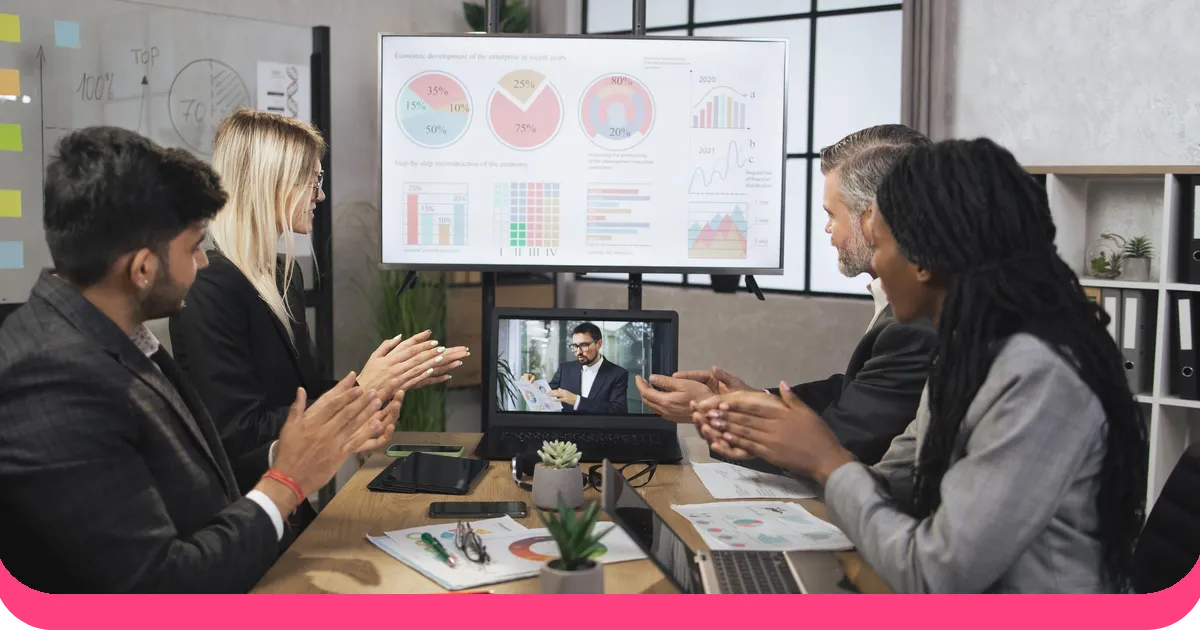



Most presentations fail the same way. Not because the content is wrong, but because the audience checked out before the third slide. They're nodding along, half-reading emails, waiting for it to end.
Modern presentation software fixes that. Not by making slides prettier, but by changing what a presentation can actually do: pull people in, get them responding, and make the message stick. Here are seven reasons the right tool changes everything.
Benefit 1: Create visually compelling presentations
Good design isn't decoration. It's how your audience decides whether to trust what you're saying before you've made your first point.
Modern presentation software makes looking good the default, not the exception. Built-in templates handle layout, colors, and typography before you've typed a single word. Animations reveal information at the right moment instead of dumping everything on screen at once. You focus on what you're saying, and the design takes care of itself.
The result is that anyone can build something that looks like it was made by someone who knows what they're doing. Because the tool already does.
Benefit 2: Save time with user-friendly tools
The best presentation software gets out of your way. Drag-and-drop layouts, one-click image insertion, and straightforward formatting mean you spend your energy on what you're saying, not how to make the slide behave.
The time savings are real. What used to take a full day to build now takes a few hours. Across a team of 100, that's hundreds of hours a month freed up for work that actually moves things forward.
It also makes updating easier. Stale decks pile up because refreshing them feels like more effort than it's worth. A tool that's genuinely easy to use means your presentations stay current, and your message stays accurate.
Benefit 3: Leverage ready-made templates
Starting from a blank slide is its own kind of procrastination trap. Templates remove that. Choose one that fits your message, and the layout, colors, and typography are already handled. You skip straight to the part that actually matters: what you're saying.
For teams, brand-compliant templates mean everyone's presentations look like they came from the same company, without anyone needing a design briefing. New hires can build something professional on day one.
Structure comes built in too. A good pitch deck template already knows you need a problem slide before a solution slide. You fill in the sections rather than figuring out what should go where. Fewer decisions, faster output, better result.
Benefit 4: Engage audiences through interactivity
This is the benefit that changes everything else. Not prettier slides or faster templates, but the moment your audience stops watching and starts participating.
Live polls, word clouds, Q&A, and quizzes turn one-way presentations into two-way conversations. When 70% of your audience votes yes to "has this happened to you?", the room shifts. Shared recognition replaces blank stares. That's not a feature, that's a completely different kind of presentation.
AhaSlides is built specifically for this. It runs inside PowerPoint and Google Slides, so there's no new tool to learn and no disruption to your flow. Audiences join on their phones, responses appear in real time, and the data you collect tells you exactly what landed and what didn't.
Research backs this up: interactive presentations consistently outperform static ones on retention, engagement, and follow-through. The average attention span in a meeting drops after ten minutes. Interactivity resets that clock every time.
Benefit 5: Enable remote and hybrid presentations
The room isn't the audience anymore. Remote and hybrid teams are the norm, and the best presentation software treats every participant equally whether they're in the front row or joining from a different time zone.
Polls, Q&A, and live interaction work just as well on a laptop at home as they do in a conference room. Nobody is watching through a grainy screen feed while everyone else participates. They're in it.
Recording adds another layer. A training session becomes a resource. A product announcement reaches people who couldn't attend live. One presentation effort keeps working for weeks after delivery, reaching audiences you didn't even plan for.
Benefit 6: Integrate multimedia without friction
Pulling together a presentation used to mean juggling four different tools. Video in one app, audio in another, slides somewhere else, and twenty minutes lost every time a format wouldn't cooperate.
Modern presentation software puts everything in one place. Embed a customer testimonial video, drop in an animated chart, add a GIF that actually makes the point faster than a paragraph would. No exports, no conversions, no compatibility headaches.
It also just works better for audiences. People retain information more effectively when it comes through more than one sense. Mixing video, audio, and visuals isn't a nice-to-have, it's how you make content stick.
Benefit 7: Collaborate and share in real-time
Presentation files sent back and forth over email are a special kind of chaos. Who has the latest version? Did anyone see the edits from Tuesday? Modern presentation software solves this by keeping everyone in the same place, in real time.
Multiple people can edit simultaneously, comments appear in context, and version history means nothing gets lost. When you're ready to share, one link does the job. Stakeholders always see the current version, even if you update it after sending.
Permission controls keep things tidy. Prospects get view-only access. Internal teams get full editing rights. One tool handles both without any workaround.
Weighing the drawbacks
A few things worth knowing before you dive in.
More features don't automatically mean better presentations. Animations work when they clarify something, not when they fill space. Interactive elements land when they're tied to a genuine question the audience cares about, not dropped in to break up a slow section. The tool doesn't fix a weak message.
It's also worth having a backup plan for technical hiccups. A saved offline copy and a set of speaker notes mean a dropped connection doesn't derail the whole thing.
The presenters who get the most out of modern software are the ones who stay intentional. Pick the features that serve your specific audience and leave the rest alone.
Choosing the right tool
Evaluate presentation software based on your specific needs. Do you need collaboration features? Interactivity? Beautiful templates? Remote presentation capability? Integration with other tools you use? Different platforms emphasize different strengths. AhaSlides excels at interactive engagement and is built for modern communication needs. Traditional tools like PowerPoint offer familiarity and deep feature sets. Google Slides prioritizes collaboration and accessibility.
The best tool is the one your team will actually use consistently. If adoption is low because the interface feels foreign, you won't benefit from features. If your team works across locations, collaboration features matter. If engagement is your priority, look for strong polling and interactive capabilities.
Modern presentation software removes barriers to clear, engaging communication. It lets you focus on your message rather than fighting tools. Whether you're pitching investors, training employees, or inspiring audiences, the right software amplifies your impact and makes communication work feel less like work.