



PowerPoint has no spinning wheel of its own, but you can spin the wheel in PowerPoint in a few minutes: draw one with shapes and a Spin animation, or embed a live random wheel with the AhaSlides add-in for PowerPoint. Spin it to call on a participant, pick the next question, draw a prize or choose a topic, and the live wheel lands somewhere new every time.
Whether you're a trainer looking to energise your workshops, a facilitator trying to hold attention through long sessions, or a presenter who wants to keep people involved, a spinning wheel gets everyone taking part. Your deck is already built, so adding a wheel shouldn't mean rebuilding it somewhere else. This guide shows both routes: building a wheel by hand with shapes and animation, and embedding a live wheel with the AhaSlides add-in.
What is a PowerPoint spinning wheel?
A PowerPoint spinning wheel is a wheel of entries that you spin during a presentation to pick one at random: names, questions, prizes, topics or any custom entries you add. You can draw one with PowerPoint's own shapes and animation, or embed a live wheel with an add-in.
The key advantage over a standalone spinner app is that the wheel lives inside your slide deck. Your audience sees it on the main screen, you spin it from your slide, and the result appears without switching windows or tabs.
Common use cases include:
Random name selection: call on participants fairly during Q&A or group activities
Question randomiser: spin to pick which topic or quiz question comes next
Prize wheel: add excitement to raffles, team competitions or training rewards
Icebreaker topics: let the wheel pick a conversation starter or warm-up prompt
Team assignments: divide participants into groups or assign project roles at random
Decision-making: use it when a group needs a neutral tiebreaker
A spin turns a static slide into a moment people take part in, which helps when attention dips during a longer session.
Build a wheel by hand or embed a live one
There are two ways to get a spinning wheel into PowerPoint. Each does something the other cannot.
By hand, with shapes and animation. Draw a circle split into coloured segments, type an entry in each, add a pointer, then apply a Spin emphasis effect from the Animations tab and set its duration (Microsoft's guide to animating objects). It is free, needs no account and works offline. What it cannot do: the wheel turns by the amount the animation sets, so it stops in the same place every time, and changing the entries means redrawing the segments.
Embedded, with the AhaSlides add-in. The add-in embeds a live AhaSlides slide inside your PowerPoint slide; it does not import or convert your file. The wheel stops on a random entry each spin, holds up to 5,000 entries and can fill itself with the names of participants who join. What it cannot do: it needs an AhaSlides account and an internet connection while you present, and the slice colours are fixed.
If you need one fixed spin for a single reveal, the hand-built wheel is enough. If you need a random result each time, or your audience's names on the wheel, embed a live one.
How to create a spinning wheel in PowerPoint
AhaSlides is an all-in-one engagement platform for teams and classrooms, and its add-in puts a live Spinner Wheel straight into your deck. The PowerPoint add-in is available on every AhaSlides plan, and works with Microsoft 365, PowerPoint 2024, PowerPoint 2021 and PowerPoint 2019. Here are the steps:
Make the wheel. Sign up for AhaSlides or log in, create a presentation, click New slide and choose Spinner Wheel from the Gamification tab.
Add your entries. Type them into the Entries field, pressing Enter after each one, or paste a list in one go. To put your audience's names on the wheel instead, tick Participant name autofill.
Install the add-in. In PowerPoint, on the Home tab, select Add-ins, then More Add-ins. Search for AhaSlides and click Add. In PowerPoint for the web, the Add-ins button is on the Insert tab.
Add the wheel to your slide. Sign in to AhaSlides in the add-in, click Select presentation next to your presentation, tick the Spinner Wheel slide and click Add slides. In PowerPoint for the web, click the slide, then Add slide.
Present and spin. Start your slideshow and press Q to show the QR code and join link, so participants can join from their phones. Click the Spin button in the centre of the wheel, or press Enter. The result appears in a pop-up: close it to keep that entry on the wheel, or click Remove entry to take it out before the next spin.
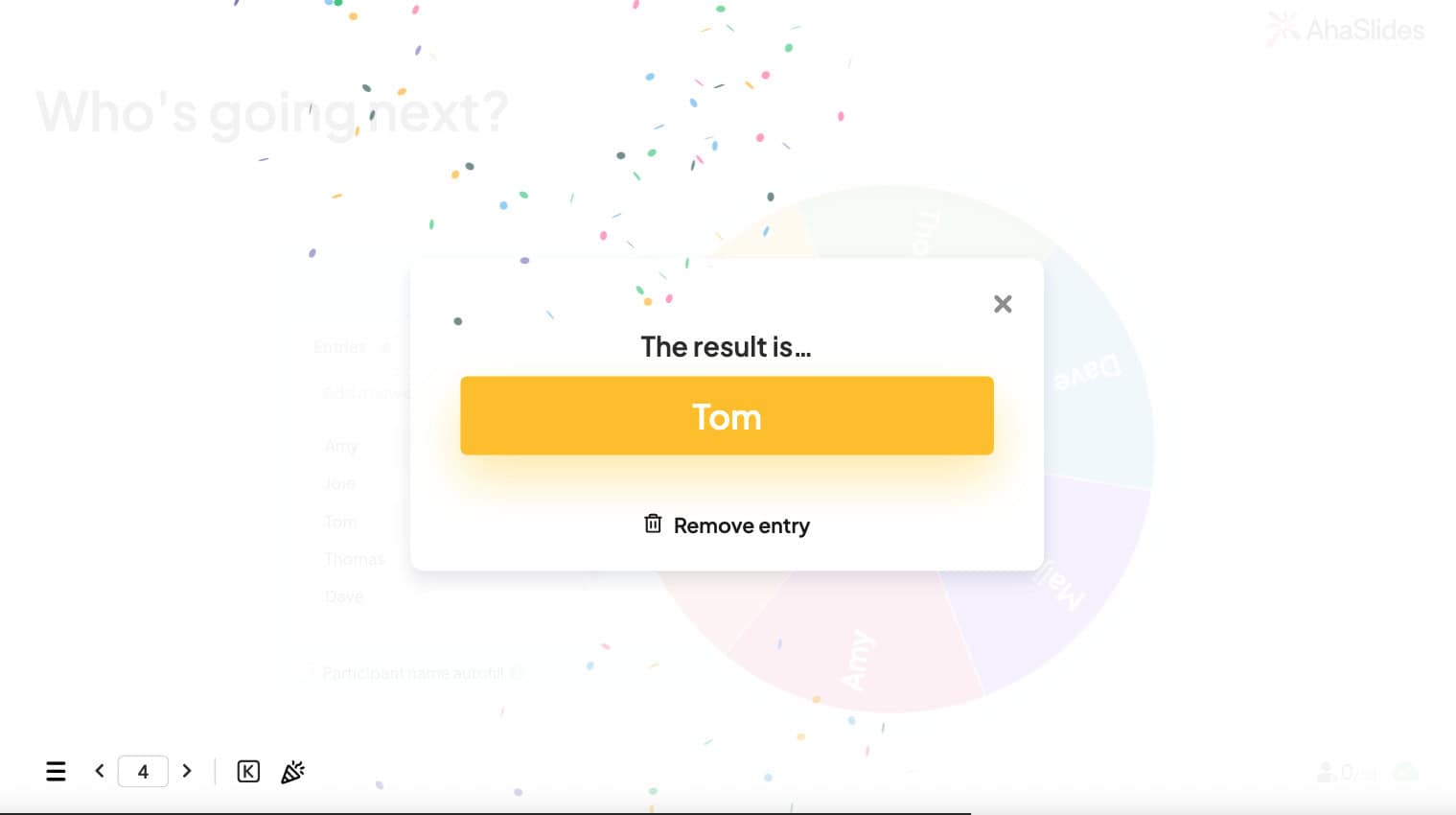
The add-in works in desktop PowerPoint (Windows and Mac) and in PowerPoint for the web. You do not need to leave PowerPoint to run the spinner: everything stays within the presentation window. To change the entries later, open the add-in's menu while editing your deck and choose Edit slides. One limit to know: the Presenter role does not work with the add-in, so if two people run the same deck at once, each needs their own copy.
How to add a spinning wheel to Google Slides
If your team works in Google Slides, AhaSlides has an add-on in the Google Workspace Marketplace:
Open your presentation. In the side panel on the right, click the + button (Get add-ons).
Search for AhaSlides and click Install.
Go to Extensions, then AhaSlides, then Open Sidebar, and log in to your AhaSlides account.
In the sidebar, choose the Spinner Wheel slide type and add your entries. The add-on offers every AhaSlides slide type (AhaSlides for Google Slides).
Click Present with AhaSlides, then Present now. Participants join with the link or QR code, with no account needed on their end.
Presenting this way imports the whole deck into AhaSlides, so your other Google Slides become static images: animations, video and links on them will not play. Edit the wheel through the add-on, as changes made in AhaSlides do not sync back to Google Slides.
Tips to make the most of a spinning wheel in PowerPoint
Now that you know how to create a spinning wheel in PowerPoint, here are practical tips for getting the most out of it.
Customise the spinner wheel
You can add any text or numbers as entries, but keep readability in mind. Text becomes hard to read when there are too many wedges, so for a wheel everyone can read from their seats, 6 to 12 segments is easiest on the eye; a long entry is shortened on the wheel and shown in full in the result pop-up. In the AhaSlides Spinner Wheel settings you can set the spin time (5 to 1,200 seconds), repeat every entry 2 to 11 times for a fuller wheel, hide the entry board so people watch only the wheel, and turn off the confetti for a calmer reveal. Repeating entries keeps every entry's chance the same; to give one entry a better chance, type it more than once. The tick and result sounds follow the presentation's sound effects setting. The theme sets the font and logo; the slice colours themselves are fixed.
Choose the right spinning wheel activities
Use the spinner at natural transition points in your presentation: after covering a major topic, before a break, or when you notice attention starting to drop. One or two spins per session is enough. Match the wheel's purpose to your session goal: a training session benefits from a question randomiser, while a team meeting might use it to set the speaking order or pick a discussion topic.
Run a prize wheel without overspending
If you're using the wheel for prizes, every entry can come up, so plan the wheel around what you can afford to give:
Set a total prize budget before the session, and only put prizes on the wheel that fit inside it.
Mix in rewards that cost nothing: recognition in front of the group, an extended break, first pick of seats, or choosing the next activity. In a workplace, first choice of a project or a development opportunity works too.
Add one or two "No prize" or "Spin again" entries to keep the suspense without adding cost.
Decide before you spin whether a won prize comes off the wheel. If it does, click Remove entry in the result pop-up.
Design quizzes effectively with the wheel
When combining the spinner with quiz content, separate the "who answers" from the "what they answer". Use one wheel to call a random participant, and a separate slide for the question itself. This keeps segments readable and stops you cramming too much text onto the wheel. You can build those question slides into an interactive quiz on PowerPoint in the same deck.
For quiz design:
Keep questions neutral and relevant to your session topic rather than personal
Mix difficulty levels so the activity feels fair across all participants
Use the wheel to create a sense of suspense before revealing the question or the person answering
In training sessions, tie questions directly to learning objectives so the activity reinforces content rather than just adding entertainment
If each spin starts a timed answer, you can also add a timer in PowerPoint so everyone gets the same time to respond.
Icebreaker ideas with the spinner wheel
A spinner wheel is a low-effort icebreaker that works at the start of a session or after a break. Try loading it with "Would you rather..." prompts, industry trivia questions or team-specific scenarios. You can also use it to assign breakout group numbers at random, pick which team presents first, or select a volunteer for a demonstration.
For professional settings, keep prompts work-adjacent: preferences about remote or office work, favourite productivity tools, or light opinions on industry trends. These keep the mood upbeat while staying relevant to the session. For more ways to play, see how to make a spinner wheel game for a class or team.
Use pre-made templates to save time
Starting from a template cuts setup time, and you can change the entries before going live. Two to try:
Class spinner wheel games: five ready-made wheel games for a class.
Innovation spinner game: spin, think, share: five wheels of prompts for team idea sessions.
Best practices for professional presentations
When you bring a spinning wheel into a professional presentation, keep these principles in mind:
Align with learning objectives. Tie each spin to a concrete outcome: a question answered, a group formed or a topic selected.
Test before you present. Run the add-in in a practice session to check that the wheel loads, the entries are correct, and participants can join on the devices your audience will use.
Give clear instructions. Tell participants how to join before you spin. A 30-second explanation at the start of the session prevents confusion and delays mid-activity.
Time it strategically. Spinning wheels work best after a stretch of information delivery, when participants need a mental reset. Use them to re-engage a group after a long stretch of slides.
Keep the tone appropriate. Set expectations for how the wheel will be used, and keep a professional pace even when the activity is playful.
Use cases by audience type
The spinning wheel adapts to many contexts. Here are specific applications by audience:
| Audience | Suggested use |
|---|---|
| Corporate training | Random question selection, name wheel for participation |
| School or university | Quiz topic randomiser, group assignment wheel |
| Team meetings | Decision tiebreaker, speaking order selector |
| Events and conferences | Prize wheel, icebreaker topic spinner |
| Workshops | Activity sequence randomiser, volunteer selector |
Make this deck interactive
People stop listening to static slides after a few minutes. A poll, a quiz or a word cloud brings them back, with answers from every phone on screen.
Frequently asked questions
How do I spin a random wheel in PowerPoint?
Embed a live wheel. A wheel drawn with the Spin animation turns by a set amount, so it lands in the same place every time. The Spinner Wheel added with the AhaSlides add-in picks a random entry on each spin, and you press Enter to spin it during Slide Show.
Does PowerPoint have a spinning wheel?
No, not as a built-in tool. You can draw one with shapes and a Spin animation, which stops in the same place each time, or embed a live, random wheel with the AhaSlides add-in.
Can I add a spinning wheel to Google Slides?
Yes. Install the AhaSlides add-on from the Google Workspace Marketplace, add a Spinner Wheel from its sidebar, then present with AhaSlides.
Is the AhaSlides PowerPoint add-in free?
Yes. The add-in is free to install and works on every AhaSlides plan, including Free, which suits small, occasional sessions. Paid plans add bigger audiences and reports; the current limits are on the pricing page.
Does the spinning wheel work on PowerPoint for Mac?
Yes. The AhaSlides add-in works in desktop PowerPoint for Mac and Windows (PowerPoint 2019 or later, or Microsoft 365) and in PowerPoint for the web.
Do participants need an AhaSlides account to join?
No. Participants join using a shared link or QR code from any device. No account or app download is needed on their end.
How many entries can the spinner wheel have?
Up to 5,000, but 6 to 12 is easiest to read during a live presentation.
Can I remove a name from the wheel after it has been selected?
Yes. Click Remove entry in the result pop-up and that entry is left out of the next spins, so nobody is picked twice.
Key takeaways
Turning a standard PowerPoint slide into an interactive moment takes a few minutes. A hand-built wheel covers a single fixed reveal; the AhaSlides Spinner Wheel, added with the add-in, gives you a random result every spin for name draws, quiz questions, prize draws and audience participation, all without leaving PowerPoint.
Used at the right moments, the spinner helps with a common problem: the attention drop that happens during longer sessions. A spin creates a moment of anticipation and gives people a reason to take part, so your audience joins in rather than just watching. AhaSlides has more than 40 slide types you can add the same way when you want a poll or quiz next, and our guide to making PowerPoint interactive covers ten of them, each with the PowerPoint-only way first.