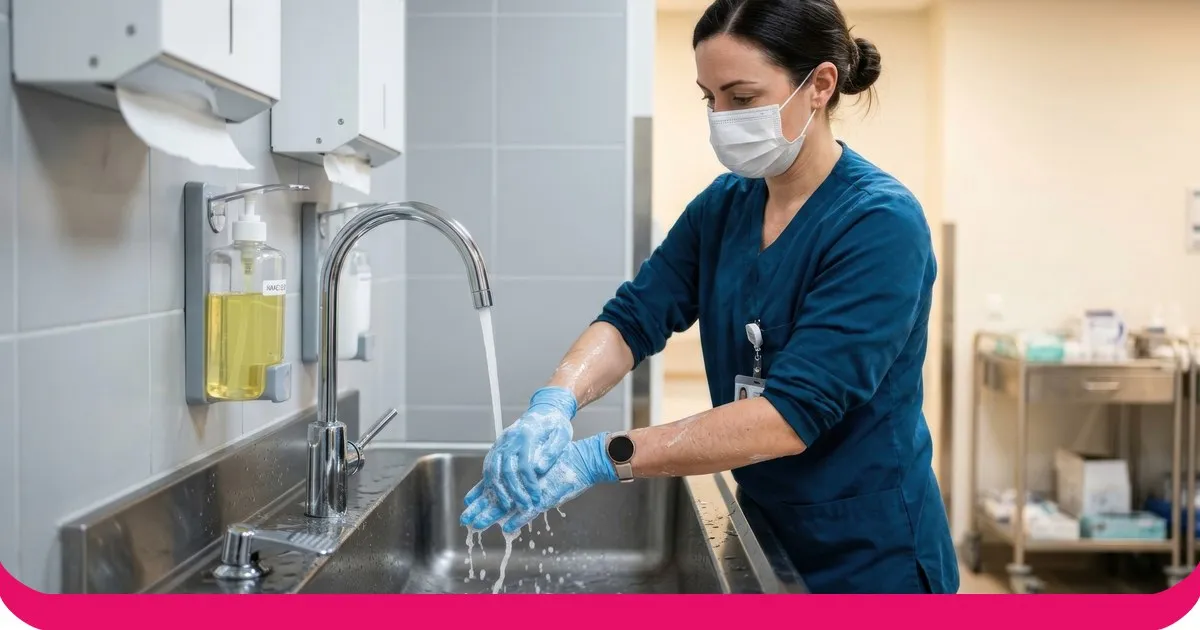
The US Centers for Disease Control and Prevention (CDC) says standard precautions are used for all patient care, based on a risk assessment, and that they protect healthcare providers and stop infection spreading from patient to patient. They matter because the risk is real: on any given day in 2023, about 1 in 38 hospital patients had at least one healthcare-associated infection, an estimated 518,000 infections in US acute care hospitals that year.
CDC's standard precautions page lists 7 elements. This post gives each one in a line, with a check question you can ask your team, in 2 sets. Set 1 covers the 4 you use at every bedside. Set 2 covers the 3 that protect the equipment, the environment and the needle. Each set ends with an Our pick, with a one-line reason. After that come the three transmission-based precautions and 5 refresher scenarios.
This post is a training refresher, not a replacement for your facility's own policy.
Set 1: At every bedside
- Hand hygiene. CDC's core practices say to use an alcohol-based hand rub or wash with soap and water before touching a patient, before an aseptic task, after touching a patient or their surroundings, after contact with blood or body fluids, and immediately after removing gloves. Soap and water is required when hands are visibly soiled. Check question: name three moments when you clean your hands.
- Personal protective equipment (PPE). Choose it by the task and the risk of exposure. CDC says to wear gloves when contact with blood, other potentially infectious material, mucous membranes or non-intact skin can reasonably be anticipated, a gown for tasks that could soil skin or clothing, and eye protection with a mask or a face shield when splashes or sprays are likely. Check question: what would you wear to empty a catheter bag?
- Respiratory hygiene and cough etiquette. WHO notes that respiratory hygiene and cough etiquette, developed during the SARS outbreak, is now part of standard precautions. In practice: tissues, masks, hand hygiene supplies and signs at the entrance, and space between people with respiratory symptoms and everyone else. Check question: what do you offer a coughing visitor at reception?
- Appropriate patient placement. Where a patient is placed is itself a precaution. CDC advises that, where possible, patients who may need transmission-based precautions wait in a single-patient room until they have been assessed. Check question: a patient arrives with diarrhoea and a fever. Where do they wait?
Our pick: element 1, hand hygiene. WHO calls it a major component of standard precautions and one of the most effective methods to prevent transmission of pathogens in health care. It is also the cheapest element to check on any shift.
Set 2: Equipment, environment and injections
- Patient care equipment and the environment. CDC says to clean and reprocess reusable equipment before use on another patient or when soiled, and to clean and disinfect frequently touched surfaces near the patient more often than other surfaces. Spills of blood or other potentially infectious material are cleaned up promptly, and disinfectants are used as the manufacturer's instructions say, including contact time. Check question: a blood glucose meter has just been used. What happens before the next patient?
- Textiles and laundry. CDC's list says simply to handle textiles and laundry carefully. CDC's page gives no further detail, so your facility's own laundry policy fills the gap. Check question: what does your policy say about soiled linen?
- Safe injection practices. CDC's core practices include using needles and syringes for one patient only, entering a medication container with a new needle and a new syringe even when taking more doses for the same patient, and preparing medication in a clean area away from sinks. Check question: can you reuse a syringe for a second dose for the same patient?
Our pick: element 7, safe injection practices. The rule is absolute, with no "just this once", and it is easy to overlook when a ward is busy.
Standard or transmission-based precautions?
CDC calls these the two tiers of basic infection control. Standard precautions apply to every patient. Transmission-based precautions are added on top for patients who may be infected or colonised with certain agents, and CDC sorts them into three:
- Contact precautions for known or suspected infections that carry an increased risk of contact transmission.
- Droplet precautions for pathogens spread by the respiratory droplets a patient produces when coughing, sneezing or talking.
- Airborne precautions for pathogens spread by the airborne route, for example tuberculosis, measles and chickenpox.
CDC also says to start transmission-based precautions as soon as possible on the patient's clinical picture, then adjust or stop them when more information, such as laboratory results, arrives. Check question: a child arrives with a fever and a rash. Which tier do you start with?
5 refresher scenarios
Answers are in brackets. Use them as a quick quiz, or as the Pick Answer slides in the next section.
- You have just taken off your gloves after dressing a wound. Do you need to clean your hands? (Yes. Clean your hands immediately after glove removal.)
- You are about to draw up a second dose for the same patient. Can you reuse the syringe? (No. Use a new needle and a new syringe: never reuse either, even for the same patient.)
- A patient in the waiting area is coughing and has no mask. What do you do? (Offer a mask and tissues, and move them away from others if space allows. This is respiratory hygiene, a standard precaution.)
- There is a spill of blood on a frequently touched surface. What do you do? (Clean it up promptly with a disinfectant, following the manufacturer's instructions. Environmental cleaning is part of standard precautions.)
- A patient is admitted with suspected tuberculosis. Which precautions? (Airborne precautions on top of standard precautions. Transmission-based precautions are added, never swapped in.)
Our pick: scenario 5. It is the one that tests whether staff know the second tier adds to the first and never replaces it.
Why refresh every year
In CDC's 2023 hospital survey, patients were 27% less likely to have an infection than in the 2015 survey (1 in 38 on any given day), which suggests prevention is working and that there is still more to do. CDC's core practices say infection prevention training should happen before staff perform their duties and at least annually as a refresher, with extra training after any lapse or when new equipment is introduced. A short, practical session each year, plus a quick one after any lapse, is the way to meet that.
Ways to host a ward refresher with AhaSlides
Run the session live on a ward, in a classroom or over video, and let staff answer on their phones.
- Pick Answer: "Which precaution?" Show one scenario per slide, from the 5 above, and ask which precaution applies. Reveal the answer and discuss.
- Word Cloud: "The step most often skipped". The biggest word tells you where to focus next.
- Rating Scale: "How confident are you putting on and taking off PPE?" Ask for a rating from 1 to 5 before and after, and compare the averages.
- Open Ended: "A question for the infection preventionist". Collect questions, then have the infection preventionist answer the best ones in the room.
The Infection control & standard precautions course template gives you ready-made slides to adapt, and the Bloodborne pathogens for healthcare template is a good follow-up. For a wider method, see our guide to scenario-based healthcare compliance training.
Frequently asked questions
What are standard precautions?
The minimum infection prevention practices for all patient care. CDC says they apply to every patient, in every setting where care is delivered, whatever the patient's suspected or confirmed infection status.
What is the difference between standard and transmission-based precautions?
Transmission-based precautions are added for known or suspected infections. Standard precautions come first and always apply. Contact, droplet or airborne precautions are used on top of them.
Is hand hygiene a standard precaution?
Yes. CDC lists it first, and WHO calls it a major component of standard precautions.
When should gloves be worn?
When contact with blood, body fluids or contaminated items is expected. CDC's wording is when contact with blood or other potentially infectious material, mucous membranes, non-intact skin or contaminated equipment could reasonably occur. Remove and discard them after the task, and do not wash them for reuse.
Where to start
Pick one set and run it at your next team huddle. If you only have time for one question, ask who can name the three moments for hand hygiene.