



Most presentations fail at the same point: when the presenter finishes a section, looks up, and gets nothing back. No questions. No reactions. Just a room of people waiting for the next slide. The lecture format is comfortable for presenters, but it's a poor vehicle for learning, persuasion, or genuine engagement.
Research by AhaSlides found that 41.7% of presenters identify lack of interactivity as a leading cause of audience distraction. The fix is not a better slide design or a louder voice. It is changing the structure so your audience does something, not just listens. This guide covers every dimension of that shift: techniques, tools, ideas for specific contexts, and how to put it into practice across PowerPoint, Google Slides, and dedicated platforms.
What makes a presentation interactive?
An interactive presentation is any presentation where the audience participates, not just observes. That participation can take many forms: answering a live poll, responding to a quiz, contributing words to a word cloud, asking questions through a Q&A tool, or discussing a scenario with a neighbor before reporting back to the room.
The common thread is that audience members must do something that changes how the presentation unfolds. A presentation is not interactive simply because it has animations or video. Those are multimedia elements. Interactivity requires a two-way exchange where the audience's input actually matters.
When interactive elements are present, AhaSlides platform data shows that 80.9% of audiences actively engage, and 44.6% interact with every single interactive page in a presentation. The numbers are not marginal. They represent a fundamental shift in how audiences experience a session.
Core interactive presentation techniques
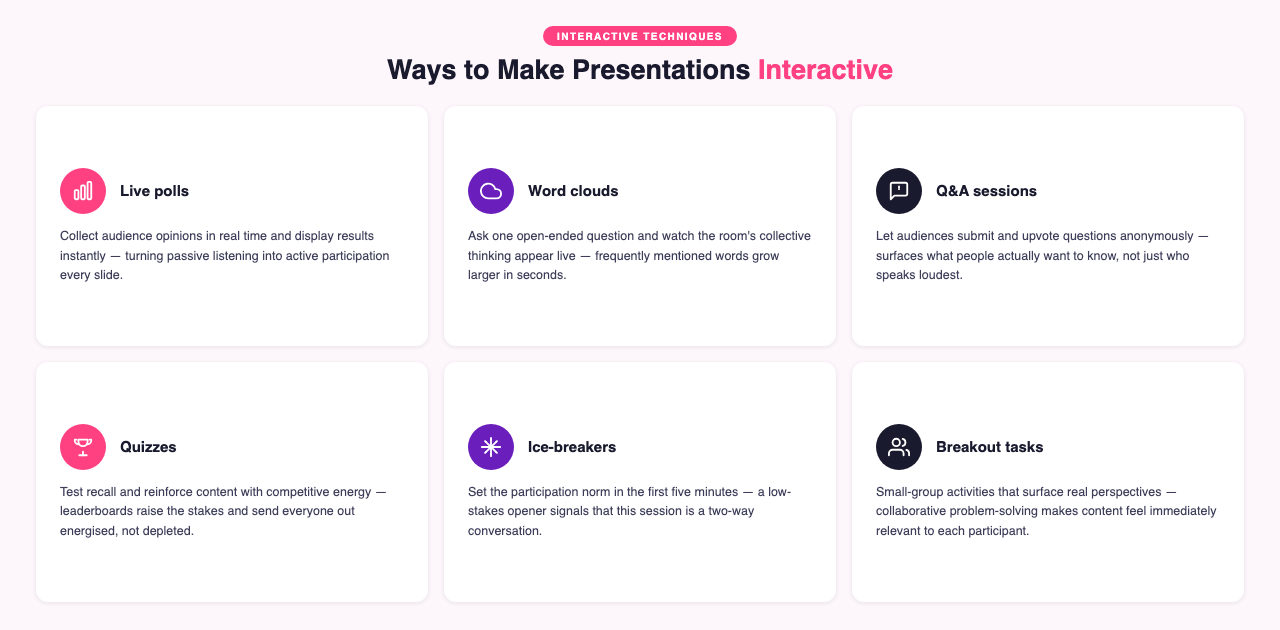
These are the core methods that work across virtually every presentation context. For a full breakdown with implementation guidance for each, see: 10 best interactive presentation techniques to engage your audience.
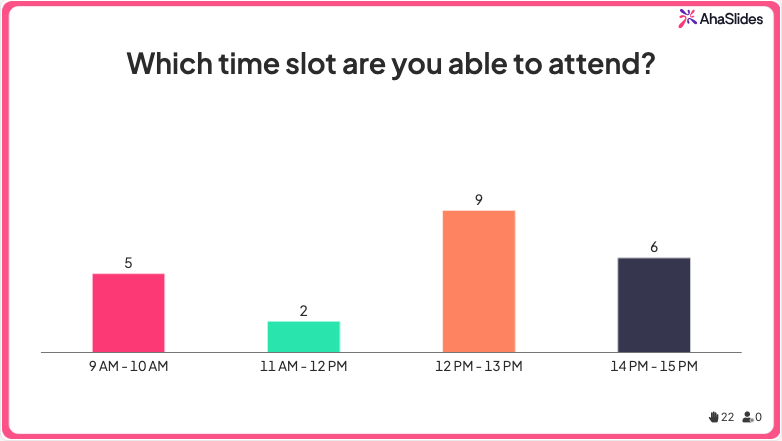
Live polls
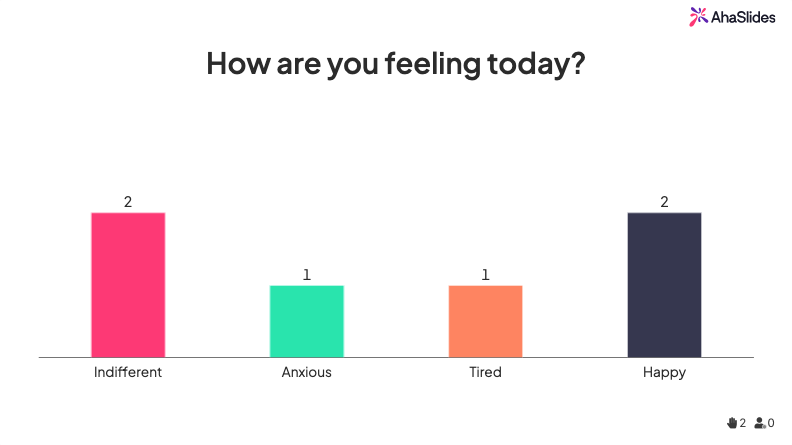
Polls collect audience opinions in real time and display results instantly. They are most useful when you want to understand where your audience stands before diving into a topic, or when you want to generate discussion from actual data rather than hypothetical examples. A good poll question is specific enough to produce a meaningful spread of answers: "How many of you have run a presentation with live audience tools?" produces more actionable data than "Do you find presentations engaging?"
Quizzes and games
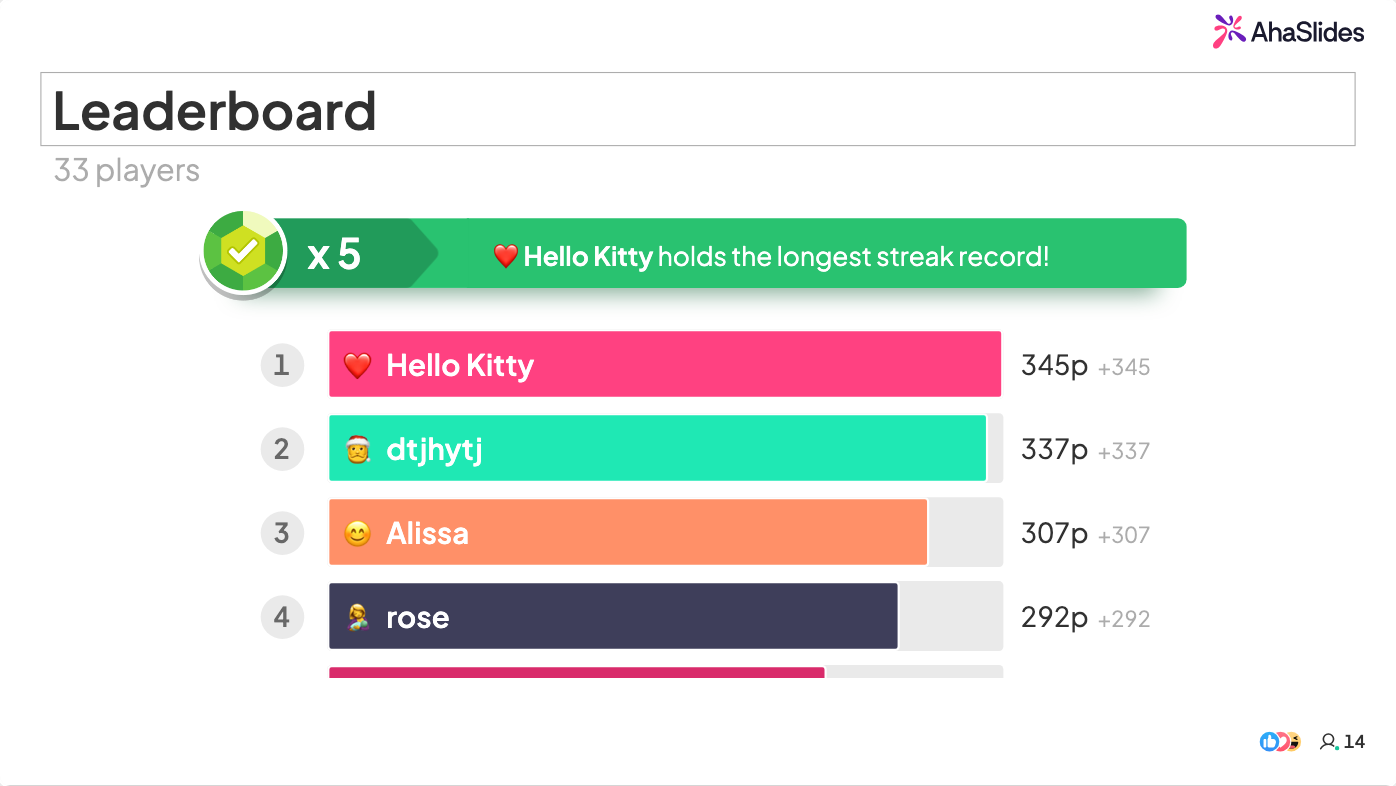
Quizzes test recall and reinforce content. Games do the same with a competitive layer that raises energy. Both work best when they are short (under two minutes), low-stakes (no grades or public embarrassment), and followed by a brief discussion of the correct answer. A quiz in the middle of a training session reactivates attention and reveals which concepts need more explanation. A game at the end of a session cements memory and sends people out energized rather than depleted.
Word clouds
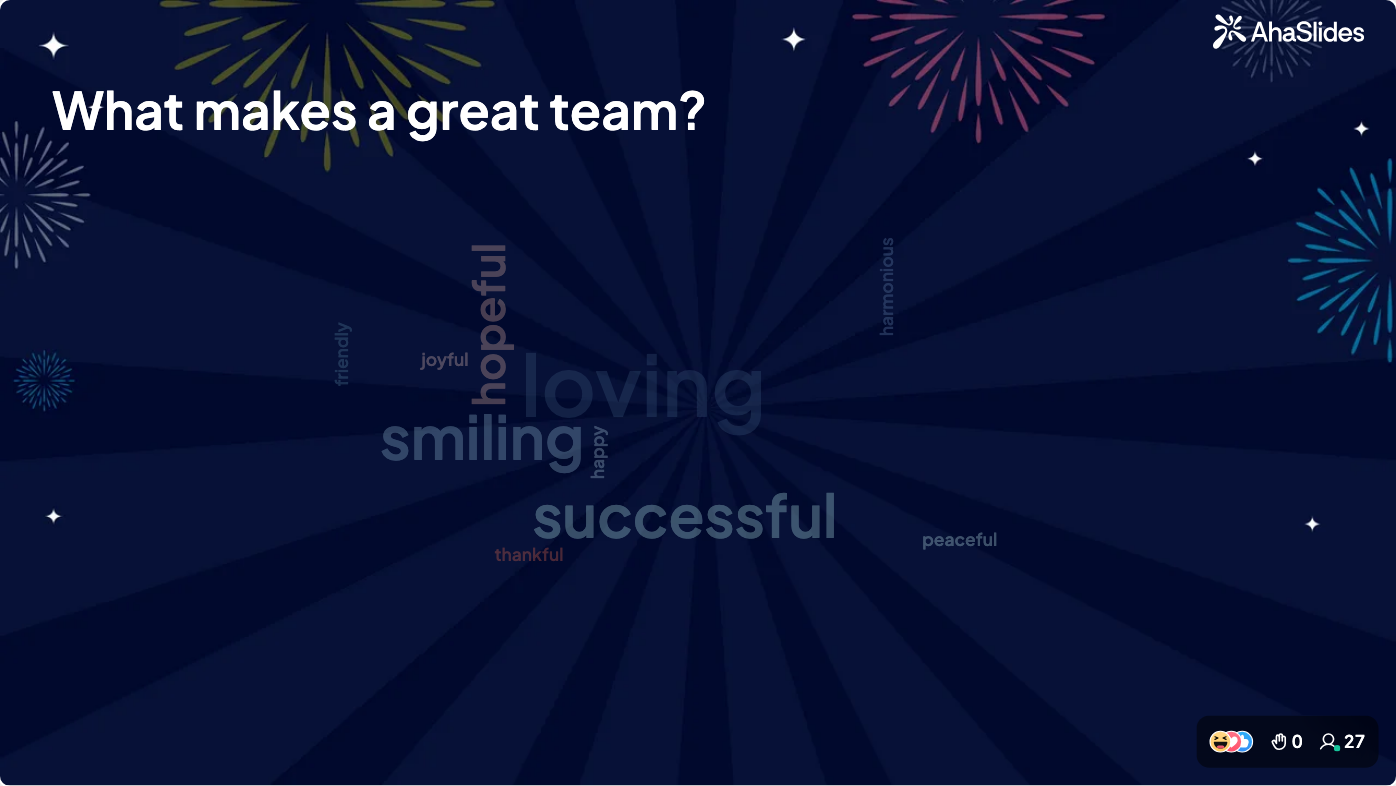
Ask your audience a single open-ended question, collect responses, and display them as a word cloud where frequently mentioned words appear larger. In 30 seconds you have a visual map of the room's collective thinking on any topic. Word clouds are especially useful at the start of a session (to surface existing knowledge or associations) and after a key concept (to check whether the message landed as intended).
Live Q&A
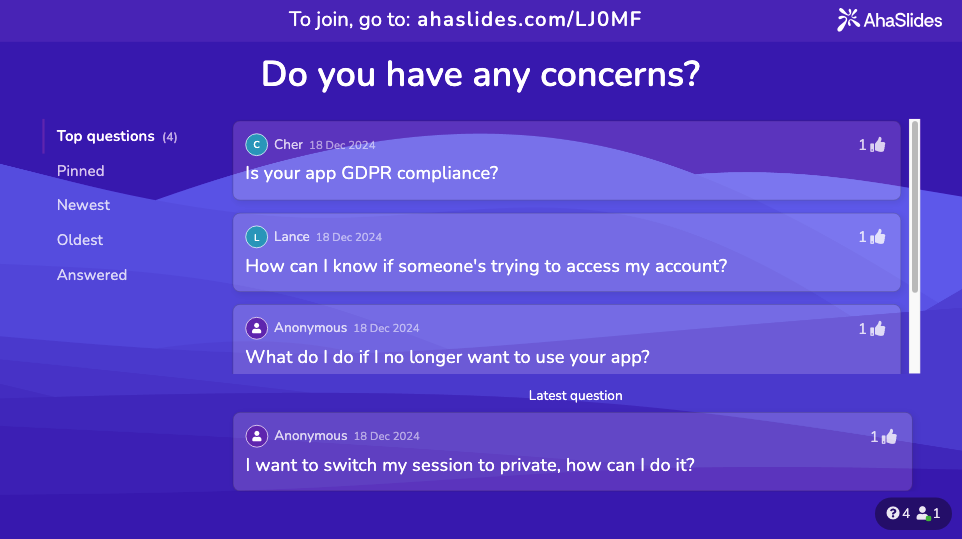
A dedicated Q&A tool allows audience members to submit questions anonymously, upvote the questions they care about most, and get answers to the things that actually matter to them rather than the questions the presenter guesses they have. This produces richer sessions than asking "any questions?" and waiting for the same three people to raise their hands.
Icebreakers
The first five minutes set the participation expectation for the entire session. If you dive straight into content, you signal that this is a lecture. If you invite a response first, you signal that participation matters. A low-stakes icebreaker question establishes the interactive contract before any serious content begins. See: 15 interactive presentation ideas to engage your audience.
Interactive presentation ideas by context
The right interactive elements depend on your audience and setting. What works in a corporate all-hands works differently in a university seminar, a Zoom call, or a marketing pitch.
Corporate training sessions
Training sessions have a specific goal: knowledge transfer that sticks. The biggest risk is passive listening, where participants appear attentive but retain very little. Interactive games, scenario-based questions, and quizzes at natural checkpoint moments all increase retention by requiring active recall rather than passive absorption.
Role-play scenarios, group problem-solving activities, and live polls that surface real workplace examples make training content feel immediately relevant rather than theoretical. See: 15 interactive games for training sessions to reinforce learning.
Student and classroom presentations
Students face the dual challenge of holding peer attention (a skeptical audience) and demonstrating understanding to instructors. Interactive elements solve both: they break the talking-head format that peers tune out and show instructors that the presenter understands the material well enough to engage with it dynamically. See: 14 interactive presentation ideas for students to boost engagement.
Virtual and Zoom presentations
Virtual presentations have fewer natural feedback mechanisms than in-person ones. You cannot read body language or gauge attention from a grid of muted thumbnails. Interactive tools compensate: a poll forces re-engagement, a word cloud gives you visible data on whether people are still with you, and a shared activity creates a moment that breaks the passivity of staring at a screen. See: 7 Zoom presentation tips to combat fatigue and boost engagement.
Marketing and sales presentations
Marketing presentations serve a persuasion goal. Interactive elements help because they shift the dynamic from "we are telling you about our product" to "let's look at your specific problem together." Polls that surface audience pain points, questions that invite the prospect to describe their situation, and data visualizations that respond to audience input all make the presentation feel tailored rather than templated. See: Guide to creating a compelling marketing presentation.
Interactive games that work in any setting

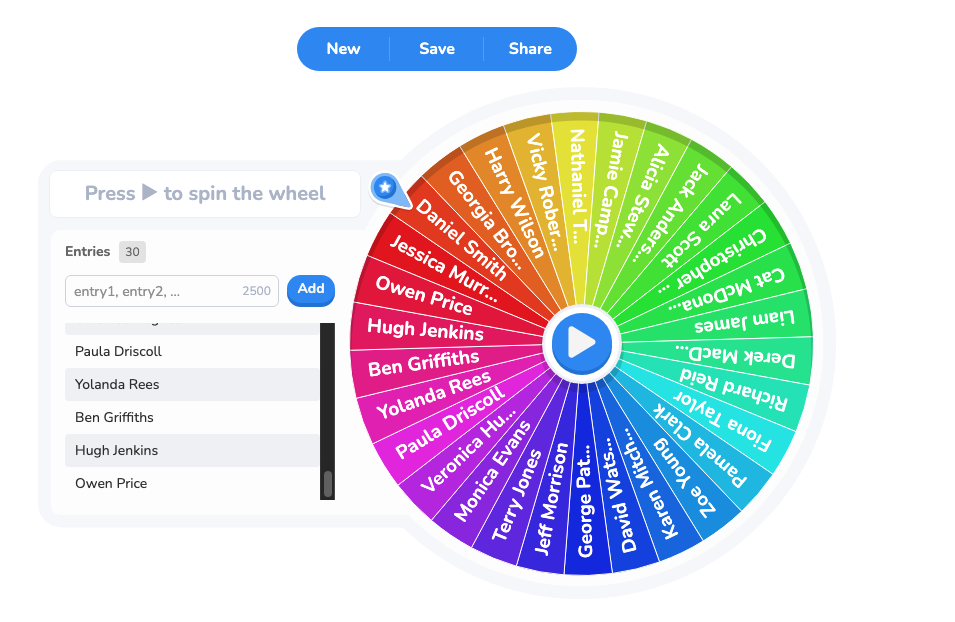
Games are the fastest way to shift energy in a room. They require minimal explanation, produce immediate engagement, and create a shared experience that the rest of the session benefits from. Live quizzes with leaderboards, trivia rounds on a topic relevant to your content, team challenges where groups compete to answer correctly first, and spinner-wheel activities that call on participants all work across in-person and virtual settings.
The key is integration: games feel gimmicky if they are disconnected from the session content. A trivia round on your topic serves both the engagement function and the learning function. A random warm-up game serves only the energy function. Both have their place, but topic-connected games are more defensible in professional settings. See the full guide: 11 interactive presentation games to score full engagement.
How to make PowerPoint interactive
PowerPoint does not have native audience participation tools. There is no built-in way to run a live poll, display real-time quiz results, or collect word cloud responses. But you can add this capability without leaving the PowerPoint environment.
AhaSlides integrates directly with PowerPoint via an add-in. You build your interactive slides inside PowerPoint, run them during your presentation, and participants join from their phones using a code. Results appear live on the slide as people respond. The workflow is the same as any other PowerPoint presentation; the only difference is that some slides collect and display audience data in real time.
For a step-by-step setup guide, see: How to make an interactive PowerPoint with AhaSlides.
How to make Google Slides interactive
Google Slides has a Questions feature that allows audience members to submit questions during a presentation, and a live view mode that lets remote participants follow along. These are useful but limited: you cannot run polls, quizzes, or word clouds natively.
The same add-in approach that works for PowerPoint applies here. AhaSlides connects to Google Slides presentations so you can embed interactive elements without changing your presentation workflow. For everything Google Slides can do natively, plus what it cannot, see: Interactive Google Slides: features, tips, and tricks.
Multimedia elements that support interactivity
Video, audio, animations, and data visualizations are not interactive on their own, but they create moments that interactive elements can build on. A short video that presents a problem or scenario provides the context for a poll or discussion. An animation that reveals data can precede a question about what the audience thinks drives that trend.
Multimedia and interactivity work best when they are paired: multimedia delivers the stimulus, an interactive element captures the response. For examples of how different multimedia formats integrate into presentations, see: Inspiring multimedia presentation examples and how to create your own.
Choosing the right presentation software
The tool you use shapes what kinds of interactivity are available to you. PowerPoint and Google Slides are ubiquitous but require add-ins for audience participation features. Dedicated presentation platforms built around interactivity handle poll, quiz, and Q&A natively without extra setup.
The right choice depends on your context: whether you need deep design control, whether your audience expects a specific format, whether you present live or async, and whether your organization has existing tool requirements. For a breakdown of the main categories and what each is best suited for, see: 9 types of presentation software for every presenter. For Mac-specific recommendations, see: 12+ best presentation software for Mac in 2026.
Using AhaSlides to make your presentations interactive
AhaSlides is a presentation platform built specifically for audience interaction. Polls, quizzes, word clouds, Q&A, spinner wheels, and gamified quiz games are all available natively, without add-ins or workarounds, and work on any device via a simple join code.
For teams that already use PowerPoint or Google Slides, AhaSlides integrates directly so you keep your existing workflow and add live audience tools on top of it. For sessions built from scratch, AhaSlides has its own slide editor where interactive and content slides sit side by side.
Results display in real time as participants respond. After the session, response data exports to Excel for further analysis. For L&D teams running regular training, the combination of fast setup, live results, and exportable data removes the need for a separate survey or feedback tool.
Try AhaSlides free and run your first interactive presentation in under five minutes.
Common mistakes to avoid
Overloading every slide with interaction. Interaction is most effective when it punctuates content at key moments: after a complex concept, at a natural transition, or when you need to re-engage attention. Making every slide interactive is exhausting for audiences. Three to five well-placed interactions in a 30-minute session is a more effective target than one per slide.
Not leaving genuine space for responses. The most common failure mode is asking a question and then immediately answering it. Pause for at least 10 seconds after asking. The silence is uncomfortable for the presenter, but it is the space where good answers come from.
Using interaction as decoration, not function. A poll that has no bearing on the conversation that follows is a gimmick. Every interactive element should either inform your next move (a poll reveals where the audience stands, shaping your explanation) or reinforce learning (a quiz checks whether the concept landed). If you cannot explain what you will do with the data, cut the element.
Ignoring the results. If you run a poll and then move straight to the next slide without discussing what people said, you signal that the poll did not really matter. Always respond to what the audience tells you, even briefly: "Interesting that 40% of you chose that option. Let's talk about why."
Frequently asked questions
How do you make a presentation interactive without technology?
Ask questions and wait for verbal responses. Use think-pair-share (individuals think, then discuss with a neighbor, then share with the group). Have people physically move to indicate their answer to a scenario. Pass an object that gives the holder the floor. Use sticky notes for a quick brainstorm and group responses on a whiteboard. Technology makes these interactions faster and scalable to larger groups, but the underlying techniques work in any setting.
What is the best tool for interactive presentations?
It depends on your primary tool and use case. If you present in PowerPoint, the AhaSlides add-in adds live polls, quizzes, and Q&A without changing your workflow. If you want a dedicated platform with all interaction types built in, AhaSlides works as a standalone tool. For a full comparison, see: 9 types of presentation software for every presenter.
How many interactive elements should a 30-minute presentation have?
Three to five is a reasonable target. One at the start (to establish the participation norm), one or two mid-session (to check understanding or re-engage attention), and one near the end (to consolidate learning or collect feedback). More than that becomes tiring. Fewer than that risks losing the benefit of the interactive format altogether.
Do interactive presentations work for large audiences?
Yes, and they often work better for large audiences than small ones, because phone-based tools scale without logistics problems. A poll of 500 people collects and displays results just as quickly as a poll of 10. The Q&A upvoting feature is especially useful at scale because it surfaces the questions most people share rather than just the ones a few people are willing to ask publicly.
How do you keep a virtual audience engaged?
Virtual sessions lose the ambient social pressure of a physical room. Interactive elements compensate directly: a poll forces a decision, a quiz requires attention, a word cloud gives visible evidence that the audience is responding. Aim for an interactive element every 10 to 12 minutes in a virtual session. For specific tactics, see: 7 Zoom presentation tips to combat fatigue and boost engagement.
Sources
[1] AhaSlides (2026). The science of distraction. AhaSlides whitepaper — presenter survey and platform engagement data cited throughout.